
Joint press statement issued after summit at Cheong Wa Dae
Asia-Pacific Business Conference seen as catalyst for expanded economic ties
Institutional framework for defense and security cooperation to be strengthened
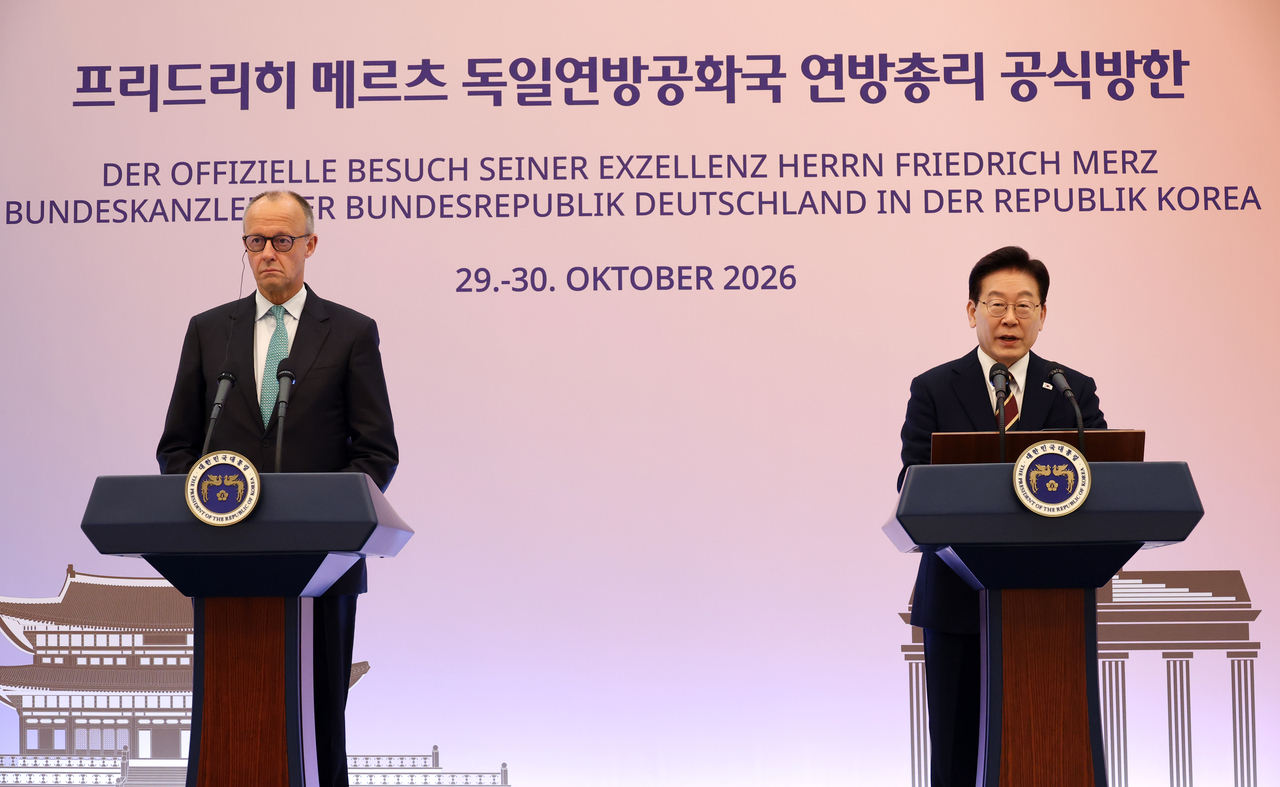
President Lee Jae Myung held a summit with German Chancellor Friedrich Merz on Thursday and announced that the two countries had agreed to establish an "enhanced strategic partnership." The two sides also agreed to expand cooperation in advanced industries and energy, and to move swiftly toward signing a military classified information protection agreement as part of efforts to strengthen the institutional foundation for defense and security cooperation.
Speaking at a joint press statement following the summit at Cheong Wa Dae, Lee said Germany is South Korea's largest trading partner in Europe and a "core cooperation partner" that shares universal values including freedom, democracy and the rule of law.
Lee added that a joint statement adopted Thursday "reflects the firm and clear resolve of both countries to deepen cooperation across a wide range of fields — including politics, security, the economy, culture and people-to-people exchanges — and to strengthen future-oriented collaboration and strategic coordination."
The two countries also agreed to pursue improvements to the investment environment for their respective businesses. Lee said a revised protocol to the Korea-Germany double taxation avoidance agreement "will allow companies from both countries to continue their investment and economic cooperation in a more transparent and fair environment."
Lee also said the Asia-Pacific Business Conference, a flagship German business event opening in Seoul on Thursday, would serve as an opportunity to expand bilateral economic cooperation. "I hope that the visit of major German business leaders will invigorate exchanges and investment between companies from both countries and create new opportunities for cooperation," Lee said.
The two countries agreed to broaden the scope of their economic and industrial cooperation beyond trade and investment to cover advanced technology and future growth engines. Lee said the "Economic and High-Tech Partnership Framework" would extend bilateral cooperation into industrial and advanced technology sectors, adding that the two sides had "laid the groundwork to respond to supply chain uncertainties by strengthening cooperation in critical minerals and energy security."
In the defense and security sphere, the two countries agreed to reinforce the institutional basis for cooperation and expand defense industry collaboration. Lee said both sides would "strengthen strategic communication between defense authorities and move swiftly to conclude a military classified information protection agreement, thereby reinforcing the institutional foundation for defense and security cooperation."
Lee also conveyed that South Korean defense companies "have a keen interest in forming long-term partnerships with Germany — the world's third-largest economy and Europe's biggest — through joint ventures and co-development." Lee said both governments would "actively seek out opportunities for mutually beneficial cooperation between defense companies, drawing on the outstanding defense technology and industrial capabilities that Korea and Germany each possess."
On the EU's proposed Industrial Acceleration Act, Lee said Seoul had "requested Germany's attention and cooperation so that Korea may receive treatment equivalent to that of EU member states."
In the energy sector, the two sides agreed to expand cooperation centered on renewable energy and power grids. Lee said that by renewing a joint letter of intent on energy partnership, the two countries would "expand policy and technology exchanges in renewable energy and power grids, and pursue substantive cooperation for energy transition and the stable supply of clean energy through joint research between companies and research institutions."
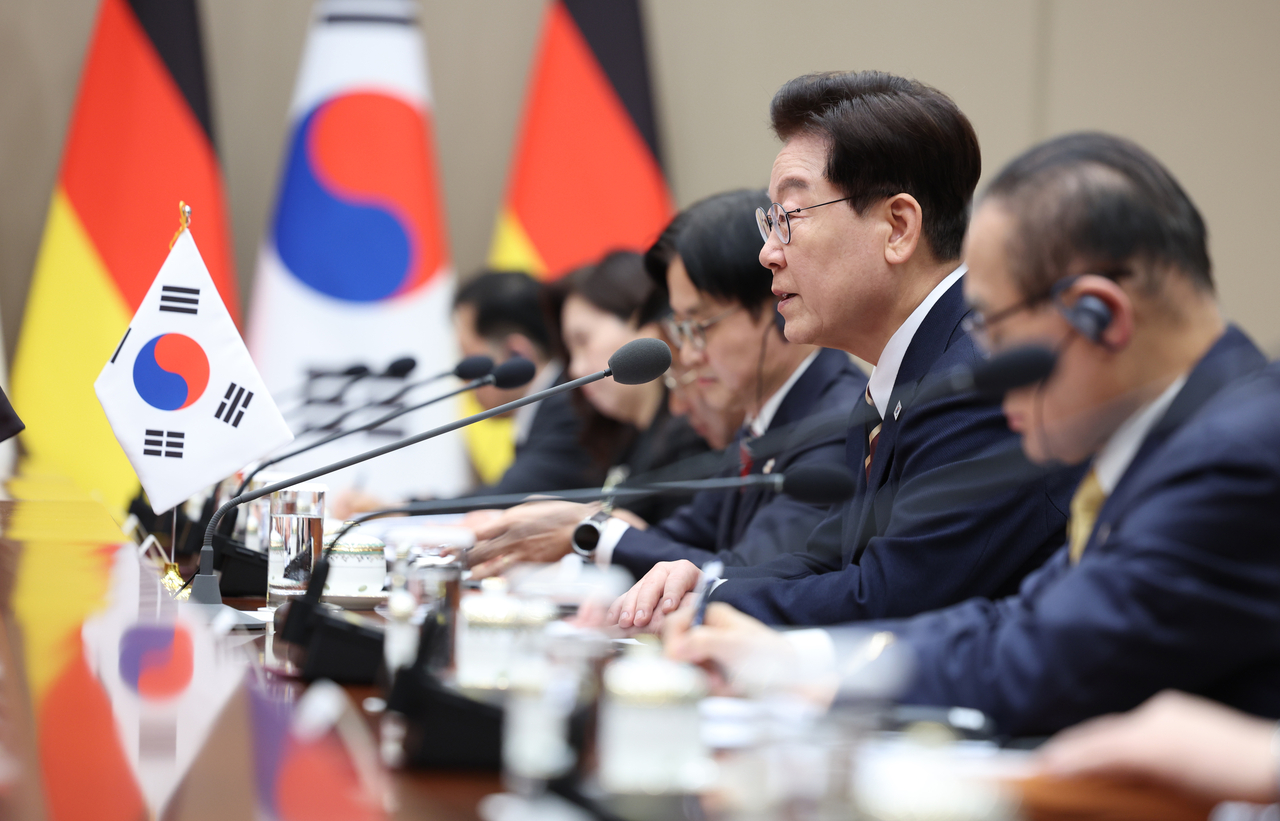
Noting that this year marks the 60th anniversary of Korean nurses being dispatched to Germany, Lee said the dedication of Korean miners and nurses who went to Germany "became the foundation of economic development for both countries and grew into the bedrock of friendship and trust between our two nations."
Lee particularly noted that Germany, having experienced the pain of division, "expressed unwavering and deep empathy for Korea's efforts to resume dialogue and build a peace regime on the Korean Peninsula." The two countries agreed to continue cooperating for peace and stability on the Korean Peninsula and to share views and strengthen coordination on major international issues, including the war in Ukraine, the situation in the Middle East, the free trade order and responses to the climate crisis.
After the summit, Lee hosted a dinner that evening at Cheong Wa Dae, inviting some 60 business leaders including Hyundai Motor Executive Chair Euisun Chung.
Cheong Wa Dae Chief Spokesperson Kang Yu-jung said the government "put special care into the official dinner and gifts to express warm hospitality toward the German side and convey the will to strengthen bilateral cooperation."
Attending the dinner on the Korean side were Korea International Trade Association Chairman Yoon Jin-sik, Euisun Chung, Posco Chairman Jang In-hwa, Hyosung Chairman Cho Hyun-joon and HL Chairman Chung Mong-won.
sang@heraldcorp.com




