
Mayor Lee Ki-hyung expresses regret over government's unilateral announcement of Gimpo Ara public housing district
Calls for rail and road expansion, compensation for fiscal losses
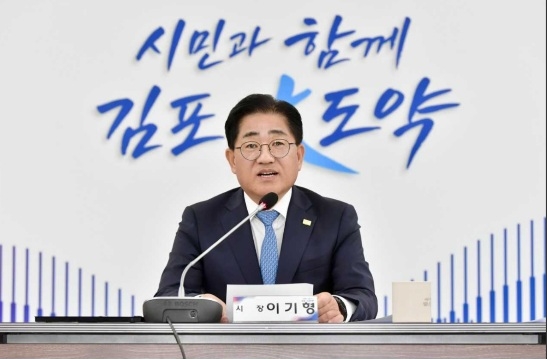
Gimpo city officials are pushing back against the government's plan to build a 37,000-unit public housing district in the Gochon-eup and Sau-dong areas of Gimpo, Gyeonggi Province, demanding that expanded transit networks and self-sustaining economic functions be secured before the project moves forward.
The city warned that a large-scale housing supply without adequate preparation could worsen traffic congestion, strain local finances and cement Gimpo's status as a dormitory suburb of Seoul.
Gimpo Mayor Lee Ki-hyung held an emergency press conference Thursday to express regret over what he described as the government's unilateral push to develop the Gimpo Ara public housing district candidate site.
Lee said concrete measures to prevent traffic inconvenience for residents, infringement of property rights and deterioration of local finances must be incorporated into the project plan.
The Ministry of Land, Infrastructure and Transport announced the Gimpo Ara public housing district, covering about 3.65 million square meters across the Gochon-eup and Sau-dong areas, with a target of supplying 37,000 housing units.
The site accounts for about 48.2 percent of the total additional supply across six new public housing candidate sites in the Greater Seoul metropolitan area. The project is set to proceed from 2027 to 2035 under the Special Act on Public Housing.
Gimpo city maintains that transport infrastructure must be secured before residents move in — a principle it describes as "transit first, occupancy second."
The city said that if additional development proceeds on top of the existing Gimpo Hangang 2 public housing district, rail and road infrastructure may be unable to keep pace with population growth.
Lee called on the government to review the extension of Seoul Subway Line 5 to Gimpo under a separate budget from existing projects to prevent administrative delays, and to reflect metropolitan transport improvement measures and project levies for extending and directly connecting Seoul Subway Line 9 to Gimpo.
Relocating the depot for the western metropolitan express railway and adding new stations were also among the key demands.
Lee also called for streamlining administrative procedures — including exemptions from preliminary feasibility studies — to shorten the project timeline, and urged that 20 to 25 percent of the total project cost be invested in metropolitan transport improvements.
On road network expansion, Lee called for the construction of Hyangsan Bridge and Yangchon Bridge, the installation of an access road at the Yeongsajeong interchange, and the widening of the Olympic Expressway between the Gaehwa interchange and Dangsan Station.
The demands also included a dedicated BRT lane connecting Gimpo Hangang-ro and the Olympic Expressway with guaranteed service, and the full underground routing of the Gyeyang–Ganghwa Expressway.
The city also identified the fiscal burden from an expanded public rental housing stock as a challenge that must be addressed.
Gimpo estimates that public rental housing will result in a local tax loss of about 111.5 billion won ($83.4 million) and an annual reduction in property tax revenue of 18.1 billion won.
The city said Gimpo's input must be reflected in decisions on the housing-type composition of the new public housing district, and called for effective tax measures to compensate for fiscal losses from local tax exemptions.
Lee also made clear that the housing supply must translate into job creation and industrial development within the city.
Lee proposed linking regional priorities — including designation of a peace economy special zone and a national industrial complex — to the district plan, and attracting a UN AI hub, university research facilities, companies and public institutions to strengthen the city's self-sustaining functions.
The concern is that if residential capacity expands without a corresponding jobs base, Gimpo could become a consumption-driven bedroom community.
Lee said the city must plan not only for housing supply but also for the long-term growth foundations of an urban area that includes industrial, research and commercial facilities.
Lee also called for measures to protect the rights of landowners and existing residents during the development process.
The demands included fair compensation assessments, effective and tailored relocation support, and the incorporation of the Han River waterfront near Yeongsajeong — currently excluded from the district plan — into the project zone to be developed as a riverside public space.
"What Gimpo is asking for represents the minimum demands directly tied to the survival rights of our residents," Lee said. "We expect a forward-looking change that aligns with the government's governing philosophy that extraordinary sacrifice deserves extraordinary compensation."
gilbert@heraldcorp.com




