Lee Ki-hyung attends housing-focused dinner after backlash over absence from Metropolitan Transport Commission session
Delivers four-point transport agenda including Seoul Line 5 extension
Local critics call the move a belated attempt to deflect blame
Gimpo Mayor Lee Ki-hyung, who drew sharp criticism for skipping a Metropolitan Transport Commission session where key regional transit issues were on the table, attended a prime minister-hosted dinner Wednesday and called for the extension of Seoul Subway Line 5 to Gimpo, among other measures.
But the move has drawn fresh criticism from parts of the local community, who say Lee chose a symbolic gathering over the working-level forum that actually shapes transit decisions — a case of settling for second best after public sentiment soured over his absence from the commission meeting.
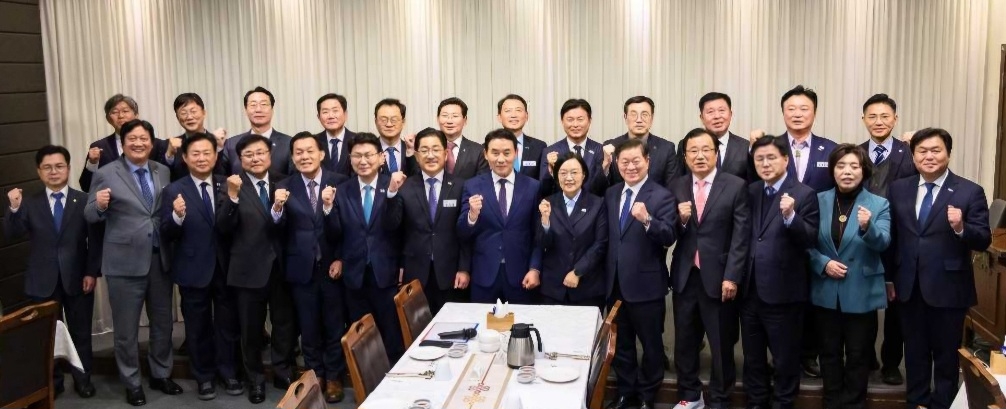
Lee attended the prime minister's dinner meeting for Gyeonggi Province local government heads on housing supply, held Wednesday afternoon in Jongno-gu, Seoul, where he urged the government to address metropolitan transport and self-sustaining urban functions in response to its announcement of new public housing districts.
The dinner brought together local government heads from across Gyeonggi Province to discuss boosting housing supply in the greater metropolitan area — a forum with a fundamentally different scope and purpose from the Metropolitan Transport Commission session, which focuses specifically on Gimpo's individual transit issues.
Lee told the gathering that Gimpo is expected to grow rapidly into a city of 900,000 people and that extraordinary measures are needed, presenting a four-point agenda of priority tasks.
The four priorities were: the extension of Seoul Subway Line 5 — including four new stations within the Gimpo Ara district and measures to prevent administrative delays — along with a consolidated rail depot; construction of the Yangchon and Hyangsan bridges; expansion of the Gimpo Hangang-ro to Olympic Expressway corridor and introduction of bus rapid transit; and allocation of metropolitan transport improvement funds exceeding 20 percent of total project costs.
On the Line 5 extension, Lee specifically requested government support to ensure four stations are built within the Gimpo Ara district without administrative delays and that the integrated rail depot project proceeds on schedule.
For road network expansion, he called for construction of the Yangchon and Hyangsan bridges to ease severe congestion on the Olympic Expressway and redistribute traffic to Jayuro and other routes.
Lee also said widening the Gimpo Hangang-ro to Olympic Expressway section from Hangang New Town interchange to Dangsam Station and introducing dedicated BRT lanes were essential. He added that metropolitan transport improvement funding must exceed 20 percent of total project costs — surpassing the standard applied to third-generation new towns — to meet surging transport demand.
The deeper problem, however, is the administrative vacuum and loss of trust that arose from Lee's absence at the Metropolitan Transport Commission session on Friday — the working-level forum that holds the practical keys to building the metropolitan rail network, including the Line 5 extension that Gimpo has long sought.
Local critics say that after missing the commission session — where stakeholders and relevant ministries sit down together to work out real solutions — Lee's appearance at a prime minister's dinner where multiple local government heads simply listed their requests amounted to a second-best substitute that missed the point entirely.
Calls are growing for Gimpo to take more substantive working-level action, with many in the community saying Lee's attendance at a ceremonial event — where he received only broad, in-principle responses — falls far short of what is needed to win back the public trust damaged by his absence from the commission meeting.
A local politician said that while Gyeonggi Province Governor Choo Mi-ae, Incheon Mayor Park Chan-dae and many other local government heads attended the Metropolitan Transport Commission session on Friday and personally made the case for their regions' transport networks, Lee was absent from the meeting that will shape Gimpo's rail future for the next decade and has offered no official explanation. "Seeing him skip the commission meeting and then show up at the prime minister's dinner to pitch metropolitan transport plans, it looks like nothing more than damage control to quiet the criticism," the politician said.
The Metropolitan Transport Commission's fifth national railway network development plan public hearing, held Friday at the Seoul Specialty Construction Hall, drew large numbers of local government heads and residents from across the country.
Gyeonggi Province Governor Choo Mi-ae, Incheon Mayor Park Chan-dae and Gwacheon Mayor Shin Gye-yong attended in person, while more than 30 residents from Sancheong-gun in South Gyeongsang Province, including the county assembly speaker, traveled to Seoul to make the case for their region's rail project.
With the session marking a critical juncture that will set the direction of national rail policy for the next decade, local governments across the country mobilized their administrative resources and public support in fierce competition to secure a place in the plan.
gilbert@heraldcorp.com