
Aims to cultivate 30 climate tech pre-unicorn companies
Up to 10 billion won in bundled support over five years for top firms
New regulatory exemptions and industry promotion law in the works
Ministry of SMEs and Startups, Ministry of Climate, Environment and Energy to back firms from R&D to market entry
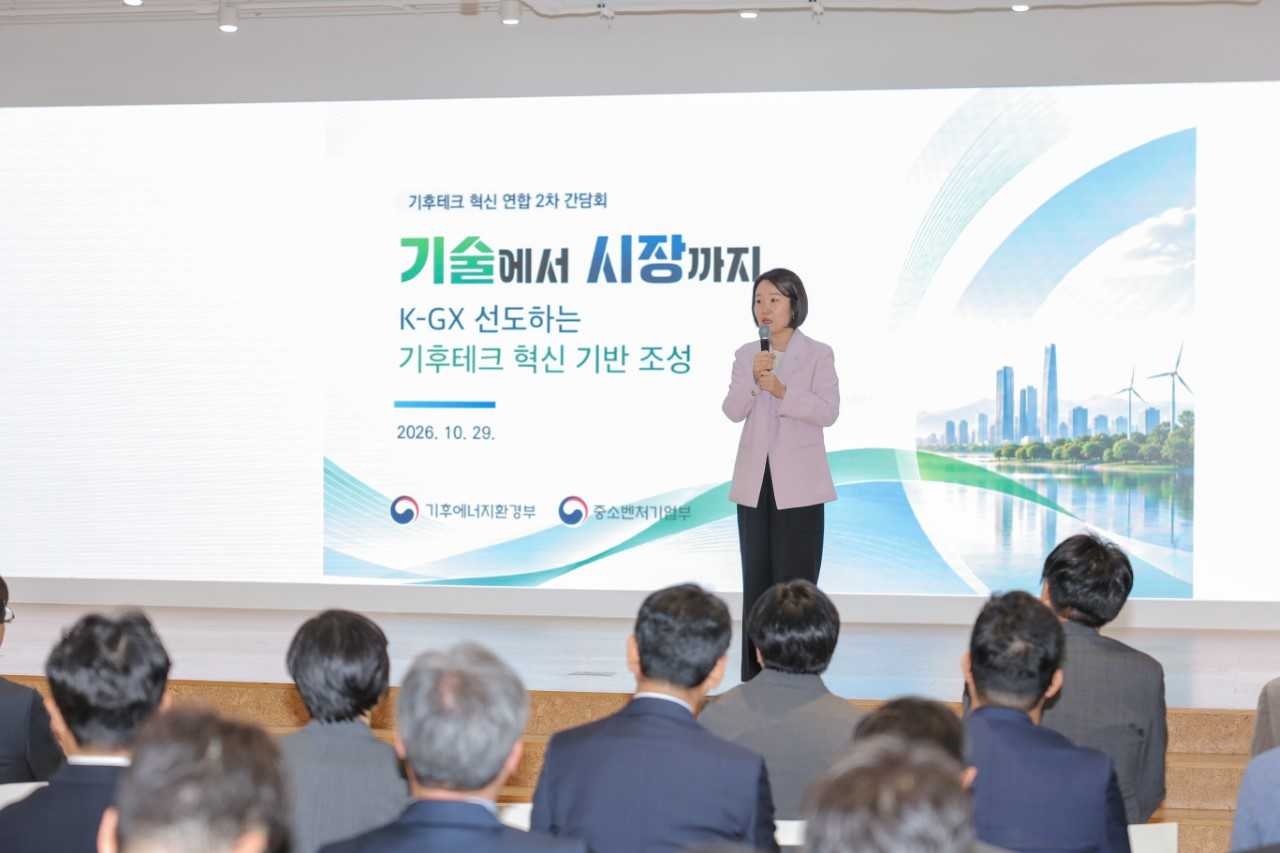
The government plans to identify 1,000 climate tech innovators and 30 pre-unicorn companies by 2030, backed by roughly 600 billion won ($449 million) in financial support. Promising firms will also be eligible for bundled assistance — covering commercialization, research and development and other areas — worth up to 10 billion won over five years.
The Ministry of SMEs and Startups and the Ministry of Climate, Environment and Energy jointly announced the plan, dubbed "Direction for Fostering Climate Tech Innovators," at the second Climate Tech Innovation Alliance forum held at Ondream So Society in Jung-gu, Seoul, on Thursday.
The initiative follows up on the Korea Green Transformation (K-GX) strategy announced Oct. 7. Its core aim is to support climate tech companies across their entire growth cycle — from technology development and demonstration through to commercialization and market entry.
Climate tech, a portmanteau of "climate" and "technology," refers to innovative technologies that help reduce greenhouse gas emissions and address climate change. The government groups the sector into five categories: clean tech for clean energy, carbon tech for carbon reduction and utilization, eco tech for resource circulation, food tech for food and agriculture, and geo tech for climate-related data and observation.
The government will first support technology development and field demonstration for climate tech firms. It plans to launch a "climate tech strategic project" grouping innovators with upstream and downstream partners along supply chains, alongside a high-risk, high-reward "innovative R&D project" for companies tackling ambitious challenges.
A "climate value assessment" framework to measure the outcomes and value of climate technologies will also be introduced. The government plans to expand demonstration testbeds using infrastructure from large corporations and public institutions, and will consider designating new climate tech TIPS Towns.
Regional green convergence clusters, energy-specialized cities and hydrogen-specialized clusters will also be developed as growth hubs for climate tech innovators.
Financial support will be strengthened as well. The government plans to channel roughly 600 billion won in climate tech-specific financing through vehicles including the Future Environmental Industry Investment Fund, green loans and a dedicated climate tech innovation fund.
Funding will be tailored to each stage of a company's growth — from early-stage startups through expansion — and proactive investment in stalled startups will be pursued through initiatives such as the Next-Generation Unicorn Project.
For high-potential firms in particular, the government will bundle commercialization support, export assistance, R&D and loans into a single package worth up to 10 billion won over five years to improve their chances of successful commercialization.
Even after achieving a technical breakthrough, climate tech companies often struggle to validate their technology in real industrial settings and secure an initial market. The plan addresses not only R&D funding but also demonstration infrastructure, investment and market access — easing the burden companies face during the commercialization process.
The government will also build an institutional foundation for regulatory reform and market creation. It plans to establish dedicated regulatory exemptions for new climate tech to reduce regulatory risk, and to expand regulatory-free special zones.
Legislation to promote the climate tech industry — a "Climate Tech Industry Promotion Act" — will also be pursued. The government will use public procurement to help firms enter the domestic market while expanding support for overseas market development.
Sector-specific support will run in parallel. In clean tech, the government will leverage demonstration infrastructure from public institutions such as Korea Electric Power Corporation, and pursue regulatory reforms to lower market entry barriers in promising areas.
In carbon tech, the government will encourage participation in R&D supply chains and strengthen related systems, including a certification scheme for carbon capture technology products. In eco tech, large-scale R&D tied to the circular economy and new regulatory exemptions will be pursued.
In food tech, the government will support development of promising technologies such as eco-friendly packaging materials, along with the creation of region-specific research support centers and innovation clusters. In geo tech, data-driven R&D will be expanded and commercialization supported through public infrastructure from institutions such as Korea Water Resources Corporation.
"Climate tech is a future growth industry capable of generating new markets, investment, jobs and exports — far beyond simply responding to carbon neutrality — yet its growth ecosystem remains underdeveloped," said Lee So-young, minister of SMEs and Startups. "We will build a growth ladder so that promising climate tech companies can establish themselves in the market and grow into global unicorns."
Kim Sung-hwan, minister of climate, environment and energy, said: "To realize the Korea Green Transformation, the role of innovative companies that can turn green transition into real changes in industry and markets is paramount. We will actively support companies with innovative technologies and ideas throughout their entire growth journey — from scaling up domestically to leaping into global markets."
boo@heraldcorp.com




