
Public sector orders to expand to 81.5 trillion won
Private residential orders to shrink amid loan curbs, regional unsold inventory
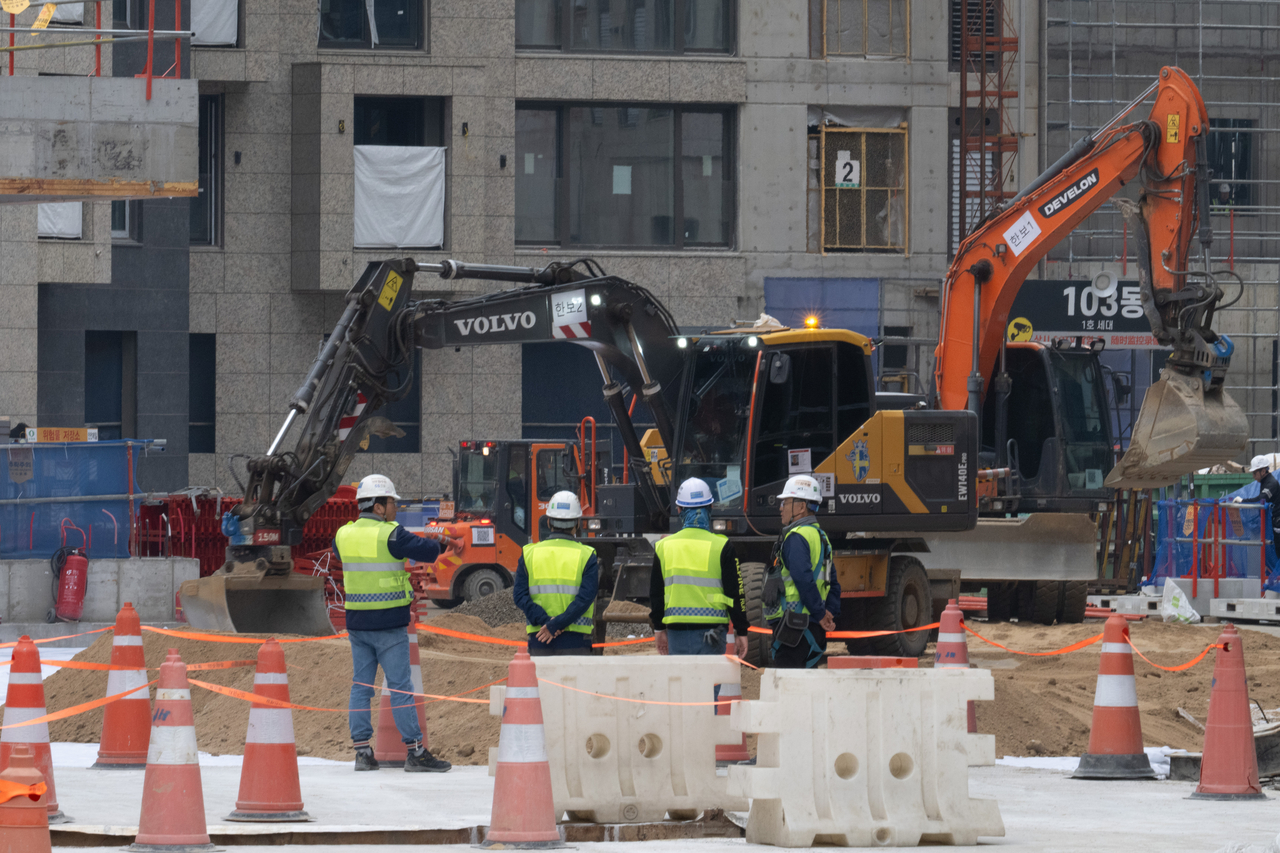
South Korea's domestic construction orders are expected to reach 241 trillion won ($180 billion) next year, with growth slowing sharply as the public and non-residential sectors continue to expand while private residential orders contract, deepening a split within the construction market.
The Korea Construction Management Association presented the forecast Thursday at a forum on construction market trends and responses for 2027, held at the Yonsei Foundation Severance Hospital Building near Seoul Station.
Ra Jin-seong, a team leader at IGIS Asset Management, projected that domestic construction orders this year will reach 238.1 trillion won, up 7.7 percent from last year's 221.1 trillion won. Next year, orders are expected to grow just 1.3 percent to 241.2 trillion won, marking a significant slowdown.
Breaking down orders by client type, public sector orders are forecast to rise 6.5 percent, from 76.5 trillion won this year to 81.5 trillion won next year. Private sector orders, by contrast, are expected to slip 1.1 percent, from 161.5 trillion won to 159.7 trillion won.
By construction type, civil engineering orders are projected to grow 4.0 percent, from 63.1 trillion won to 65.7 trillion won, while building construction orders are seen rising 0.4 percent, from 174.9 trillion won to 175.5 trillion won.
Within the building construction segment, residential and non-residential orders are moving in opposite directions. Residential building orders are expected to fall 2.0 percent, from 102 trillion won this year to 99.9 trillion won next year, while non-residential building orders are forecast to rise 3.7 percent, from 73 trillion won to 75.7 trillion won.
This year's construction orders rebounded in the first half, driven by semiconductor facility investment and early execution of public contracts, but momentum slowed in the second half, particularly in private building construction. Next year, public housing supply and non-residential construction centered on semiconductors and data centers are expected to underpin the market, while private residential orders are projected to decline due to tighter loan regulations and the drag from unsold units in regional markets.
Regional divergence in the housing and real estate market is expected to intensify. With 84 percent of the roughly 28,000 completed but unsold units concentrated outside Seoul, analysts said a selective, region-by-region approach to pre-sales will be essential. The construction of approximately 218,000 publicly backed housing units under the government's residential stability policy, along with large-scale redevelopment projects in Seoul, were identified as areas with relatively high order visibility.
The government's social overhead capital budget for next year stands at 28.9 trillion won, rising for a second consecutive year, but road spending is projected to fall 16.0 percent and rail spending 6.5 percent. Construction demand is instead expected to shift toward industrial complex infrastructure tied to advanced industries such as semiconductors, AI and data centers, as well as power grid and energy transition projects.
Overseas construction orders are forecast to rebound. This year's overseas orders are expected to fall 36.9 percent from the previous year to $29.8 billion, weighed down by a high base effect from last year's Czech Republic nuclear power plant contract and project delays caused by conflicts in the Middle East.
Next year, overseas orders are projected to rise 11.3 percent to $33.2 billion, as gas and reconstruction projects in the Middle East resume alongside infrastructure detour contracts, and as investment in power infrastructure and data centers expands across North America.
Son Tae-hong, a senior research fellow at the Korea Construction Industry Institute, characterized next year for the construction industry as a year of "selection" rather than "rebound." With construction costs remaining stubbornly high and expectations for interest rate cuts fading, Son said companies will need to restructure their order strategies around profitability and cash flow.
Son identified infrastructure for advanced industries such as semiconductors and AI, along with Middle East reconstruction, LNG and power grid projects, as new growth areas. To navigate the environment, Son recommended that firms pursue selective bidding based on project-level profitability and cash flow, secure key materials in advance, review price and exchange rate adjustment clauses, and build up construction capabilities in advanced infrastructure.
quq@heraldcorp.com




