Sinbanpo 20 enters reconstruction levy verification process
Maple Jaye exempted from levy, transformed into 3,307-unit complex
Seoul push to reform excess-profit recapture regime stalls
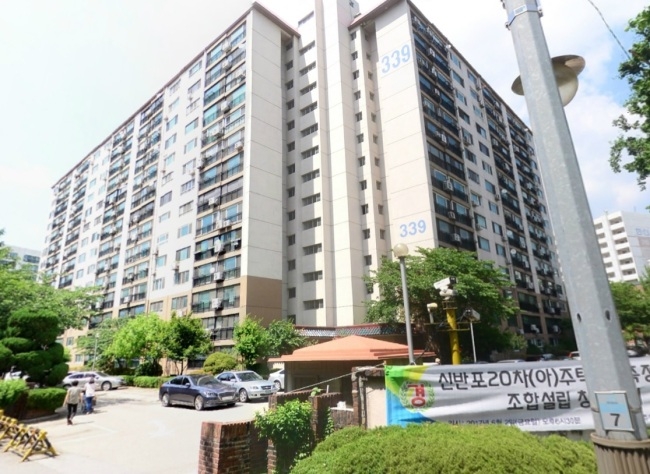
The Sinbanpo 20 apartment complex in Jamwon-dong, Seocho-gu, Seoul abandoned a joint reconstruction plan with the nearby Sinbanpo District 4 over concerns about the reconstruction excess profit recapture regime and is now undergoing a preliminary levy assessment. Sinbanpo District 4, by contrast, was exempted from the reconstruction levy and has since been redeveloped into Maple Jaye, a large-scale complex of 3,307 units. Eight years after the merger talks collapsed, Sinbanpo 20 is still working its way through the reconstruction process.
The Korea Real Estate Board is verifying the preliminary reconstruction levy amount for the Sinbanpo 20 small-scale reconstruction project, according to industry sources Thursday. Seocho-gu notified the association Wednesday of second and third rounds of supplementary requirements related to the verification. The specific levy amount has not been disclosed.
Completed in 1983, Sinbanpo 20 is a 112-unit apartment complex made up entirely of units with an exclusive use area of 143 square meters. The complex had originally explored a joint reconstruction with the nearby Sinbanpo District 4 but ultimately pivoted to an independent project after weighing business viability and the implications of the excess-profit recapture regime.
In December 2015, the Sinbanpo District 4 association held a general meeting and voted to pursue a joint reconstruction with Sinbanpo 20. Residents of Sinbanpo 20, however, concluded that proceeding independently would better secure the project's financial viability. There was also a calculation that going it alone would speed up the permitting process, given the approaching expiration of the moratorium on reconstruction levies.
Under the reconstruction profit recapture law at the time, projects that applied for management and disposal plan approval by Dec. 31, 2017, were exempt from the levy. Sinbanpo 20 received association establishment approval in June 2017 but subsequently fell behind schedule, missing the exemption deadline. Sinbanpo District 4, by contrast, filed for management and disposal plan approval before the end of that year and secured the exemption.
In 2018, Sinbanpo 20 and the nearby Hansin Town revived talks about a joint reconstruction with Sinbanpo District 4, bringing the question of levy applicability back to the fore. The central issue was whether a project that had already secured a levy exemption could retain that benefit if it merged with one that had not.
The Ministry of Government Legislation issued an interpretation in September of that year, concluding that if an exempted project merged with a non-exempt one, the formerly exempted project would also become subject to the levy. The rationale was that changes to the redevelopment zone, association membership and construction plans were substantial enough that the merged project could not be considered the same undertaking as the original exempt one.
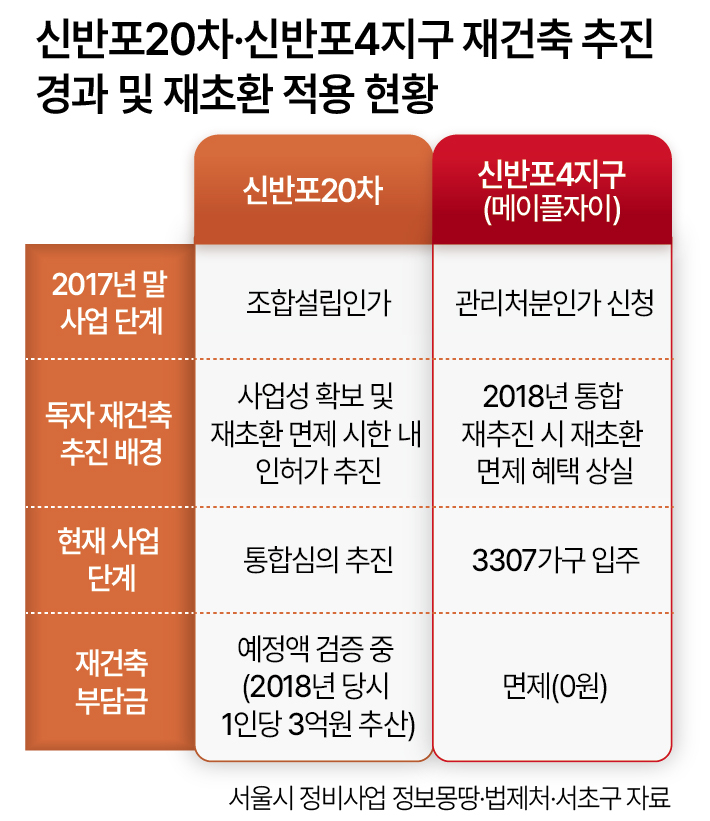
With Sinbanpo District 4 unable to preserve its levy exemption under a merger, the joint reconstruction talks fell apart. At the time, industry estimates suggested the reconstruction levy for Sinbanpo 20 could reach around 300 million won ($225,000) per association member.
Sinbanpo 20 revisited the idea of a joint reconstruction with Hansin Town in 2022, but those talks also came to nothing. The complex is now pursuing a small-scale reconstruction that would increase the unit count from 112 to 142. It applied for an integrated review last month, and inter-agency consultations have continued this month, with the preliminary levy verification and permitting procedures advancing in parallel.
Small-scale reconstruction involves a simpler approval process than standard reconstruction, but the excess-profit recapture regime applies equally. For smaller projects where the volume of units available for general sale is relatively limited, the reconstruction levy can translate into a significant additional financial burden for association members.
The Seoul Metropolitan Government has also said the recapture regime needs to be reformed to encourage small-scale reconstruction. When it unveiled a plan to promote small-scale reconstruction in September last year, the city said it would continue pressing the central government to reconsider applying the reconstruction profit recapture law to small-scale projects where development gains are limited relative to project size.
No meaningful progress on reforming the regime has been made since then. "There have been no concrete developments since the plan was announced," a Seoul Metropolitan Government official said. "Seoul's position is not limited to small-scale reconstruction — we are opposed to the excess-profit recapture regime as a whole."
Since May last year, the city has been implementing measures to improve project viability, including a temporary relaxation of floor-area ratio limits up to the legal ceiling for small-scale reconstruction projects in second- and third-class general residential zones. The integrated review application recently submitted by Sinbanpo 20 also incorporates this floor-area ratio relief.
Industry observers note that smaller reconstruction projects face structural limitations that can ultimately make it difficult to secure financial viability.
"Excluding a specific building or complex from a reconstruction project due to differences in land share can amount to penny-wise, pound-foolish thinking," said Kim Je-gyeong, director of Toomi Real Estate Consulting. "It would have been better to align interests in a way that fully recognizes the value of each party's land share when calculating rights values and assigning unit types and floor numbers." Kim added that "as the project scale has shrunk, achieving economies of scale has become harder, and there is a strong likelihood that construction cost burdens on association members will grow as a result."
quq@heraldcorp.com