
Kang Shin-chul, Hegseth hold first in-person talks
OPCON transfer language shifts from 'early' to 'timely,' 'acceleration' dropped
'Discussions and timeline decisions likely to be delayed'
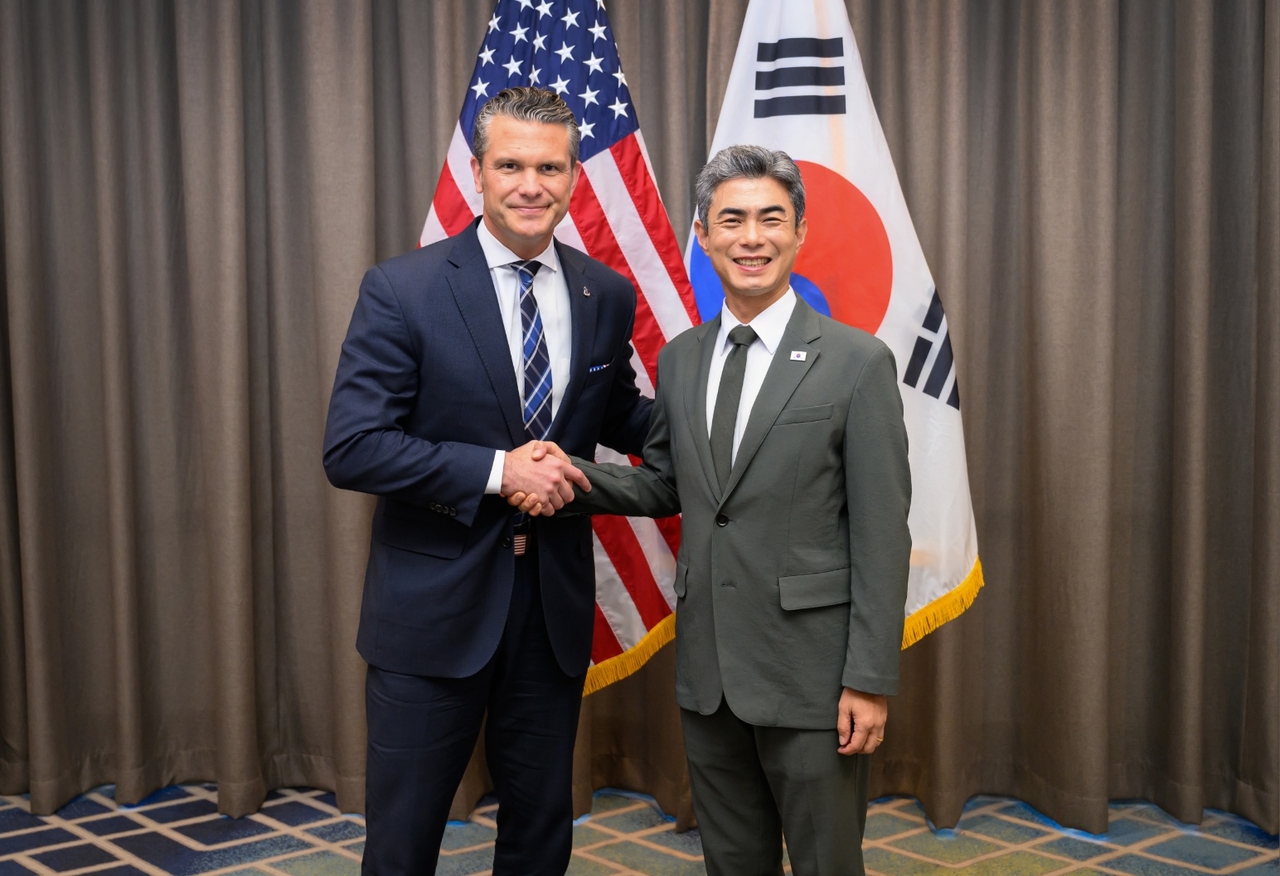
South Korea and the United States have agreed to hold bilateral defense ministerial talks in Washington at the end of this year, with the annual Security Consultative Meeting to follow in early next year. The SCM, which addresses core security issues between the two allies, has traditionally been held each November. Pushing it past the new year would mark the first such delay in 28 years — the last time was in 1998, when the meeting was postponed due to US airstrikes on Iraq. The postponement has prompted speculation that the two sides have yet to narrow their differences over the transfer of wartime operational control.
Defense Minister Kang Shin-chul and US Defense Secretary Pete Hegseth met Wednesday (local time) on the sidelines of the ASEAN Defence Ministers' Meeting-Plus in the Philippines, where they agreed to hold the 58th SCM next year, affirming that a successful meeting would be of historic importance. Hegseth reaffirmed the United States' commitment to the OPCON transfer, and the two ministers agreed to work closely together to ensure the transition proceeds smoothly at the right time.
The SCM is an annual forum in which the defense ministers of the two countries discuss a full range of defense issues, including OPCON transfer and extended deterrence. Seoul had been pursuing a plan to complete the Full Operational Capability verification of the Future Combined Forces Command at this year's SCM and use it as a basis for determining the year of OPCON transfer — known as "X-Year."
The government has assessed that the Final Mission Capability evaluation and verification — the step following FOC completion and the last stage before transfer — could be wrapped up in about a year. That had led to speculation that 2028 or next year could be put forward as X-Year.
With the SCM now pushed into next year, however, delays to the FOC verification process and the broader OPCON transfer roadmap appear unavoidable.
Also notable is the language used in the Defense Ministry's readout of the ministerial talks: the transfer was described as happening at the "right time" rather than "early," a shift from previous formulations. A joint statement from the Korea-US Integrated Defense Dialogue in September had included language about strengthening cooperation to "accelerate" the OPCON transfer — wording that was absent from Wednesday's readout. The SCM delay is also understood to reflect circumstances on the US side, including the war involving Iran.
"The postponement is likely to push back the schedule for related discussions and decisions to some extent, given that this year's SCM had been expected to complete the FOC verification and pin down a specific year for the transfer," said Yoo Ji-hoon, a research fellow at the Korea Institute for Defense Analyses (KIDA). "That said, what matters more than a specific date is substantive preparation and the building of mutual understanding between the two countries. There is no need to read this as a sign of disagreement or any anomaly in the alliance."
Yoo added that advancing policy coordination on key security issues — including OPCON transfer, extended deterrence, the role of USFK, and nuclear-powered submarine cooperation — through future ministerial talks would be important. "The SCM early next year should not simply be treated as a rescheduled meeting," Yoo said. "It should serve as an opportunity to reach concrete agreements and chart a clear direction for cooperation on major issues."
The Joint Chiefs of Staff said Thursday that South Korea's military had expanded its combined verification task force to strengthen evaluators' capabilities and ensure a smooth FMC assessment when the time comes. The Joint Chiefs also noted that South Korea and the United States conducted Iron Mace, a nuclear-conventional integration command post exercise, at the Joint Chiefs headquarters from Sept. 29 to Oct. 2.
Meanwhile, Kang held a series of bilateral meetings Wednesday with defense ministers from Japan, Australia, the Philippines, India and Malaysia, in addition to the talks with Hegseth. The Defense Ministry said South Korea briefed those countries on the landmine explosion incident in North Korea in September and stressed the need for international cooperation to address escalating military tensions on the Korean Peninsula and deepening military cooperation between North Korea and Russia. That content was notably absent from the readout of the bilateral talks with the United States.
youknow@heraldcorp.com




