'Theaters compete with Netflix and department stores'
Seoul Arts Center hosts plaza book fair and silent disco
Sejong Center opens stage as reading room, National Theater adds book lounge
Venues reframe idle space as extended performance halls
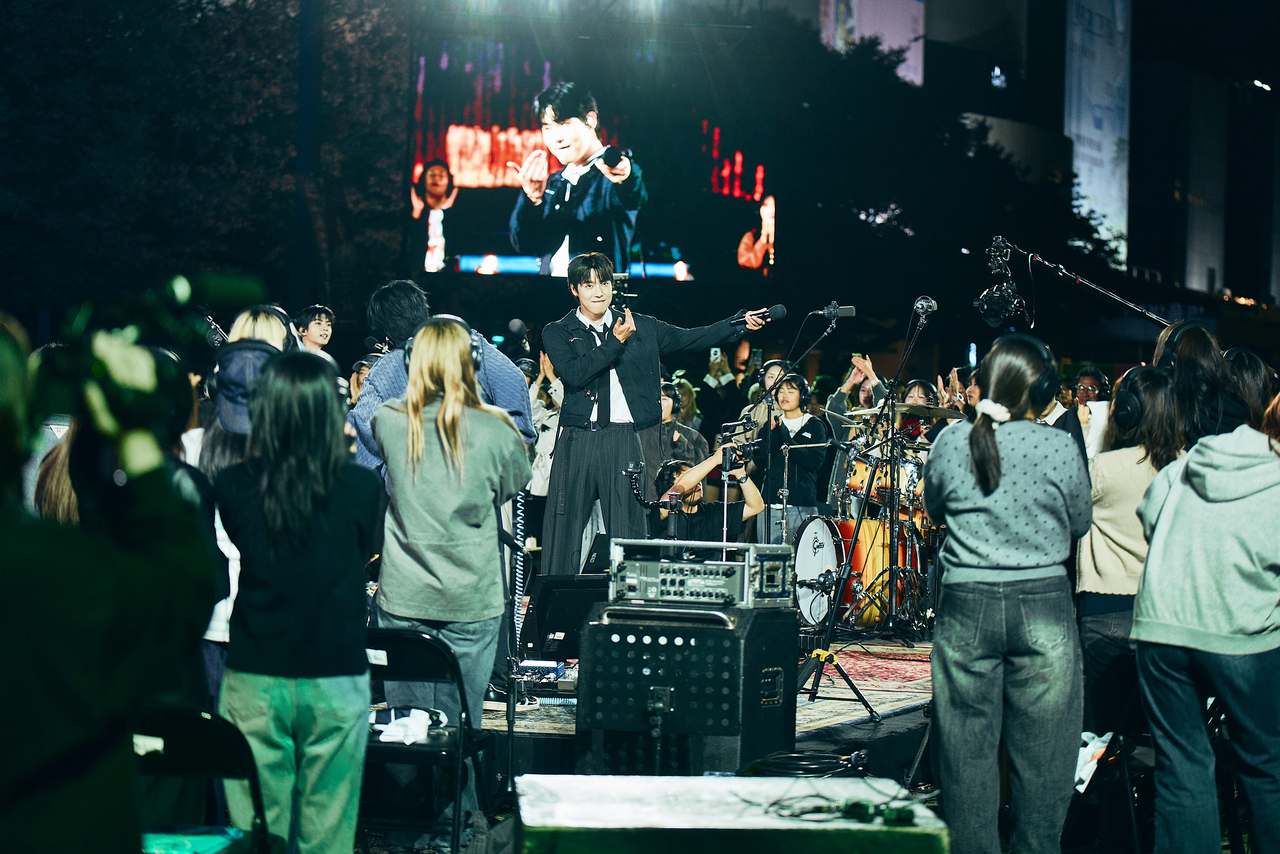
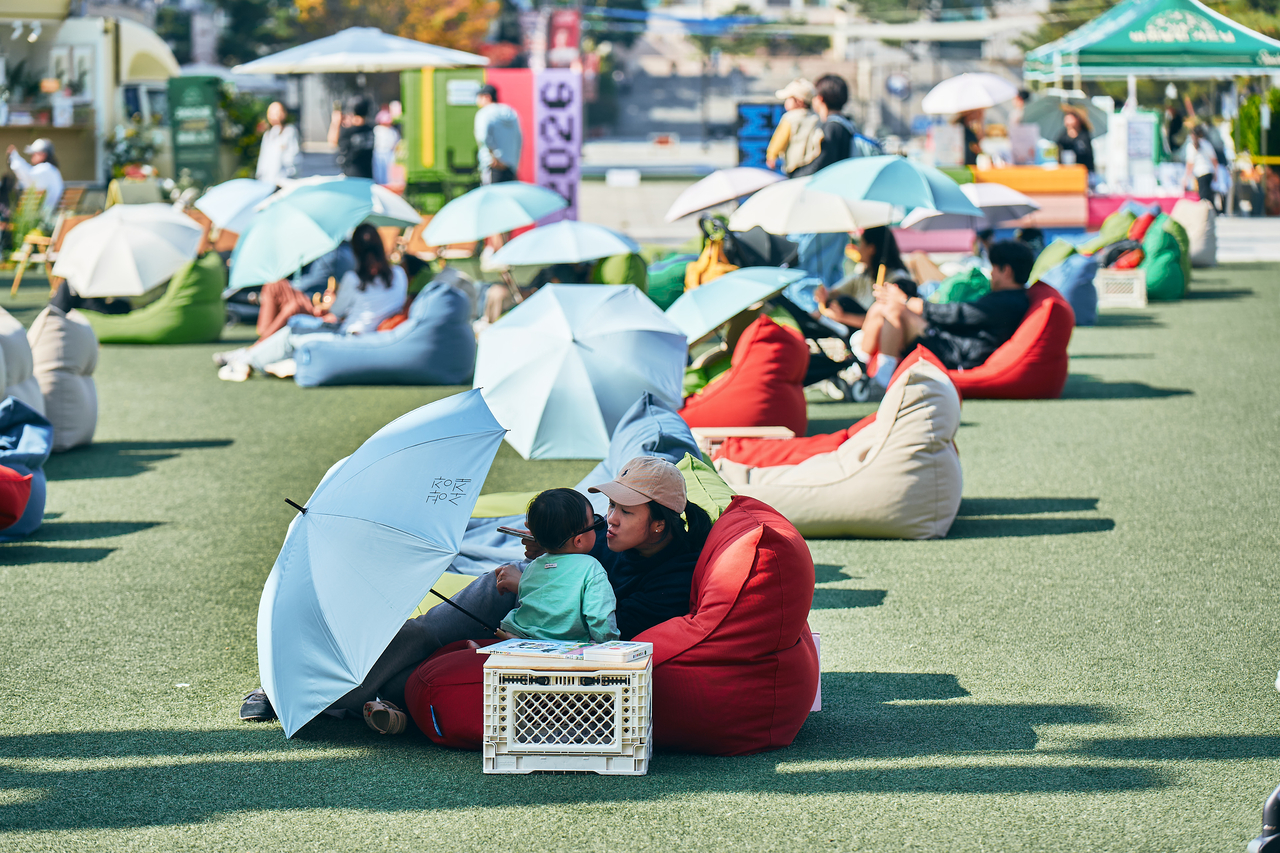
Bean bags were spread across the lawn in front of the musical fountain. Visitors stretched out on them and read books selected by publisher Gimmyoung Publishers and the Kim Dal-jin Art Research and Information Center. The scene was part of "Gwangjang Seojae," a book festival held at the music plaza of Seoul Arts Center in Seocho-gu through Oct. 18. On Oct. 15, the same space became a runway, where 30 models from designer Ji Chun-hee's Miss Gee Collection walked the green lawn. The night before, a busking performance marking the 10th anniversary of Arirang International Broadcasting's "I'm Live" had filled the plaza.
Performing arts venues are changing. The era of ticketed audiences sitting in silence before a stage at a fixed hour is giving way to something more open. In January, Sejong Center for the Performing Arts cleared its 3,000-seat auditorium and invited audiences onto the stage itself to read poetry collections. At the National Theater of Korea on the slopes of Namsan, even visitors without tickets can open a book in the second-floor lobby of the Haeoreum Grand Theater. The common thread running through all three venues is lowering the threshold. Each is dismantling a different boundary — between stage and audience at Sejong Center, between performance hall and public plaza at Seoul Arts Center, and between ticketholders and ordinary citizens at the National Theater.
"The goal is not the novelty of the program itself," a Sejong Center official said. "The meaning lies in broadening the points of contact between performing arts and audiences, and in lowering the psychological barrier to entering a theater." The idea, in short, is to get people who have not bought a ticket to come inside and stay.
Runway in the plaza, library on the stage
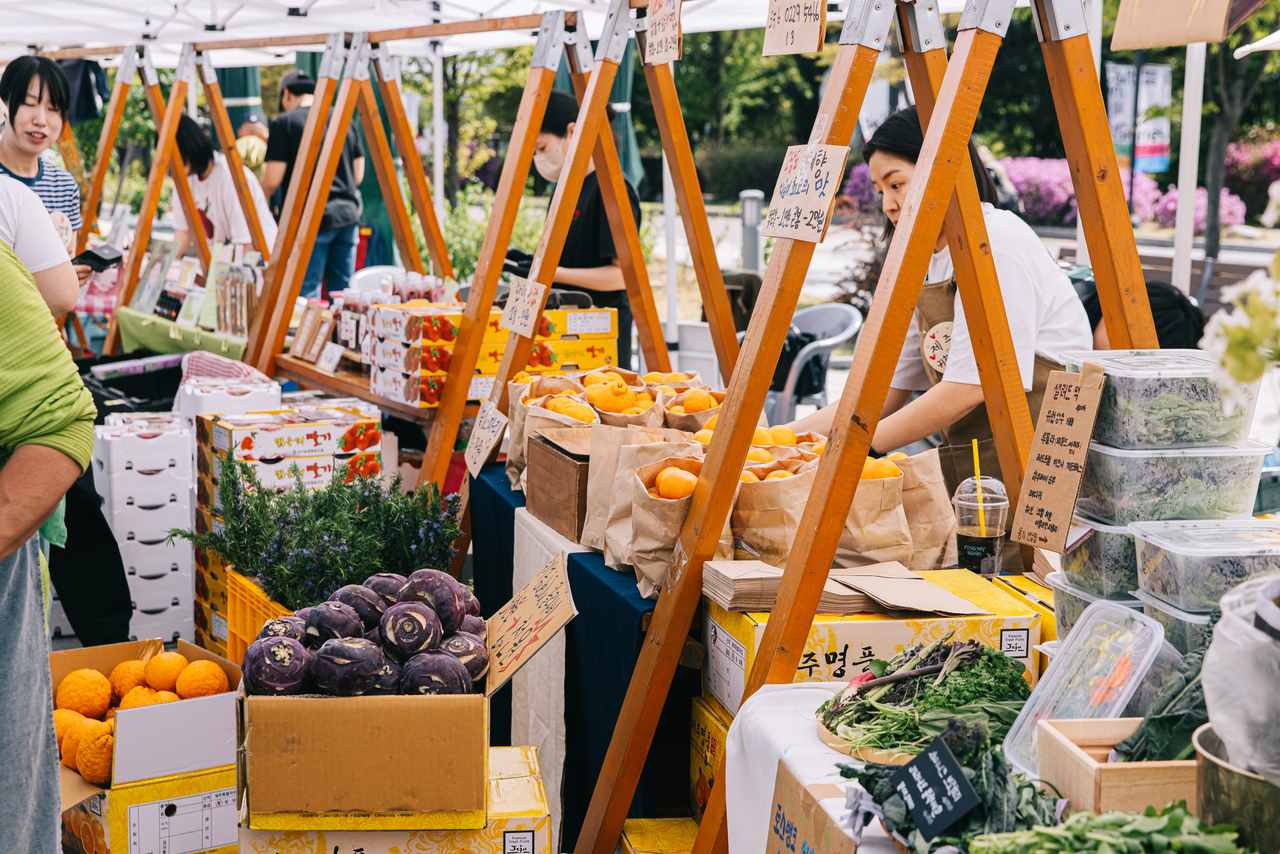
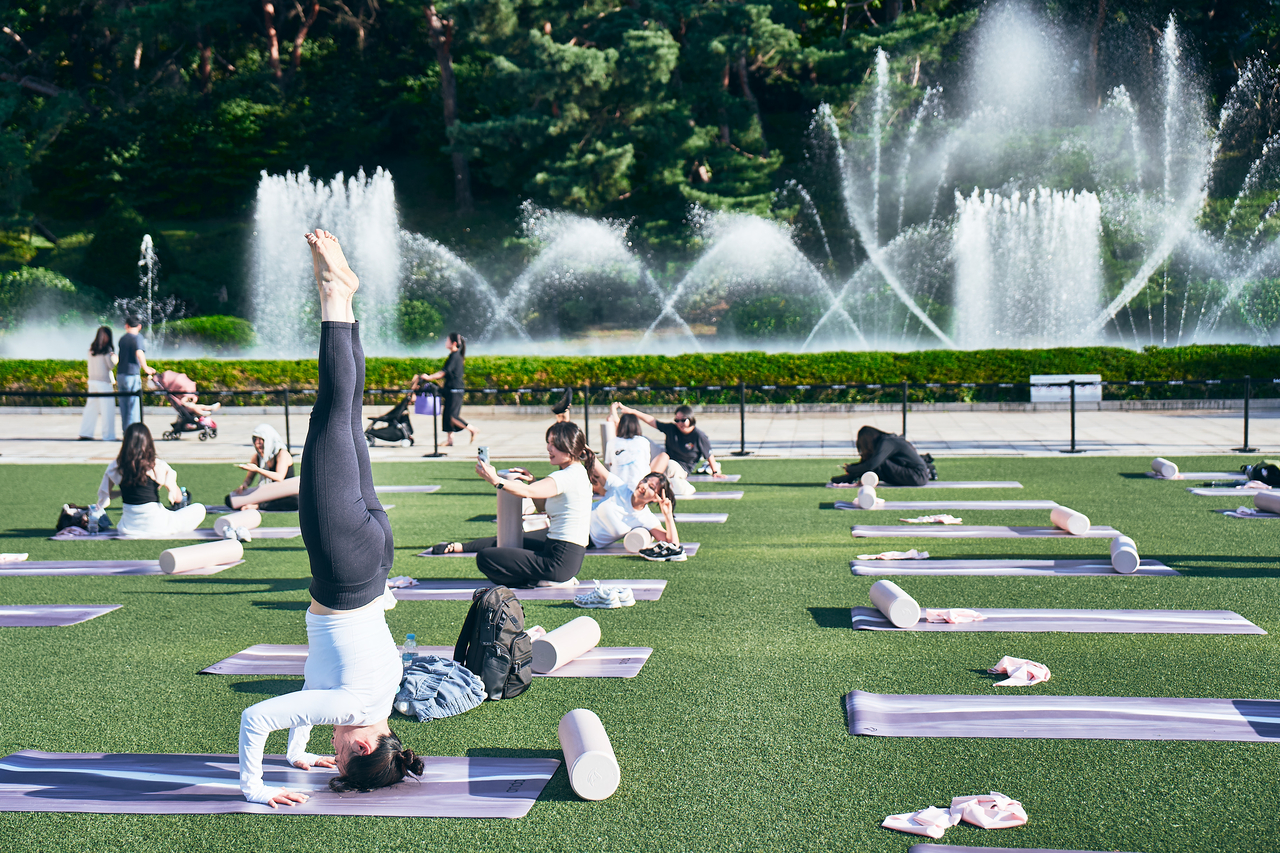
Seoul Arts Center's transformation has been striking. The venue began staging casual events in the fountain plaza — a space passersby had long simply crossed without stopping — starting last summer. In August, a silent disco drew visitors who danced to classical music, K-pop and EDM through wireless headphones, while a farmers market called Marché brought 85 teams of farmers and chefs with seasonal produce. Together the two events drew about 7,000 visitors, including people with no intention of attending a performance. "It was a new attempt to open the plaza as a space for diverse everyday experiences," said Jang Han-na, president of Seoul Arts Center.
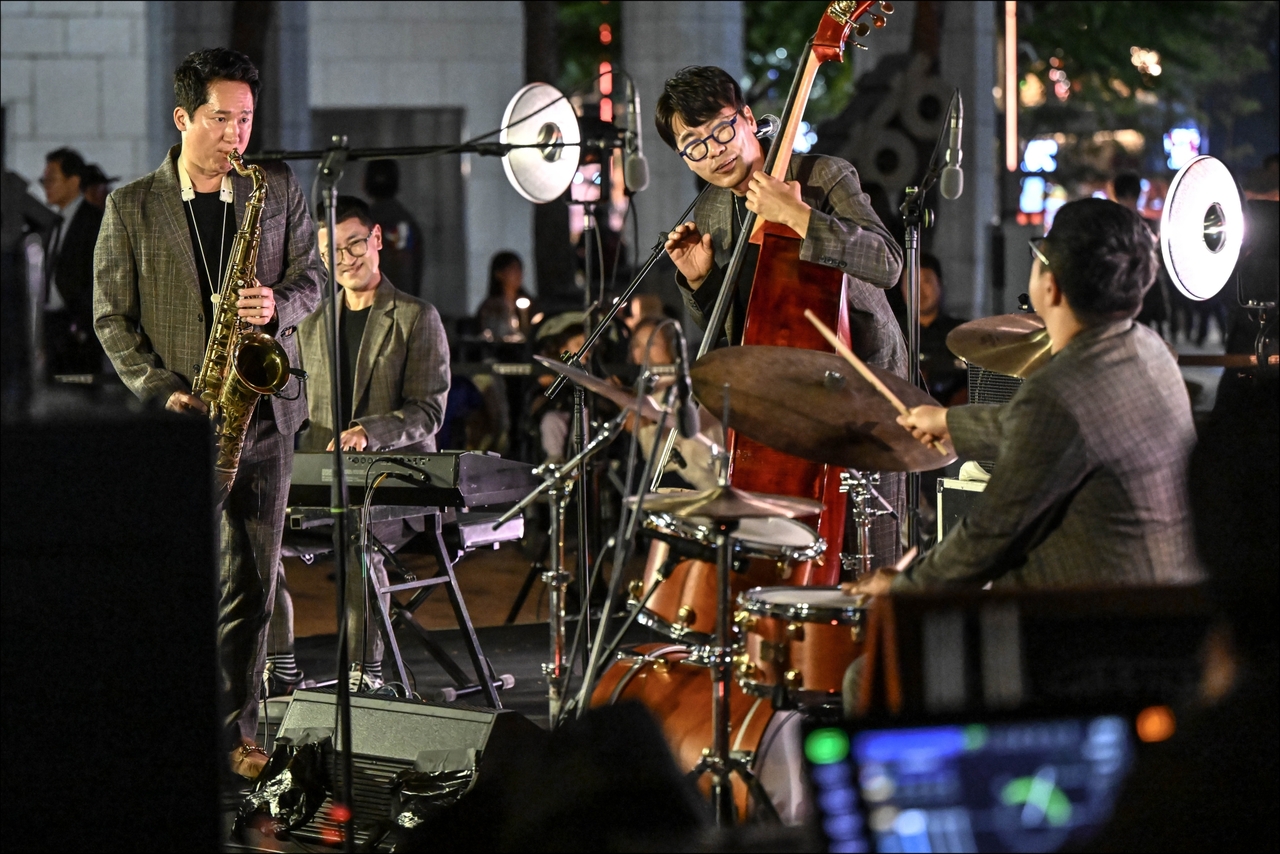
The programming has continued every month since. In September, models walked a runway to the live accompaniment of the 40-piece Seocho Symphony Orchestra, and on weekend evenings the staircase plaza transforms into an outdoor screening venue called "Staircase Theater," projecting performance footage. During the day, K-pop plays from the musical fountain. Seoul Arts Center said it does not view these activations as simply making use of idle space. "The perspective is that Seoul Arts Center has gained another performance hall and exhibition space," it said.
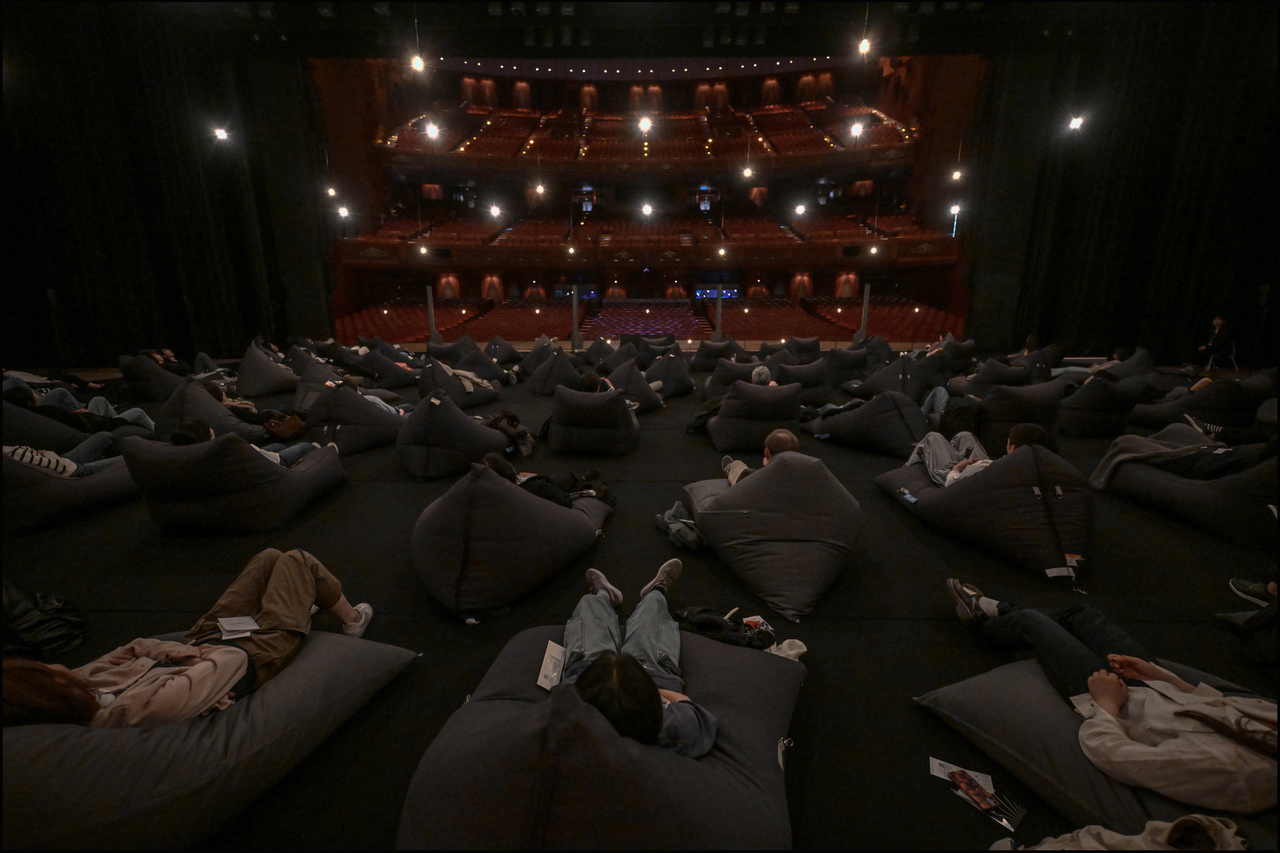
While Seoul Arts Center has turned the space outside its walls into a stage, Sejong Center for the Performing Arts has opened up the inside. Earlier this year, participants in the "Reading & Listening Stage" program sat before bookshelves on the main theater's stage, listening to 27 pieces from the 2026 Sejong season and reading poetry collections paired with each work — an inversion of the usual stage-and-audience relationship designed to make the venue feel unfamiliar in a new way.
Tickets for "Reading & Listening Stage" sold out within an hour, prompting organizers to expand capacity from 50 to 80 seats per session. According to Sejong Center, audience satisfaction for last year's "Sejong Inspiration" program reached 91.1 points. In July, the "Death and the Maiden Concert" led 120 audience members through the main theater's stairways, lobby and a normally closed VIP room for a preview of the Seoul Ballet Theatre's double bill "Death and the Maiden." Unconventional programs, in effect, serve as trailers for main productions.
An outdoor garden called "Curtain Call Garden," which opened Oct. 15, runs free of charge from 5 p.m. to 11 p.m. daily through Nov. 8. Part of the Seoul Metropolitan Government's nighttime economy initiative, it offers a 30 percent discount on food and beverages to same-day performance ticket holders.
"We designed it to encourage audiences to linger before and after performances, and to help revitalize the nighttime economy around Gwanghwamun by connecting with local businesses," a Sejong Center official said. The underlying vision is to make the time spent at the venue itself — not just the performance — a cultural experience.
The National Theater of Korea was the earliest mover in this direction. Its "Art In Series" — a market-and-festival hybrid that launched at the Culture Plaza in November 2021 — has been held 57 times through this month, drawing about 155,000 visitors. When the Haeoreum Grand Theater was fully opened to the public in April 2023, the second-floor lobby was converted into a free reading space called the Haeoreum Book Lounge. The aim was to reinforce the theater's public role while expanding its identity as a multifaceted cultural space.
"The Haeoreum Book Lounge has grown beyond a waiting area for performance audiences into a rest stop for Namsan hikers and a reading and work space for residents," a National Theater official said. In March, the venue also added a dedicated listening zone where visitors can sample National Theater productions.
'Theaters compete with Netflix and department stores'
60.2% vs. 72.0%.
According to the Ministry of Culture, Sports and Tourism's 2025 National Culture and Arts Activity Survey, 60.2 percent of the population attended a live cultural or arts event — a performance, exhibition or film — in person, down 2.8 percentage points from the previous year's survey. Meanwhile, the rate of indirect consumption through smartphones and other devices reached 72.0 percent. More people are now encountering art through a screen than in person.
Intent to attend live events has fallen sharply for the fine arts. Compared with 2016, the share of respondents expressing interest in theater dropped from 20.1 percent to 10.1 percent, and in dance from 3.2 percent to 1.8 percent. The only genre to see an increase over the same period was popular music, which rose from 23.5 percent to 29.6 percent. Seoul Arts Center's decision to pipe K-pop through its musical fountain, targeting "diverse age groups including younger generations," reflects exactly this trend.
What makes the picture more complicated is that the market itself is growing. According to the Korea Performing Arts Box Office Information System, ticket sales for the first half of this year reached about 809.5 billion won ($611 million), rising for the fifth consecutive year. The growth, however, has been driven by higher ticket prices and a handful of blockbuster productions. The average ticket price climbed to 70,963 won over the past year, up 1,748 won. In theater, the top 10 productions captured 56.6 percent of total genre revenue — the most concentrated in five years. The result is a striking mismatch: the share of people attending live arts events is shrinking, yet performing arts revenue keeps rising. Soaring ticket prices and fandom-driven demand have created this paradox. If venues cannot attract new audiences, the market risks becoming one where existing theatergoers simply divide a fixed pie among themselves.
The competition venues face has also changed. Audiences have limited evenings and limited budgets. For someone hesitating over a 200,000-won ticket to a major musical, a monthly streaming subscription offering films and drama series from the couch is an easy alternative. Sejong Center President Ahn Ho-sang has consistently made this point: "In the past, Sejong Center's competitors were other theaters. That is no longer the case. Digital platforms including Netflix, and department stores, are now our competitors."
That is precisely why Sejong Center moved outside its walls earlier than anyone else. In May 2024, it became the first public performing arts venue to open a pop-up store, setting up in Seongsu-dong, the neighborhood known as a hub for such activations. Part of the thinking was that simply seeing the Sejong Center logo in Seongsu-dong would feel fresh to visitors. That September, the venue partnered with secondhand trading platform Bungaejangter and opened roughly 4,343 square meters of its premises as a flea market. About 15,000 people visited over two days.
Once past the threshold, do visitors make it to their seats?
Opening a space and developing an audience are not, in fact, the same thing. Whether a citizen who comes to the plaza to read or dance to EDM will become a loyal theatergoer remains an open question.
"There are practical limits to continuously tracking whether visitors go on to attend performances or exhibitions, and whether they return," a Seoul Arts Center official said. Other venues face the same challenge. The National Theater acknowledged that it is difficult to accurately count visitors to the open-access Haeoreum Book Lounge. Instead, since the second half of last year, it has placed young education trainees from its resident companies on the "Art In Series" stage to introduce visitors to National Theater productions. The series has drawn a cumulative 155,000 visitors — but how many went on to buy a ticket for an actual performance has yet to be determined. The venues' reinventions do not appear to be translating directly into revenue growth.
Overseas venues moved earlier and went further, redesigning the physical spaces themselves. London's Royal Festival Hall at the Southbank Centre introduced its Open Foyer policy in 1983, unlocking a lobby that had been reserved for ticketholders to anyone who walked in. New York's David Geffen Hall at Lincoln Center reopened in 2022 after a $550 million renovation that reduced seating from 2,738 to 2,032 while nearly doubling the size of the lobby, turning it into a "living room" with sofas and free Wi-Fi open to visitors without tickets. That is a different proposition from the seasonal programming that anchors domestic venues. Seoul Arts Center itself noted that its outdoor spaces are subject to "constraints from season and weather" — the Oct. 18 session of the Gwangjang Seojae book fair was canceled due to a rain forecast.
Opening a theater also costs money. Hamburg's Elbphilharmonie, whose free public viewing platform "Plaza" had welcomed about 25 million visitors through July last year since the hall opened, began charging an admission fee of 5 euros ($5.58) on Oct. 5. The city of Hamburg, which had been covering about 3.6 million euros ($4.01 million) a year to keep the plaza free, reversed course under pressure on its cultural budget. The hall projected a 25 to 30 percent drop in visitors. How to fund an open theater — and how to convert that openness into actual audience development — is a question domestic venues cannot avoid either.
Even so, the experiments at home continue. Starting Tuesday, the National Theater has been running an exhibition and interactive space in the Haeoreum Book Lounge photo zone, featuring original artwork from the book "Joahseo Geurae." Seoul Arts Center is planning outdoor events with a Christmas atmosphere for the year-end. The National Theater said it would "explore diverse ways to use theater spaces in connection with performing arts and cultural content," while Sejong Center expressed hope that these efforts would go beyond being "simply unusual events" and become "an opportunity for citizens to continuously experience culture and the arts in their daily lives."
Ultimately, the challenge facing these venues is the same: turning the footsteps that cross the threshold into footsteps that reach the seats. "Rather than replacing the functions of performance halls and exhibition spaces, or affecting their operations, the new spaces and programs will focus on helping the public feel a sense of familiarity with Seoul Arts Center and naturally develop an interest in performances and exhibitions," a Seoul Arts Center official said.
shee@heraldcorp.com