Asia premiere set for Nov. 28 at Seosomun Shrine History Museum
Work for countertenor and string quartet sets Rilke sonnet cycle
Istanbul premiere revealed need for 'one short final movement'
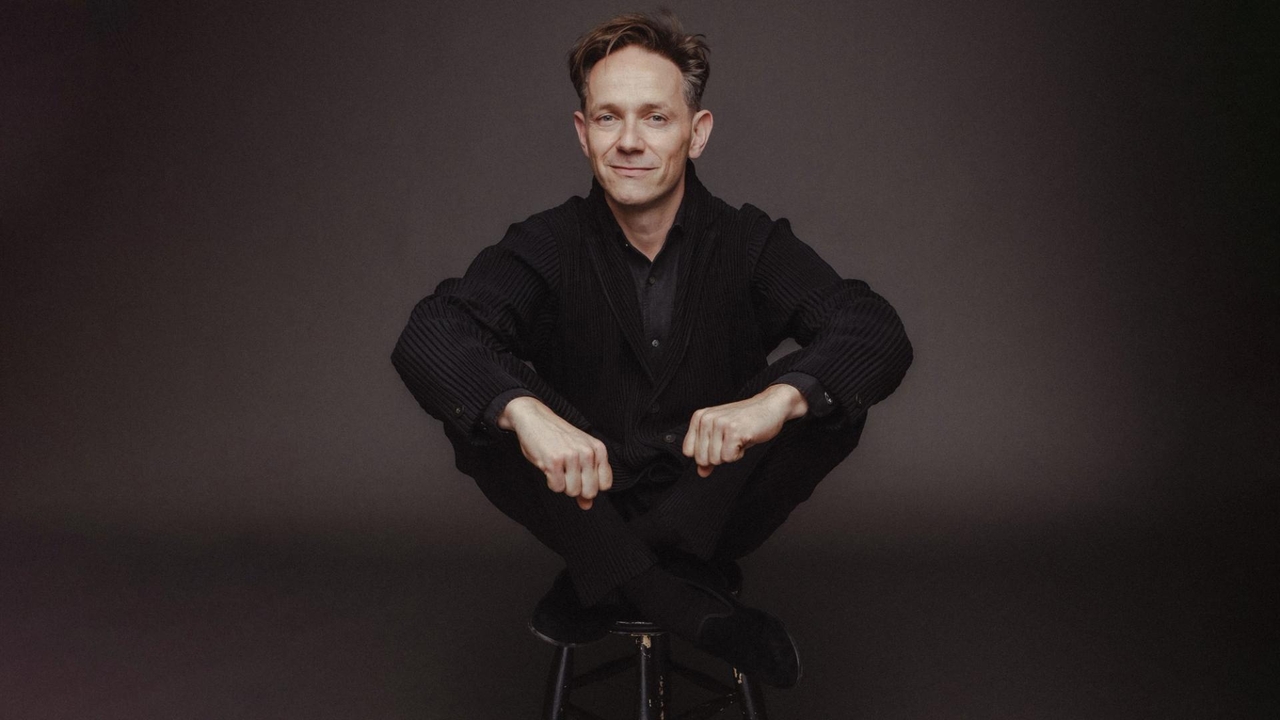
"When I work with composers, I always make a careful request: 'Write it plainly — don't try to make it special.'"
Countertenor Iestyn Davies, 47, has spent his career moving between myth and magic. He has been Oberon, the fairy king who rules the forest in Britten's "A Midsummer Night's Dream"; Orpheus, descending to the underworld to reclaim his dead wife, in Gluck's "Orfeo ed Euridice"; and Bertarido, the king believed dead who cries out for his lost queen, in Handel's "Rodelinda." In the play "Farinelli and the King" alongside actor Mark Rylance, Davies sang the repertoire of the legendary 18th-century castrato Farinelli on stage, earning an Olivier Award nomination.
Hailed as a "heavenly voice," Davies does not regard his falsetto as something mysterious. He describes his own instrument as "completely natural and ordinary."
Composer Shin Dong-hoon's new work, "Sonnets to Orpheus," answers that wish. Davies and Shin spoke recently with Korean journalists in an online meeting, where Davies said there is "always a risk that composers use the countertenor voice as a kind of special effect — but Shin did none of that," adding that Shin "fully embraced the masculine quality this sound carries."
The work for string quartet and countertenor arrives in Korea on Nov. 28 at the Seosomun Shrine History Museum in Seoul. Davies and members of the Berlin Philharmonic gave the world premiere at the Istanbul Music Festival in June; this time, members of Sejong Soloists will join Davies for the Asia premiere.
"Iestyn's voice is high, as a countertenor's is, but it also carries a very dark, melancholic color," Shin said. "I felt it suited Rilke's poetry beautifully." Shin has become one of the composers most sought after by leading international ensembles, winning the Young Composer Award from the Critics' Circle in Britain in 2019 and the Claudio Abbado Composition Prize at the Berlin Philharmonic's Karajan Academy in 2022. Last November, a piano concerto he wrote for pianist Cho Seong-jin received its world premiere with the London Symphony Orchestra.
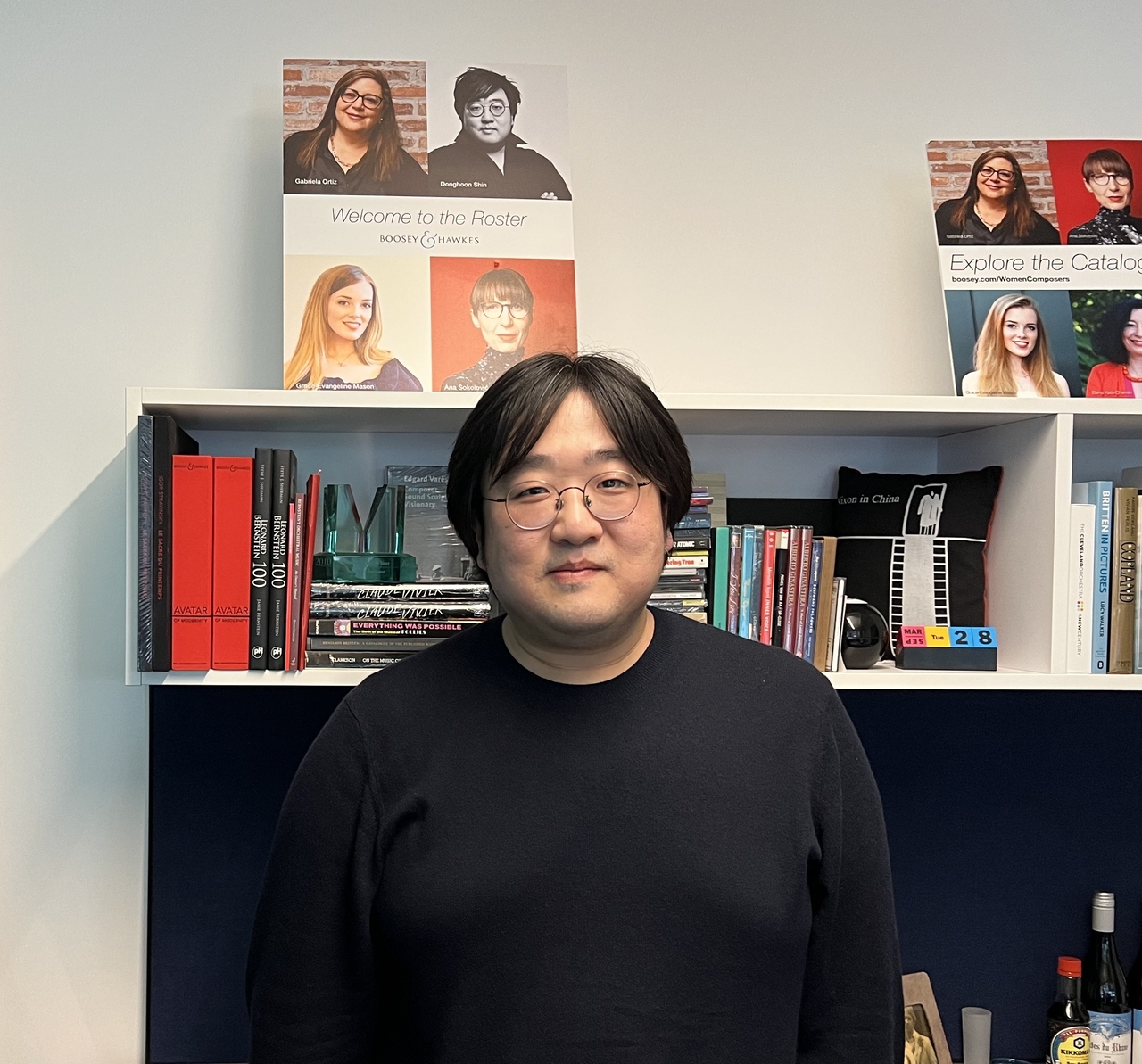
A song written for one voice
"When I was asked what piece I most wanted to write, the very first thing I said was: a song cycle for Iestyn Davies." — Shin Dong-hoon
The seed of the work was planted at a breakfast the two shared several years ago. At the time, Shin had already been commissioned by members of the Berlin Philharmonic to write a string quartet. When Shin proposed combining the two projects, Davies readily agreed, and the pairing of countertenor and string quartet was set.
It was Davies who chose the poetry — a cycle Rilke wrote in 1922 in memory of Vera Ouckama Knoop, a young dancer who had died. Less well known than much of Rilke's other work, the cycle was unfamiliar even to Shin, who read through the entire collection in both English translation and the original German. "It is not a poem that tells the Orpheus myth directly," Shin recalled. "It suggests the story through metaphor and imagery. It was deeply poetic and beautiful."
From the cycle, Shin selected Sonnets I, II and IX from Book One and Sonnets XXV and XXVI from Book Two, building five movements. His program note describes an emotional arc moving through "grief and rage in the face of death, resignation, reconciliation with death, and ultimately transcendence beyond life." Orpheus inhabits the string writing as well: in the first movement, the cello plucks three strings simultaneously in an unbroken pizzicato — a portrait of the lyre Orpheus played as he sang.
"Handel and Bach — their music was contemporary music in its own time. We know those styles now, so when you pick up the score you can anticipate what is coming. With 21st-century music you cannot say 'this is the style of 2026.' A newly commissioned work is, at first, completely unknown. It is a world you have never lived in before." — Davies
Before asking Shin a single question, Davies first tried to work out for himself why the composer had set each line of poetry the way he had, and what every marking on the page meant. After weeks of "living inside Shin's sound world," the piece became strange again at the first rehearsal with the string quartet: what he had imagined at the piano sounded entirely different when he was singing surrounded by strings. "There is a movement where the strings sound like Orpheus's lyre," Davies said, "and the way that sound wrapped around my singing was genuinely fascinating."

The two had never worked together before this piece. Even so, Davies said that from the score alone he could tell it was "written for a voice — and specifically for my voice," adding that Shin had "captured my range exactly."
'The voice is your closest friend — and your enemy'
The path to Davies's current voice was not straightforward. He began singing in a choir at age seven, lost his upper register when his voice broke, and discovered his own sound almost by accident when he stumbled into falsetto.
"The voice is something you sleep with, eat with, wake up with, live with. The instrument is you yourself, and it stays with you until you die. It is your closest friend — and sometimes your enemy." — Davies
Davies said that once he began singing as a countertenor, he found his way back to "the same place inside" that he had reached when singing as a boy, and described the singer's role as "a bridge between the music and the listener." He added that the countertenor voice within him still feels like something growing.
"The countertenor was used in choral music for a long time, and it has only been about half a century since it was used as a solo voice. Unlike the soprano or tenor, which have been refined over hundreds of years, there is still so much room to develop. Countertenors today sing higher and higher notes compared with ten or twenty years ago. New music has pushed young countertenors to explore just how far the voice can go." — Davies
Davies said that George Benjamin, Thomas Adès and Shin Dong-hoon — composers he has worked with closely — have each "interpreted the countertenor voice in completely different ways."
Shin, who lived in London for more than a decade before moving recently to Berlin, said he had long been largely unaware of his Korean identity in his music. Lately, he has begun looking back at the era and environment in which he grew up.
"My music has a wide palette — from tonal writing to avant-garde noise. The 1980s, when I was growing up, was a time when Korean and Western things were all jumbled together. I suspect that period influenced my tendency to mix extremes." — Shin Dong-hoon
Shin has lived abroad for years, but he said he has never felt Western interest in Korean culture as intensely as he does now. "K-pop, novels and films have raised the West's attention toward Korea," he said, and went on to say that "composition is an art where the boom always arrives later than in other fields," expressing hope that the interest would eventually extend to Korean composers as well.
Also receiving its Asia premiere on the same program is Shin's "Winter Sonata," performed by violinist Kim Ji-yeon and pianist Jo Jun-young — a work originally written for violinist Christian Tetzlaff and pianist Leif Ove Andsnes. Thinking of Tetzlaff's Beethoven, Shin was improvising at the piano when he found his starting point in the distinctive resonance of a C minor chord.
"Beethoven's sonata form is ultimately an experiment in harmony. I took that as my cue and conducted my own experiment with harmony. Beyond the music itself, I also wanted to trace the journey Beethoven always focused on — setting out from suffering and anguish, moving through struggle, and arriving at joy." — Shin Dong-hoon
According to the program note, the work moves between tonality and atonality, setting a dark "winter theme" against a "spring theme" rooted in F major — the key of Beethoven's Violin Sonata No. 5, "Spring." The rainy, sunless London winters Shin experienced seeped into the piece.
A final movement still unwritten
"Sonnets to Orpheus," which has already had its world premiere, is in a sense still unfinished. Shin told Davies and the Berlin Philharmonic members as much immediately after the Istanbul premiere.
"I felt that for the music to be truly complete, it needs one more very short final movement. I have not written it yet — I am still looking for the time." — Shin Dong-hoon

The Seoul performance will proceed with the current five movements; the new movement is expected to be unveiled for the first time at a subsequent New York concert. Performing the work for the second time, Davies recalled advice he received around age eight from the director of the Cambridge choir: "Aim for expression, not perfection." He described the singer's task as "adding something to the piece that the composer could not quite put into the score."
"When you perform a new work for the first time, your attention is consumed by getting it right — by analyzing the terrain of the complex map the composer has transferred from mind to page. But what the composer wants is for us to take the music off the page and breathe life into it." — Davies
The second half of the Seoul program is also woven around Orphic loss. Haydn's "O Tuneful Voice," which mourns a beloved voice and the grief of losing it, is paired with Beethoven's "Adelaide," written after Beethoven completed his studies under Haydn. Davies called it "a beautiful way of connecting the two composers across time."
The program closes with "Cara sposa" from Handel's opera Rinaldo — an aria Handel himself reportedly considered his finest. It is the song of Rinaldo, left alone after his beloved Almirena is taken from him. Davies described it as "a piece that places the character in a desolate landscape and wraps him in beautiful fugal orchestration — a demonstration of Handel's penetrating understanding of human emotion," adding that it "connects directly to what Orpheus felt when he lost Eurydice."
Anticipation for the Seoul performance is running high. Davies said the concert will bring "a new string quartet, a different hall, a different audience — and jet lag on top of it all," and expressed genuine curiosity about "how the piece has grown in the time since I last looked at it." Shin, whose Korean appearances have largely featured large-scale orchestral works with the Seoul Philharmonic Orchestra, said he was grateful for the chance to introduce his chamber music to audiences here.
"A composer's work ends with putting notes on paper and completing the music. Once the composing is done, I believe the music passes to the performers and the audience. I hope everyone will come with an open mind and simply enjoy it." — Shin Dong-hoon
shee@heraldcorp.com