Fed hold probability at 93.4%
Korea likely to maintain tightening path
October CPI seen rebounding to around 3%
High oil prices push up import costs
Narrowing rate gap could strengthen won
The US Federal Reserve is widely expected to hold its benchmark interest rate steady this week, but the Bank of Korea remains firmly on a tightening path. Third-quarter economic growth came in well above the BOK's own forecast, and if October consumer prices confirm a renewed uptick in inflation, the case for another rate hike will grow stronger.
According to financial industry sources, the Fed is holding its Federal Open Market Committee meeting Tuesday and Wednesday (local time), with the result to be announced early Thursday morning Korean Standard Time. At its meeting last month, the FOMC raised its benchmark interest rate by 0.25 percentage point to a range of 3.75 to 4.00 percent — its first hike in three years and two months.
Markets broadly expect the Fed to hold this time around. August personal consumption expenditures price index data came in below expectations at 3.4 percent year-on-year, and September employment figures also fell well short of forecasts. Cautious remarks from key Fed officials have further reinforced expectations of a pause.
The CME Group's FedWatch tool put the probability of a hold at this week's meeting at 93.4 percent as of Tuesday (local time), up 57.6 percentage points from a month earlier (35.8 percent) and 4.5 percentage points from a week earlier (88.9 percent).
Even if the Fed holds, the BOK's rate-hike clock is expected to keep ticking.
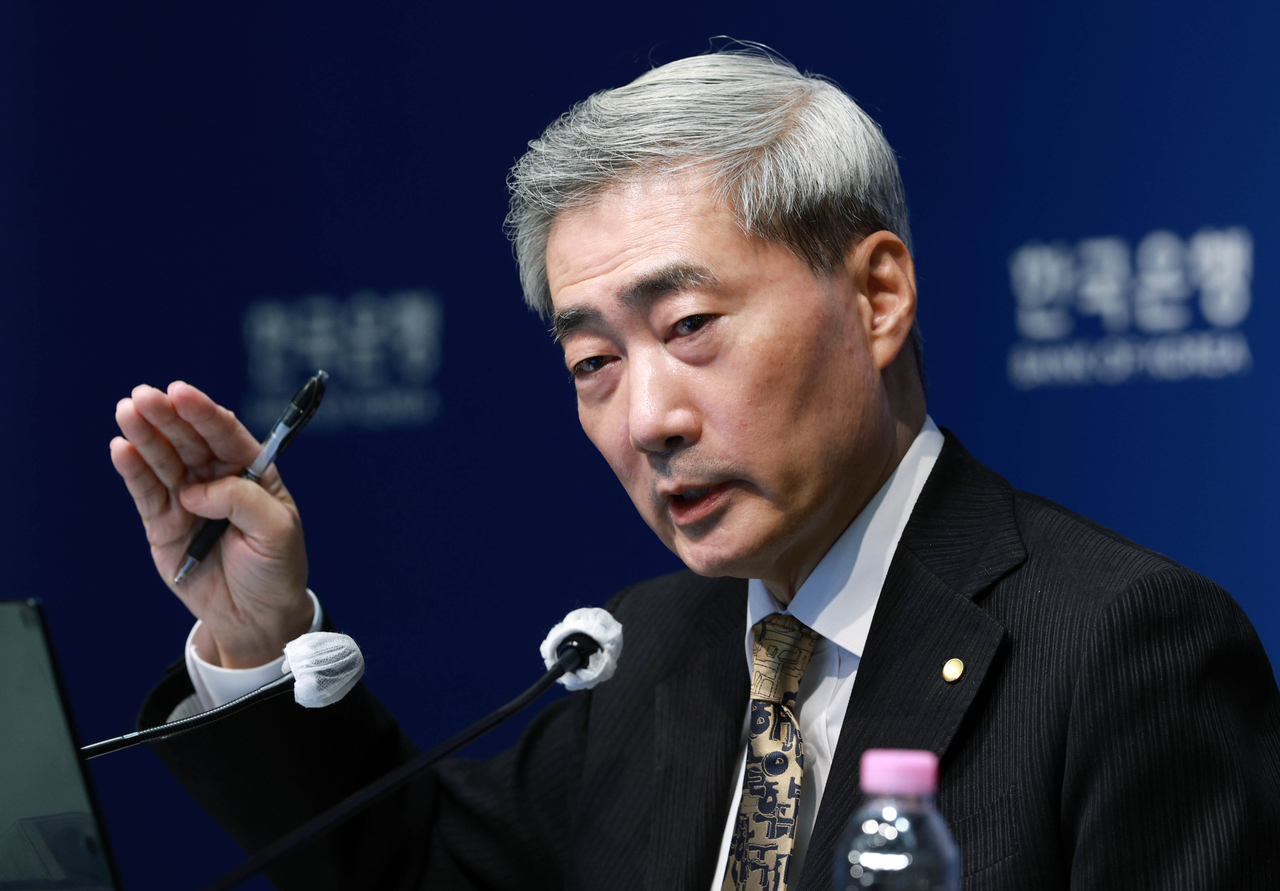
Governor Shin has repeatedly emphasized the need for preemptive action. While raising the benchmark rate in consecutive moves in July and August, Shin argued that acting ahead of the curve reduces the cost of bringing inflation under control. He has also credited the BOK's decision to move before the Fed with helping stabilize domestic financial markets — a view that suggests the Fed's decision this week will have limited bearing on the BOK's own monetary policy.
Key economic indicators continue to point toward further tightening. Speaking at the International Monetary Fund and World Bank Group annual meetings in Bangkok, Thailand, on Oct. 13 (local time), Shin signaled the possibility of additional tightening, saying: "Right now in Korea, inflation is too high, the exchange rate has room to strengthen further, and there are financial stability considerations as well. All three point in the same direction."
Third-quarter real GDP growth data released Tuesday added further weight to the case for a rate hike. Real GDP expanded 1.0 percent quarter-on-quarter in the third quarter, more than three times the BOK's August forecast of 0.3 percent. Growth had already come in strong at 1.8 percent in the first quarter and 0.6 percent in the second, and the third quarter defied expectations of a slowdown by accelerating further. Semiconductors and government spending were the primary drivers.
Private consumption fell for the first time in roughly four years, but the BOK does not expect this to be a major variable. The bank attributes the decline to temporary factors such as a stock market correction and strikes at automakers, and expects income growth — led by the semiconductor sector — to lift private consumption from the fourth quarter onward. Lee Dong-won, director general of the BOK's Economic Statistics Department 2, cited a rebound in passenger car purchases, cash dividends and performance bonuses from chipmakers, and an expansion of government transfer payments as grounds for his view that "private consumption will gradually recover from the fourth quarter of this year through the first quarter of next year."
October consumer price data, due for release early next month, will be another key variable. The September consumer price index rose 2.9 percent year-on-year, slipping back into the 2 percent range within a month, and core inflation eased from 3.4 percent to 2.8 percent — but both moves were heavily influenced by a temporary base effect from last year's telecommunications fee discounts. The BOK expects consumer prices to rebound to around 3 percent in October as underlying price pressures persist.
International oil prices have resumed their climb as conflict in the Middle East flares again. According to Korea National Oil Corporation, the average price of Dubai crude in October through Monday was $109.7 per barrel — slightly below September's $113.7 but still above the levels seen in April ($105.7) and May ($103.2) at the height of the Middle East war's impact. September import prices rose 1.7 percent month-on-month, reversing four months of declines. A falling won-dollar exchange rate offset some of the oil price increase, at least limiting the overall rise.
Shin has repeatedly signaled his intention to maintain the tightening stance until he is confident inflation will fall to the 2 percent target. At a press conference on Thursday, he said he expected inflation to "approach the target level the year after next," suggesting the tightening cycle will continue at least through next year.
If the Fed holds and the BOK raises rates next month, the gap between the two countries' benchmark interest rates would narrow from 1 percentage point back to 0.75 percentage point. That could put additional downward pressure on the won-dollar exchange rate, which has recently fallen to the 1,320 won range. As of 9 a.m. Wednesday, the won was trading at 1,327 per dollar.
kimstar@heraldcorp.com