
Closure begins Saturday at 7 a.m.
Traffic to shift to 7-lane at-grade intersection
Linear park three times the size of Gwanghwamun Square planned above
Underground road set to open in June 2031; surface park to be completed in June 2032
The Seoul Metropolitan Government will close the underpass beneath the Hongik Hospital intersection starting Saturday at 7 a.m. as construction begins on the National Assembly Boulevard underground road project, the city announced.
With the closure, traffic at the intersection will shift from the current six-lane configuration — four above-ground lanes and two underground lanes — to a seven-lane at-grade intersection. The two underground lanes will be sealed off, and a setback operation will free up additional road space, allowing the number of above-ground lanes to increase from two to three.
On the western side of the intersection (toward Incheon), the existing underpass will be filled in and converted to a surface road. On the eastern side (toward Yeouido), a ramp will be installed to connect the at-grade intersection with the remaining underground section. U-turns at both ends of the intersection will be prohibited, and the city plans to strengthen advance signage to prevent driver confusion.
A side road along the Mok-dong Complex 7 section (running from Incheon toward Yeouido) will be temporarily widened from two lanes to three and operated that way through June next year to minimize traffic delays from the transition.
The city will implement traffic management measures alongside the transition to limit disruption to residents. Traffic analysis projects that average travel speeds on National Assembly Boulevard will drop by about 3 kilometers per hour after the switch, with travel times increasing by roughly four to five minutes. The Incheon-Bucheon to Yeouido corridor (Sinwol IC to the National Assembly) is expected to lengthen from 23 to 27 minutes, while the reverse direction (National Assembly to Sinwol IC) will stretch from 24 to 29 minutes. Drivers heading from Gangseo-gu toward Yeouido, however, are expected to save about three minutes during the morning commute, as a redesigned route will allow them to turn left at the surface intersection and enter the Gyeongin No. 1 underpass directly.
Drivers heading toward Yeongdeungpo and northern Seoul can use the Southern Circular Road and the Western Arterial Road as alternatives, while vehicles entering from outside the city boundary can take Bucheon-ro and Sinjeong-ro. Those heading directly to Yeouido may also use the Sinwol-Yeouido Underground Road, which charges a toll.
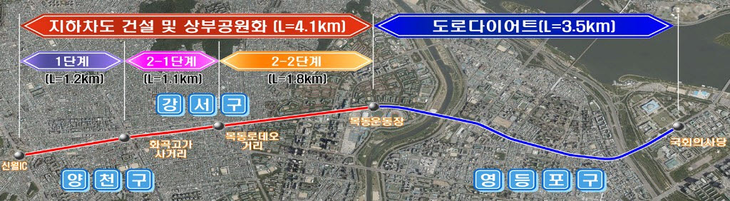
The National Assembly Boulevard underground project will build a 4.1-kilometer tunnel along a 7.6-kilometer stretch from Sinwol IC to the National Assembly intersection, routing vehicle traffic underground. The remaining 3.5-kilometer section will be reorganized as a linear park of about 110,000 square meters — equivalent to 15.4 soccer fields — above the road. The traffic transition follows completion of a revised design for the Mok-dong Complex 4 and 7 sections, which secured the construction zone needed to begin full-scale tunneling work.
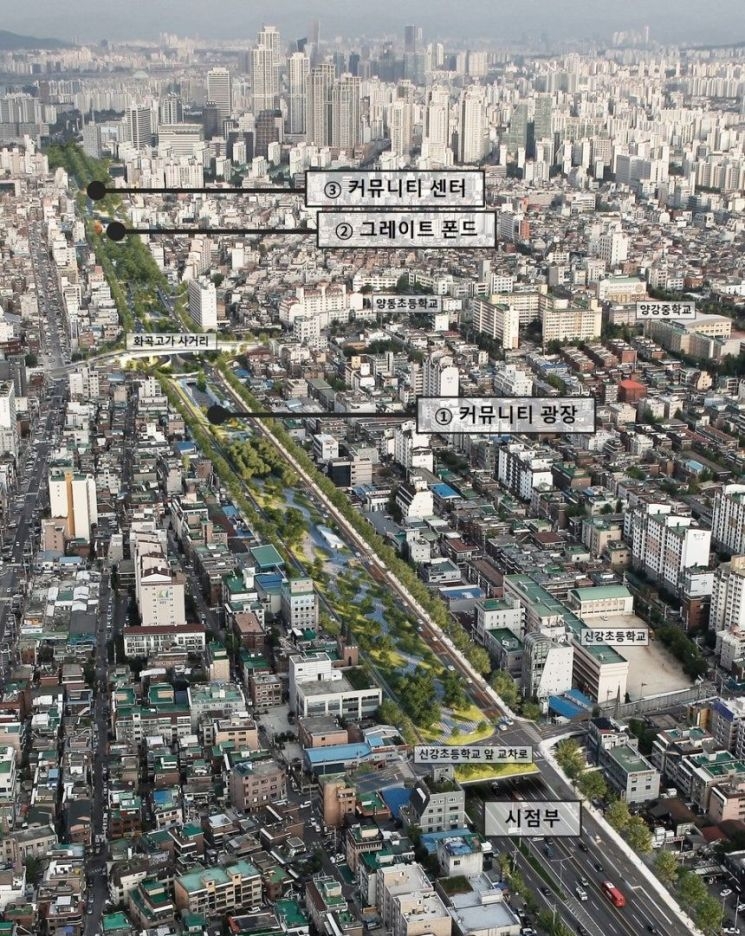
Once complete, the project will create a green space above National Assembly Boulevard roughly three times the size of Gwanghwamun Square and about eight times that of Seoul Plaza. The park will feature a sunken plaza passing naturally beneath the Hwagok overpass, a large pond called the Great Pond, a community center and a garden culture center connected to it, and a sweeping lawn area called the Great Field — offering residents spaces for walking, relaxation and cultural activities.
"This traffic transition is part of the process of strengthening vehicle flow through the underground road while creating a citizen-centered green and recreational space above ground, and we plan to carry out construction with safety as the top priority," said Im Chun-geun, head of the Seoul Metropolitan Government's Urban Infrastructure Headquarters. "We will closely monitor traffic conditions and strengthen on-site management throughout construction to minimize inconvenience to residents, and we ask for the public's understanding and cooperation."
National Assembly Boulevard was part of the Gyeongin Expressway, South Korea's first highway, which opened in 1968. For more than 50 years it served as a key corridor for the movement of people and goods. As the city expanded and traffic volumes grew, the road became a persistent source of congestion, noise and exhaust complaints.
The underground project was conceived to ease congestion on National Assembly Boulevard. Plans accelerated in late 2015 when construction began on the 7.53-kilometer Seoul Jemullo Tunnel linking Sinwol IC to Yeouido.
The total project cost is 850.4 billion won ($642 million). The city is targeting a June 2031 opening for the underground road and a June 2032 completion for the surface park.
cook@heraldcorp.com




