Free AI service to launch by year-end; W2.1 trillion earmarked for AI education next year
AI to be integrated into 7 seed projects including biotech and quantum
The government plans to more than triple its physical AI budget next year to 3.1 trillion won ($2.34 billion) — over three times this year's allocation — to drive productivity gains in manufacturing and robotics.
The government also intends to integrate AI into next-generation industries such as advanced biotech, small modular reactors, quantum technology and aerospace to build growth engines beyond semiconductors, and will roll out a free AI service accessible to all by the end of this year.
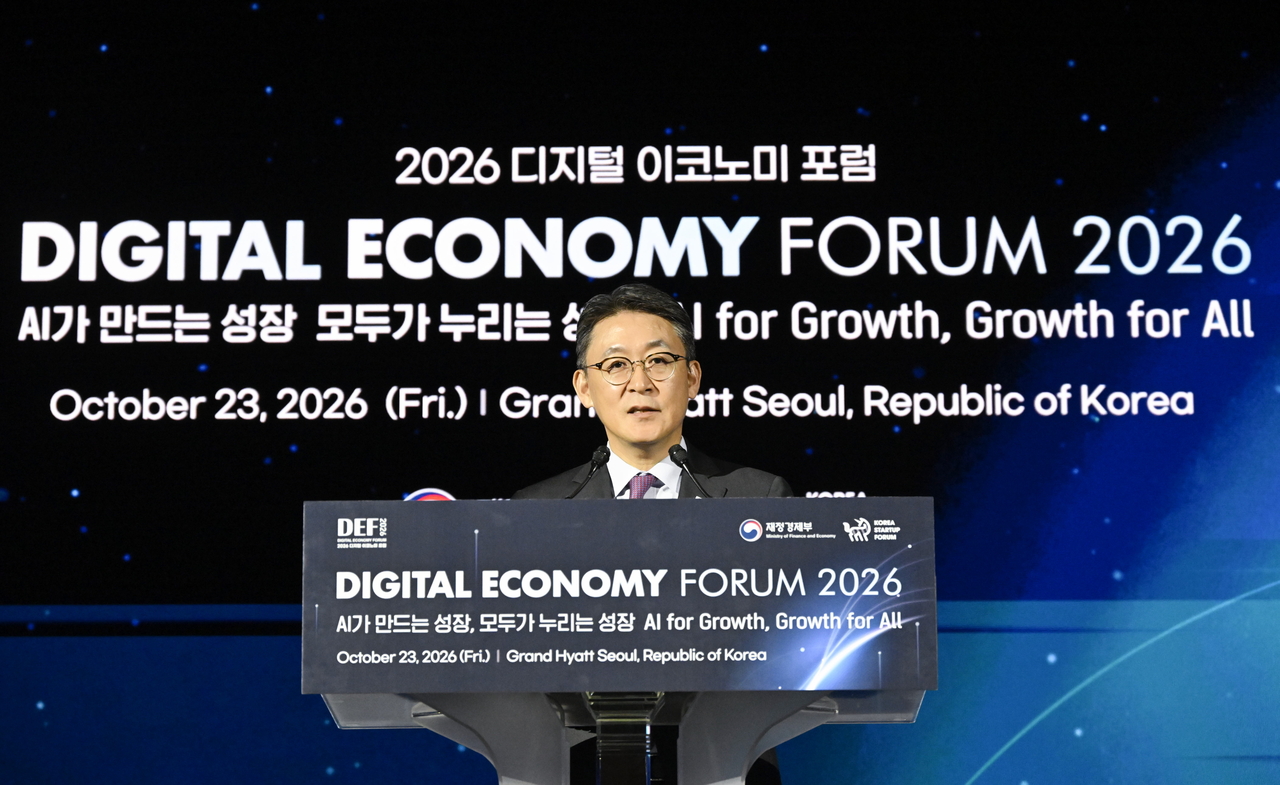
Vice Minister of Economy and Finance Kwon Dae-young outlined the policy direction in an opening address Friday at the ninth Digital Economy Forum, held at the Grand Hyatt Seoul. "Now it is our turn to lead from the front," he said.
Kwon said the government would "put AI into factories and robots," adding that South Korea's manufacturing strength and the volume of data generated on factory floors gave the country a solid foundation for physical AI. "That is why we have a real shot at this," he said.
To that end, the government has reflected in its budget proposal an increase in physical AI spending from 900 billion won this year to 3.1 trillion won next year — a roughly 3.4-fold rise, or an increase of 2.2 trillion won. The government also plans to back the initiative through the 200 trillion won National Growth Fund.
Kwon also stressed the need to identify new growth drivers to follow semiconductors. "Our hospitals have accumulated a wealth of high-quality medical data," he said. "Properly refined, it becomes a strong asset." He said the government would integrate AI into seven so-called SEED projects — spanning advanced biotech, small modular reactors, quantum technology and aerospace, among others — to "nurture them into the industries that feed us 10 and 20 years from now."
The government will also step up efforts to prevent AI from widening inequality. "AI must not become an opportunity for some and a wall for others," Kwon said. He announced plans to launch a free AI service for everyone by year's end and to raise the AI education budget to 2.1 trillion won next year. He added that the government would ease generational, regional and corporate disparities through residential, employment and financial policies.
Kwon likened the spread of AI to the opening of the Gyeongbu Expressway, saying the highway's interchanges allowed villages and factories across the country to get on the road together. "AI must be something anyone can get on board with, not just something that moves fast," he said.
The forum, organized by the Ministry of Economy and Finance and hosted by the Korea Startup Forum, was held under the theme "Growth Created by AI, Growth Enjoyed by All." The annual event, held every year since 2018, brings together participants to discuss trends in the digital economy and how to respond to them.
In a keynote address, Frederik Werner, head of strategic engagement at the International Telecommunication Union, said international cooperation and collective effort were needed to ensure the benefits of AI technology were not concentrated in particular countries or social groups. Lim Chi-hyun, head of the DX strategy division at Posco Holdings, presented case studies on redesigning steel, secondary battery materials, energy and infrastructure processes using AI, as well as efforts to transform office and research work and commercialize AI solutions.
Panel discussions covered four topics: the AI transition in traditional manufacturing, identifying growth drivers beyond semiconductors, changes in employment and building AI capabilities across generations, and AI-based regional growth strategies. A startup presentation session newly introduced this year featured five companies — Onepredict, Pablo Air, Galaxs, Elice Group and Route Energy — showcasing their technologies and business models in manufacturing, biotech and education.
fact0514@heraldcorp.com