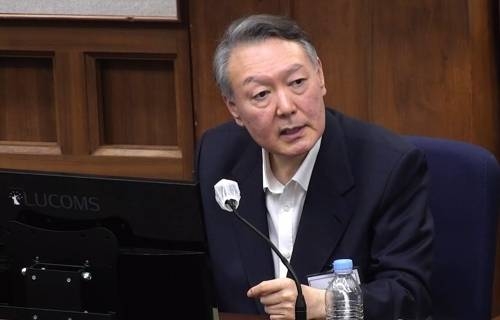
Former President Yoon Suk Yeol again argued in court Thursday that his declaration of emergency martial law last December was intended as a warning to the public, not as a measure meant to be carried out.
Yoon made the remarks during a defendant examination at the Seoul High Court, where a three-judge panel of the court's Criminal Division 12-1 is hearing his case on charges of leading an insurrection.
Responding to questions from his defense team about the circumstances surrounding the martial law declaration, Yoon said he wanted to tell citizens focused on their daily lives: "The country you own has been ruined like this — can we just leave it alone?"
He added that he had told then-Defense Minister Kim Yong-hyun he viewed the situation as a constitutional emergency — and that under the constitution, martial law was the only available instrument for such a state. "It wasn't martial law in the traditional sense," Yoon said. "I told him I wanted to turn it into a political issue, inform the public about the opposition party's abuses, and fight back."
Yoon also claimed he had anticipated that the National Assembly — where the opposition held a majority at the time — would lift the declaration almost immediately. "Wouldn't they have lifted it instantly, at 'ultra-speed'? What trick could I have used to stop them?" he said. "I told him it would be lifted, and that from that moment political attacks against me would begin."
He went on to say the timing of the declaration was itself evidence he had no intention of blocking the Assembly's vote. "Didn't I not declare it on a weekend or after the regular legislative session ended, to dodge that kind of resolution by some trick?" he said. "The message was: come and lift it. Pass the resolution to lift it."
Yoon repeated his earlier claim that he had planned the declaration for around 10 p.m. — rather than the early hours of the morning — precisely so the Assembly could convene and vote without difficulty. "I planned it for around 10 p.m., after citizens got off work and before they went to sleep," he said. "Doing it at 2 or 3 in the morning, when the Assembly would have to scramble to gather — wouldn't that have been foul play?"
He also argued that the martial law decree issued at the time was never intended to function with real effect.
"For example, the decree said media organizations must follow the martial law command's guidelines — but you can't punish anyone based on a vague decree like that. It has no practical force," Yoon said. "There are hundreds of media outlets. Could anyone have controlled them? I think that provision was just put in there."
He repeated his longstanding claim that deploying troops to the National Assembly was solely for the purpose of maintaining order and safety, and that he had intended to withdraw them immediately once the Assembly voted to lift the declaration.
On the deployment of troops to the National Election Commission, Yoon said, "Why would I have sent them at that late hour? It was simply to conduct a brief inspection" — denying that the move had any investigative or prosecutorial purpose.
Yoon also sharply criticized the Democratic Party of Korea's legislative conduct during his presidency as he explained his motivations for declaring martial law. "During the Lee Myung-bak administration, the ruling party had a majority, but they didn't churn out laws like stamping bricks," he said. "Bills should go through deliberation, but they just pushed things through by sheer numbers."
The defendant examination of Yoon will continue at the next hearing on Tuesday. The court plans to conclude the examination by that session and begin closing arguments at the Oct. 29 hearing. Over three subsequent hearings, the special prosecution team led by Cho Eun-seok will deliver its final arguments and sentencing recommendation, followed by the defendants' final arguments and last statements, after which a sentencing date will be set. The second-instance verdict could come as early as this year.
In February, a first-instance court found Yoon guilty and sentenced him to life in prison, ruling that his deployment of troops to the National Assembly met the legal threshold for insurrection — specifically the requirements of intent to undermine the constitutional order and the use of force. It was only the second time in South Korean history that a sitting or former head of state had been convicted on insurrection charges, after former President Chun Doo-hwan.
klee@heraldcorp.com