About 8,000 brain cells used to reconstruct 10-second clips
Study relies solely on neural signals, not generative AI
Clarity still about one-third of a mouse's actual visual acuity
Pulling images from someone's mind and displaying them on a screen has long been a staple of science fiction. More recently, a growing number of studies have used AI to analyze brain scans and reconstruct images of what a person has seen.
However, critics have noted that generative AI fills in much of the detail on its own, making it difficult to know how closely the reconstructed image matches what the brain actually recorded.
Now, researchers say they have reconstructed 10-second video clips of what mice were watching using only the animals' neural responses — with no help from generative AI.
A research team led by Joel Bauer and Claudia Clopath at University College London published the findings in the international journal eLife, reporting that they had reconstructed video from activity in the mice's visual cortex.
Tracing brain responses to reconstruct video
The research team drew on experimental data recorded while mice watched short video clips. During viewing, the activity of roughly 8,000 neurons in the primary visual cortex — the brain's first processing stage for visual input — was captured.
The dataset, first released at an international brain research competition, was collected using a specialized microscope that imaged individual neurons in genetically modified mice whose brain cells were engineered to emit light when active.
The team then ran a predictive AI model in reverse — one designed to forecast how neurons would respond to a given image. Rather than a generative AI that draws new images, this was a predictive model that matched expected neural firing patterns.
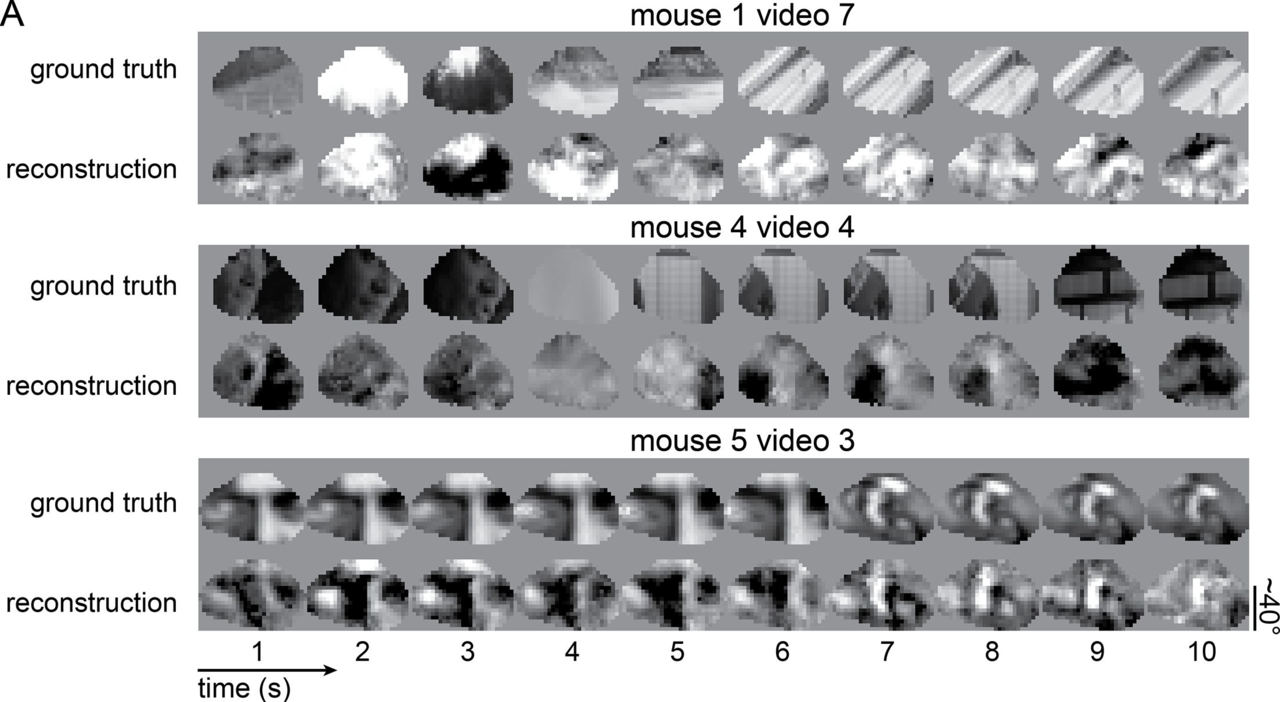
Starting from a blank gray screen, the model adjusted the image pixel by pixel until the neural responses it predicted matched those actually recorded in the brain.
Working backward from the brain's responses to determine what the mouse had seen, the team reconstructed 50 ten-second video clips viewed by five mice.
Correlation of 0.57 with originals — but images remain blurry
A pixel-by-pixel comparison of the reconstructed and original videos yielded a correlation coefficient of 0.57, where a value of 1 indicates a perfect match.
An earlier study that reconstructed still images from mouse brain activity produced a correlation coefficient of 0.24. The research team noted, however, that direct comparisons are difficult because the two studies used different data and evaluation methods.
Existing studies on humans have typically used brain-imaging equipment such as functional MRI, then relied on generative AI to reconstruct what a person saw.
The team said it deliberately avoided generative AI because such models, trained on vast image libraries, risk filling in details that were never actually present in the brain's recording.
"When the brain does not contain a complete image, the reconstruction should fail," the team wrote in the paper. "We must not generate an image when only semantic information is present."

The reconstructed video's clarity still falls well short of a mouse's actual visual acuity, and the team could only reconstruct the portion of the visual field covered by the neurons it had recorded — not the full image the mouse saw.
Even so, the reconstructions came close to capturing motion at a level recognizable to the naked eye. Mice cannot perceive flickering light as a flicker when it blinks faster than 14 times per second, and the reconstructed video captured changes at that temporal resolution.
The team acknowledged that the method cannot be directly applied to humans, as it relied on data from genetically modified mice imaged under a specialized microscope.
Reference
DOI: 10.7554/eLife.105081.3
Joel Bauer, Troy W. Margrie, Claudia Clopath (2026) Movie reconstruction from mouse visual cortex activity. eLife 14:RP105081.
dbsdn1110@heraldcorp.com