Groups urge ruling and opposition parties to resolve constitutional reform deadlock and present a referendum roadmap
Two-track approach — targeting second half of 2027, with 2028 general election as fallback — proposed at Busan forum
Debate on decentralization reform splits between advocates and skeptics
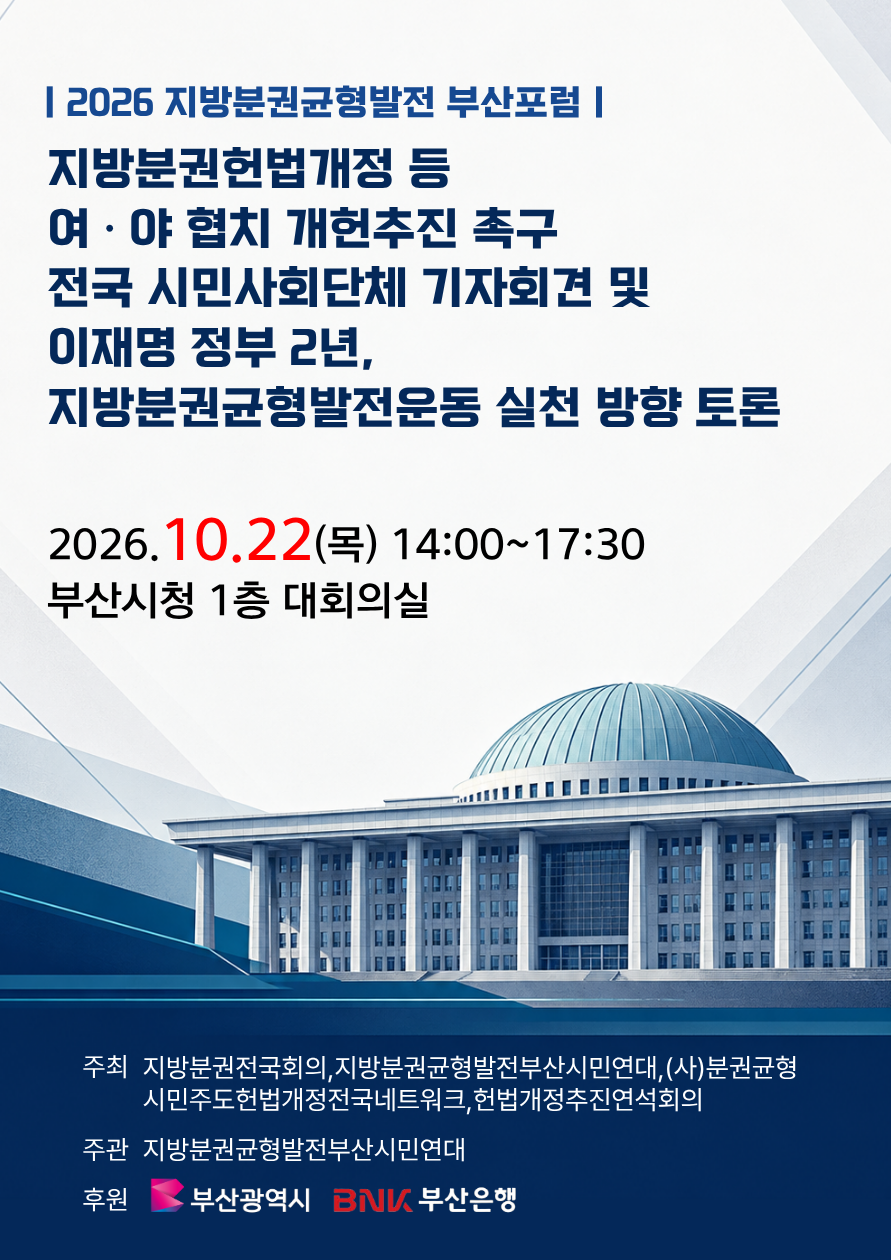
As political controversy over a constitutional amendment to allow presidential re-election shows no sign of abating, civic groups from across the country gathered in Busan to push for a decentralization-focused constitutional reform. They called on the ruling and opposition parties to break the political deadlock through bipartisan cooperation and present a roadmap for a national referendum in the second half of 2027.
Four organizations — the National Council for Decentralization, the Busan Citizens' Solidarity for Decentralization and Balanced Development, the National Network for Citizen-Led Constitutional Reform on Decentralization and Balanced Development, and the Constitutional Amendment Promotion Liaison Council — held a joint press conference Thursday afternoon at the main conference hall of Busan City Hall.
In a statement read by National Council for Decentralization co-executive chairs Shin Dae-woon and Baek Jong-rak, the groups argued that "the constitutional framework established in 1987 was a historic achievement of democratization, but it has failed to respond to nearly 40 years of social change — including a centralized power structure, the concentration of resources in the Greater Seoul area, the threat of regional depopulation, and deepening inequality." They called for a fundamental overhaul of a system in which the central government monopolizes authority and fiscal resources while local governments remain dependent on central directives and subsidies.
The civic groups demanded that constitutional reform not be "consumed as political rhetoric or an election campaign pledge" but instead be backed by a responsible action plan presented to the public. They called on the National Assembly to swiftly form a special committee on constitutional amendment, with the second half of 2027 as the primary target for a national referendum, and to pursue the effort jointly with the government. They also stressed that even where disagreements exist over restructuring the power system or reforming the electoral system, areas of potential consensus — such as decentralization and balanced regional development — must not be allowed to collapse.
At a subsequent forum titled "Two Years of the Lee Jae Myung Administration: Directions for the Decentralization and Balanced Development Movement," Park Jae-yul, standing co-chair of the National Council for Decentralization, said the government had designated constitutional reform as its top national policy priority. He proposed a two-track approach: targeting a national referendum in the second half of 2027 as the primary goal, with simultaneous implementation during the April 2028 general election as a fallback. Park identified the political dynamic — in which the ruling party pushes for reform while the opposition resists — as the biggest obstacle.
Lee Ki-woo, an emeritus professor at Inha University, pointed to the winner-takes-all power structure as the core reason constitutional reform is needed, and proposed holding a referendum separate from elections, issue-by-issue voting, the introduction of a regionally representative upper house, and a citizen-initiated referendum system. Jeong Du-hwan, co-chair of the Citizens' Action for Constitutional Amendment, called for a digital public deliberation platform featuring neighborhood and interest-based message boards along with audio and video discussion tools. Jeong Jeong-hwa, a preparatory committee member for a signature campaign, announced a goal of collecting 1 million signatures by September 2027 and plans to launch a signature campaign headquarters in November.
The forum saw a split between advocates for swift reform and those urging caution. Jang Jun-dong, standing chair of the Busan Decentralization Innovation Movement Headquarters, called for enshrining residents' right to self-governance as a new fundamental right and reviving a citizen-initiated constitutional amendment process. Choi Min-ho, planning committee chair of the Daegu and North Gyeongsang Province Decentralization Movement, called for the redistribution of national and local taxes to be written into the constitution. Lee Chang-yong proposed expanding the 1 million signature drive into a broader "residents' deliberation movement."
On the cautious side, Park Chung-hoon, a senior research fellow at the Busan Research Institute, argued that efforts to expand local autonomy at the statutory level should come first, and warned that issue-by-issue voting could undermine the internal consistency of the constitutional framework. Park Jae-wook, an emeritus professor at Silla University, said 1 million signatures would not necessarily represent the will of the entire public, while co-executive chair Shin noted that the requirement of approval by two-thirds of all National Assembly members remained a practical constraint.
No Min-ho, a policy committee member of the preparatory committee for the Gyeonggi Province Decentralization Solidarity, cited the failure of a constitutional amendment bill jointly proposed in May by the Assembly speaker and six political parties — which fell short of the required quorum — as evidence of the limits of a politics-driven approach to reform. Hwang Yeong-sik, co-chair of the Busan Transparent Society Practice Public-Private Network, proposed that integrity and anti-corruption measures be adopted as the first consensus agenda item that both the ruling and opposition parties could pursue together.
kaf2002@heraldcorp.com