135 tonnes of kiwi waste unaccounted for in records, representing 24.2% of total disposal
Agriculture Minister Song Mi-ryung pledges drone localization push as sector fleet tops 500 units
Lawmakers call for dedicated animal abuse investigation unit; minister cites need for local government talks
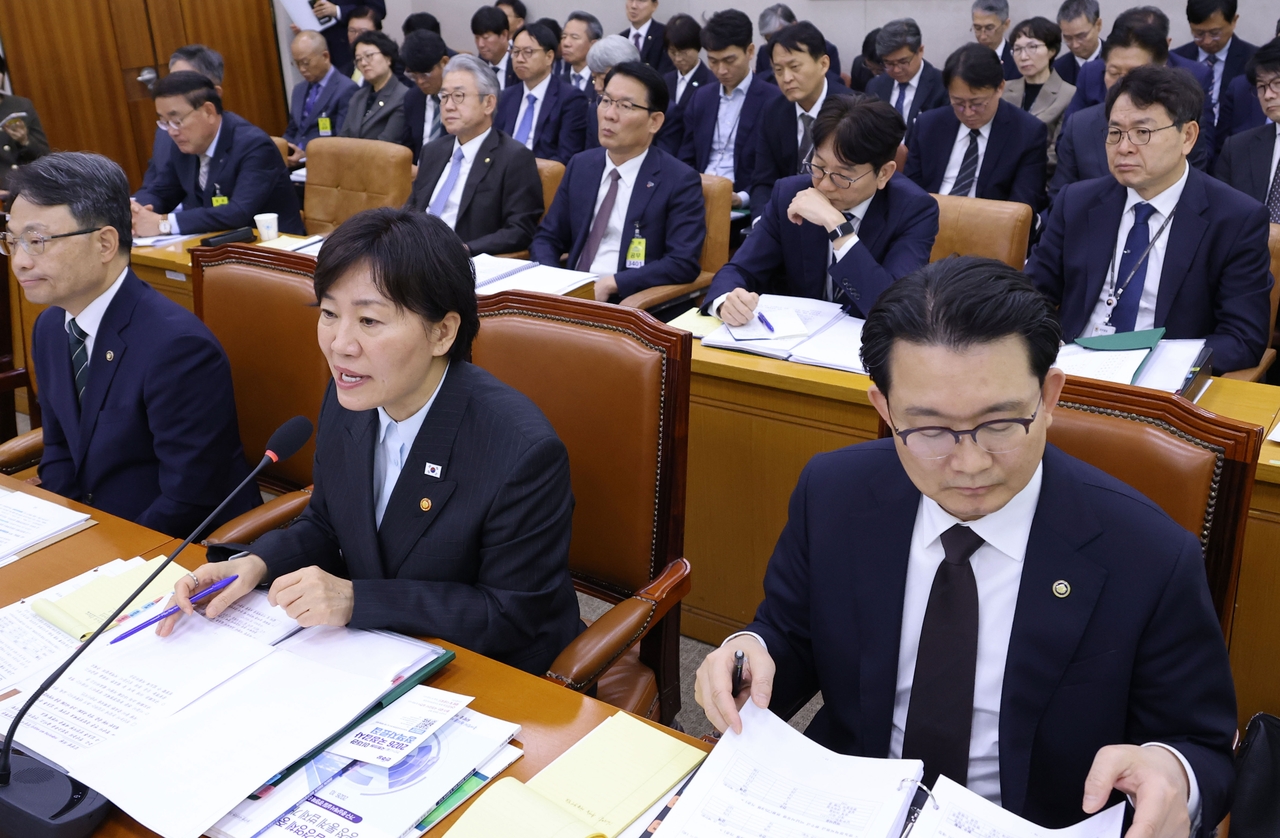
A comprehensive national audit of the Ministry of Agriculture, Food and Rural Affairs on Thursday surfaced a string of contentious issues — including allegations of improper disposal and market distribution of Jeju-grown kiwi waste, security concerns over Chinese-made drones, and calls for a dedicated animal abuse investigation unit. The government pledged to verify the facts on the waste disposal allegations and to expand the localization of drones used in the agricultural sector, while expressing broad agreement on the need for professional training and deployment standards for animal protection officers.
The National Assembly's Agriculture, Food, Rural Affairs, Oceans and Fisheries Committee held the comprehensive national audit of the ministry and its affiliated agencies. Lawmakers also pressed the ministry on agricultural distribution structures, a planned overhaul of agricultural statistics, agri-solar energy projects and a full survey of farmland.
Democratic Party of Korea lawmaker Moon Dae-rim raised allegations that KKMC Agricultural Corporation, which sorts and packages Jeju-grown kiwis, had distributed substandard kiwis through intermediaries and improperly handled waste — including kiwis that farmers had been told were destroyed.
Moon compared data submitted by the Korea Environment Corporation with handwritten transaction slips from the company's waste management system and found that the slips recorded 558.36 tonnes of waste processed between last October and the end of February this year. Of that total, 135.01 tonnes — about 24.2 percent — could not be confirmed in the Korea Environment Corporation's weighing records. The GPS systems on waste transport vehicles were not registered, and on some removal dates, system errors made it difficult to verify weighing records and entry footage. A follow-up on-site inspection, however, confirmed that the weighing facilities and closed-circuit television cameras were operating normally.
The company received 8.3 billion won ($6.26 million) in government policy funds over the past five years through interest subsidy and loan programs. Its largest investor was identified as Jeong Woon-cheon, a former minister of food, agriculture, forestry and fisheries under the Lee Myung-bak administration.
"Given that a former agriculture minister is an investor and that the company received government policy funds, the ministry must investigate the facts strictly and transparently," Moon said. Agriculture Minister Song Mi-ryung said she would verify the facts and take immediate action.
Security concerns over drones used in the agricultural sector also drew scrutiny. People Power Party lawmaker Kim Yong-tae raised concerns about Chinese-made drones and foreign software used in farmland surveys and other operations, urging the ministry to draw up a localization roadmap. Song said a review found that more than 500 drones are currently in use across the agricultural sector and that research and development to promote domestic production would begin this year. "We will push in the direction of expanding localization," she said.
The ministry will also join government-wide drone policy discussions. Song said the government had convened a meeting chaired by the prime minister last June to discuss a national drone development strategy and establish a related plan, but the agriculture ministry had been left out. "We will join soon and work to carry out the intent of that strategy at a pan-government level," she said.
Kim had earlier raised security concerns about Chinese-made drones and Russian software at a previous ministry audit session. Song said no data leaks had been confirmed but that she had ordered a temporary halt to aerial photography using Chinese-made drones as a precautionary measure.
Lawmakers also called for a dedicated investigative unit to handle animal abuse crimes. Democratic Party lawmaker Song Ok-ju said the current animal protection officer system was falling short due to staffing shortages and a lack of expertise, and proposed establishing a dedicated animal abuse investigation unit — dubbed "Animal Police" — at the metropolitan and provincial level. Animal protection officers hold the status of special judicial police and can investigate animal abuse crimes, but their deployment is left to the discretion of individual local governments, and many also handle other administrative duties. Specialized investigative training is not mandatory.
Song Ok-ju urged amendments to the Animal Protection Act to mandate the deployment of animal protection officers, require professional training, establish a cooperative framework with police and prosecutors, and provide a legal basis for national government funding. Minister Song said she strongly agreed, adding that professional training for animal protection officers was necessary and that deployment standards reflecting regional conditions needed to be established. On the creation of a dedicated unit, she said consultations with local governments would be required and pledged to work actively with them to achieve real institutional reform.
The policy results of the online wholesale market for agricultural products also came under scrutiny. Democratic Party lawmaker Moon Geum-ju said that while transaction volume on the platform had surpassed 1 trillion won, it remained to be seen whether that had translated into higher farm incomes. She questioned whether the original policy goal of improving the distribution structure was being met, given the focus on expanding transaction volume, and called for a review of the basis and actual effect of the government's claim that distribution costs had fallen 10.1 percent.
Democratic Party lawmaker Im Mi-ae raised concerns about the reliability of agricultural statistics. She said the government was pursuing farm management entity-centered agricultural policy while its statistics and performance indicators remained anchored to the household unit. Citing figures showing that agricultural income accounted for just 21 percent of farm household income in 2025 while transfer income reached 36 percent, she said farm household income alone was an inadequate measure of agricultural management performance and urged a restructuring of the statistical system around farm management entities.
Democratic Party lawmaker Ju Cheol-hyeon said a draft enforcement decree on agri-solar energy projects could unduly restrict the participation of agricultural corporations, with eligible project areas concentrated in certain regions in ways that could effectively shut out corporations elsewhere in the country. Minister Song said she would review expanding the scope of eligible activities for agricultural corporations and consult with local governments.
Ruling and opposition party lawmakers clashed over the full farmland survey. People Power Party lawmaker Lee Seong-gwon criticized the survey as rushed, pointing to discrepancies in the target area, which shifted from 1.15 million hectares to 1.36 million hectares. Fellow PPP lawmaker Lee Yang-su said the survey had not adequately accounted for the realities of rural communities, including elderly farmers, inherited farmland and customary lease arrangements. Minister Song said updating farmland registry information was necessary and pledged to "separate out and correct farmland law violations that are speculative in nature, while addressing the gap between reality and the law."
Democratic Party lawmaker Lee Jae-gwan urged the government to draft special legislation to bring customary, non-speculative farmland lease arrangements into legal compliance. Minister Song said she would pursue related institutional reforms by the end of the year.
People Power Party lawmaker Lee Sang-hwi said the ministry's false information reporting center should not treat policy criticism as misinformation. Minister Song, responding to criticism of the farmland survey by the National Assembly Research Service, said, "I do not view things like that as fake news at all."
Democratic Party lawmaker Yun Jun-byeong raised questions about the screening process for rehiring retired executives of the National Agricultural Cooperative Federation and the submission of a breakdown of advertising expenditures by media outlet. Federation Chairman Kang Ho-dong said he had not been briefed on the specific details of the employment screening process. Committee Chairman Seo Sam-seok said the matter would be reviewed according to proper procedures.
adastra@heraldcorp.com