City maps 3 residential zones reflecting population, industry and environment
Urban regeneration to be tailored to each district's characteristics
Ulsan has established its "2035 Ulsan Metropolitan City Urban Regeneration Strategy Plan," laying out a new direction for urban regeneration that reflects changing conditions and the evolving policy environment.
The plan was drawn up under Article 12 of the Special Act on Promotion of and Support for Urban Regeneration, with a focus on strengthening the continuity of urban regeneration projects and enabling flexible responses to shifts in government policy.
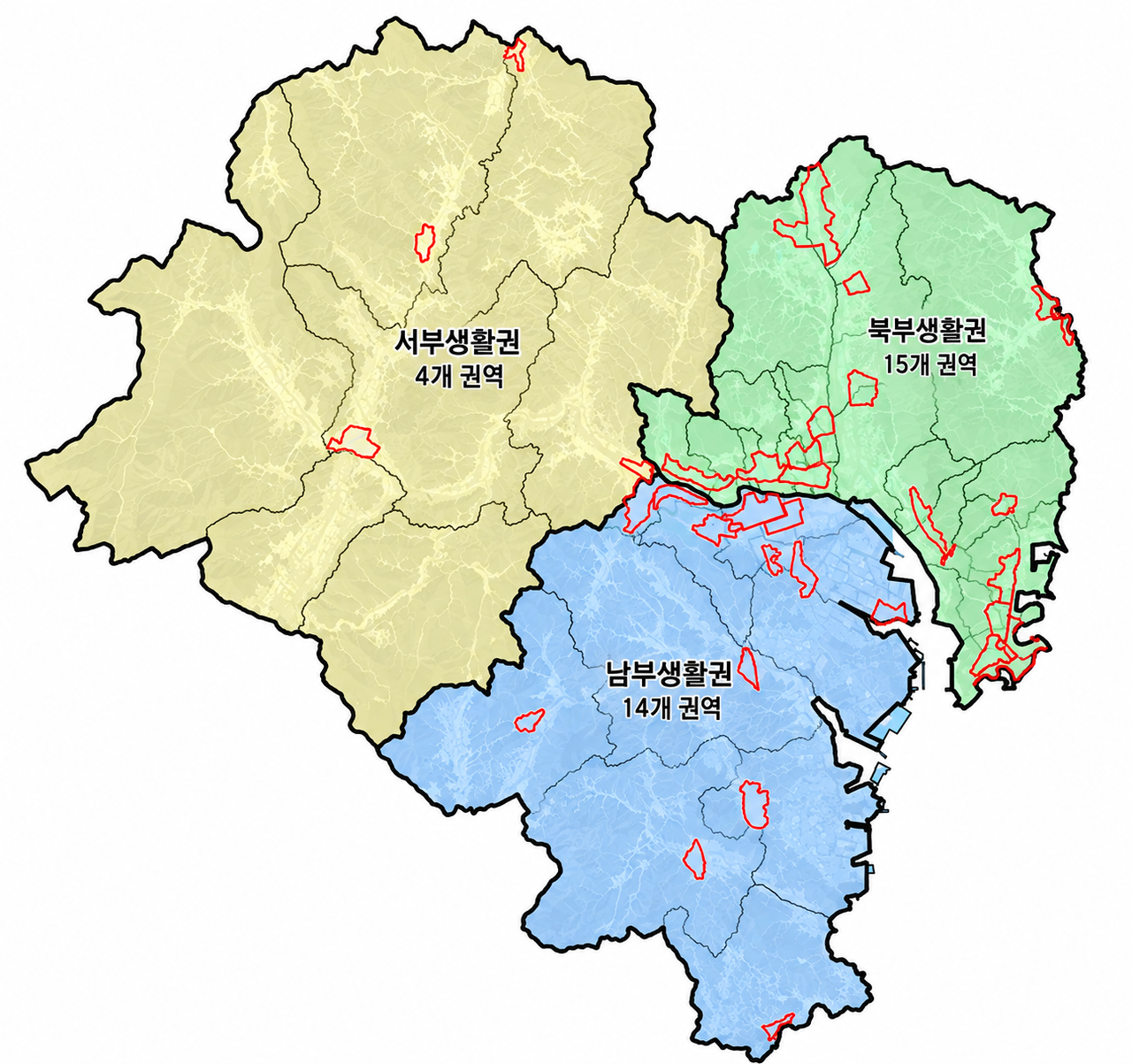
Based on a comprehensive analysis of Ulsan's population and social trends, industrial and economic conditions, and physical environment — as well as a diagnosis of urban decline — the plan envisions three residential zones, 33 urban regeneration districts and 71 urban regeneration activation areas.
The three residential zones are defined as follows: the Northern Zone, covering 15 districts across Jung-gu, Dong-gu and Buk-gu, aims to build a commercial and cultural foundation that makes the area a place people want to stay; the Southern Zone, covering 14 districts across Nam-gu and parts of Ulju-gun, focuses on supporting industrial growth and creating a balanced residential base; and the Western Zone, covering four districts in parts of Ulju-gun, specializes in developing a livable, nature-centered local environment.
Alongside this, 71 urban regeneration activation areas were designated through a comprehensive review of local conditions, current circumstances and decline analysis. The total area spans 9,051,052.3 square meters.
By district, the activation areas break down as follows: Jung-gu with 17 sites, Nam-gu with 17, Dong-gu with 12, Buk-gu with 14 and Ulju-gun with 11. Of the areas designated under the previous 2025 strategy plan, 24 were retained, 29 were modified, 18 were newly added and 16 were removed.
The full details of the strategy plan are available for public review through Nov. 20 at Ulsan's Urban Landscape Division and the urban regeneration departments of each district and county office.
"The 2035 Ulsan Urban Regeneration Strategy Plan redefines the direction of urban regeneration to reflect changes in Ulsan's local conditions and policy environment," a city official said. "We will pursue sustainable urban regeneration in connection with open calls from the Ministry of Land, Infrastructure and Transport."
cityblue@heraldcorp.com