Government and Korea Land and Housing Corporation to discuss target areas and housing volumes; LH chief proposes raising average ratio to 250 percent
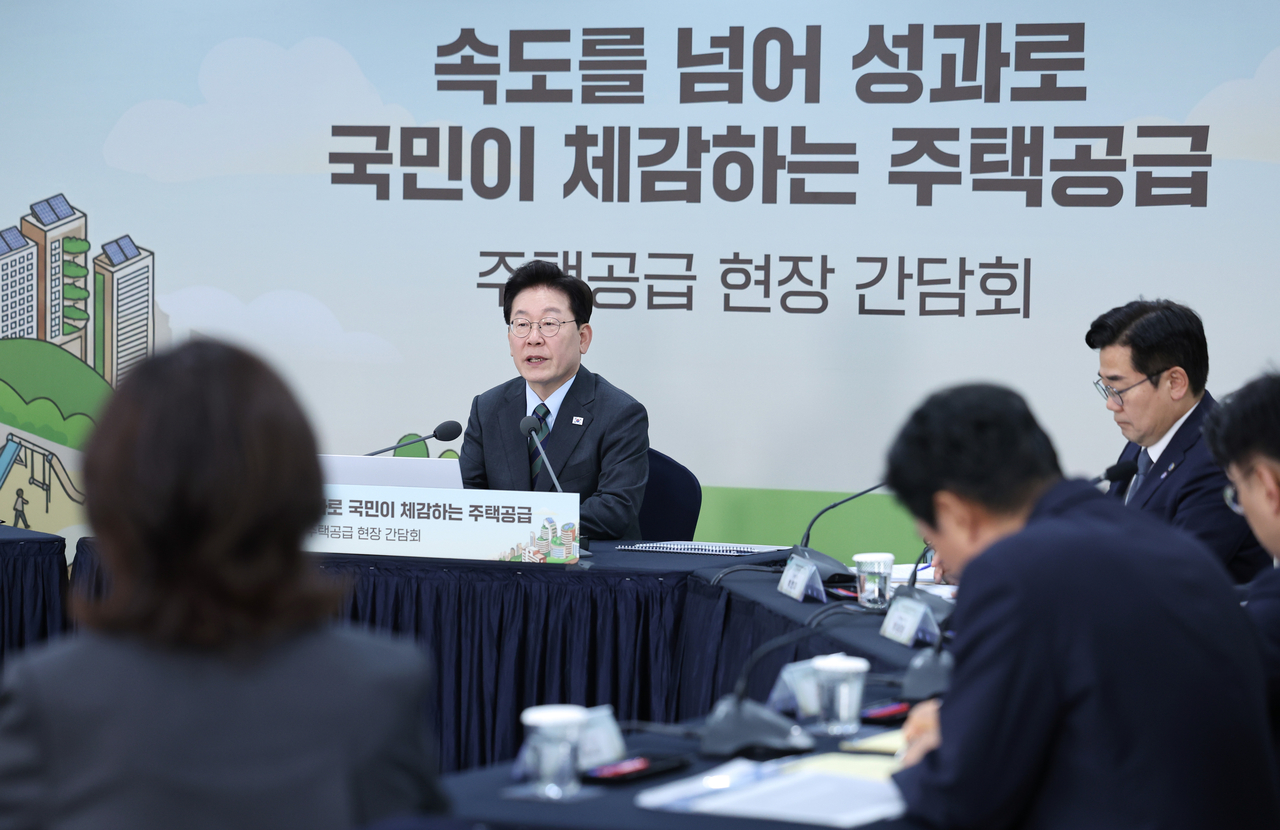
The government is actively reviewing plans to raise floor-area ratios at the later-stage third-generation new towns — starting with Gwangmyeong-Siheung — to accelerate housing supply in the Greater Seoul area.
According to officials, Korea Land and Housing Corporation President Lee Seong-hun briefed President Lee Jae Myung on Wednesday at the Incheon Gyeyang district, one of the third-generation new town sites, on a proposal to raise the average floor-area ratio across the third-generation new towns to at least 250 percent.
"The current average floor-area ratio for the third-generation new towns stands at around 206 percent," Lee said. "We plan to expand it significantly to 250 percent or more, and will also incorporate additional land adjacent to the new towns to increase the housing supply."
High-density development through higher floor-area ratios at the third-generation new towns has been discussed as a supply-expansion idea since the government unveiled its Aug. 13 and Sept. 7 real estate and housing supply packages.
When it announced the Sept. 7 measures, the Ministry of Land, Infrastructure and Transport said it would add 121,000 more homes on public land in the Greater Seoul area by 2030 through more efficient use of public housing sites.
"Optimizing public housing sites encompasses not only raising floor-area ratios but also converting non-residential land to residential use and consolidating parcels," a ministry official said.
Academics have consistently argued that securing enough land for adequate housing supply in high-demand urban areas is difficult, and that redevelopment and reconstruction projects take years before units actually reach the market — making it faster to work with the third-generation new towns already underway.
Because some third-generation new town districts are in their final stages — Incheon Gyeyang is set to welcome its first residents by year-end — or have already broken ground, the later-stage sites are seen as better candidates for a floor-area ratio increase. These include Gwangmyeong-Siheung in Gyeonggi Province (67,000 units), Uiwang-Gunpo-Ansan (41,500 units) and Hwaseong Jinan (34,000 units).
Gwangmyeong-Siheung, the largest of the third-generation new towns, completed its appraisals for land compensation in the first half of this year and began the compensation process in July. Uiwang-Gunpo-Ansan and Hwaseong Jinan are also at the stage where compensation procedures must be carried out.
The government plans to consult with Korea Land and Housing Corporation on target areas and housing volumes. "It is difficult to arrive at specific figures for the floor-area ratio increase, as a number of preconditions must be met — including school capacity, water and sewage reviews, and the ratio of pre-sale to rental units," a Ministry of Land, Infrastructure and Transport official said.
hss@heraldcorp.com