- KRISO completes first domestic sea trial of dynamic positioning system that keeps vessels on station through wind, waves and currents
- Technology expected to reduce reliance on foreign suppliers and support offshore wind, survey ships and unmanned vessels
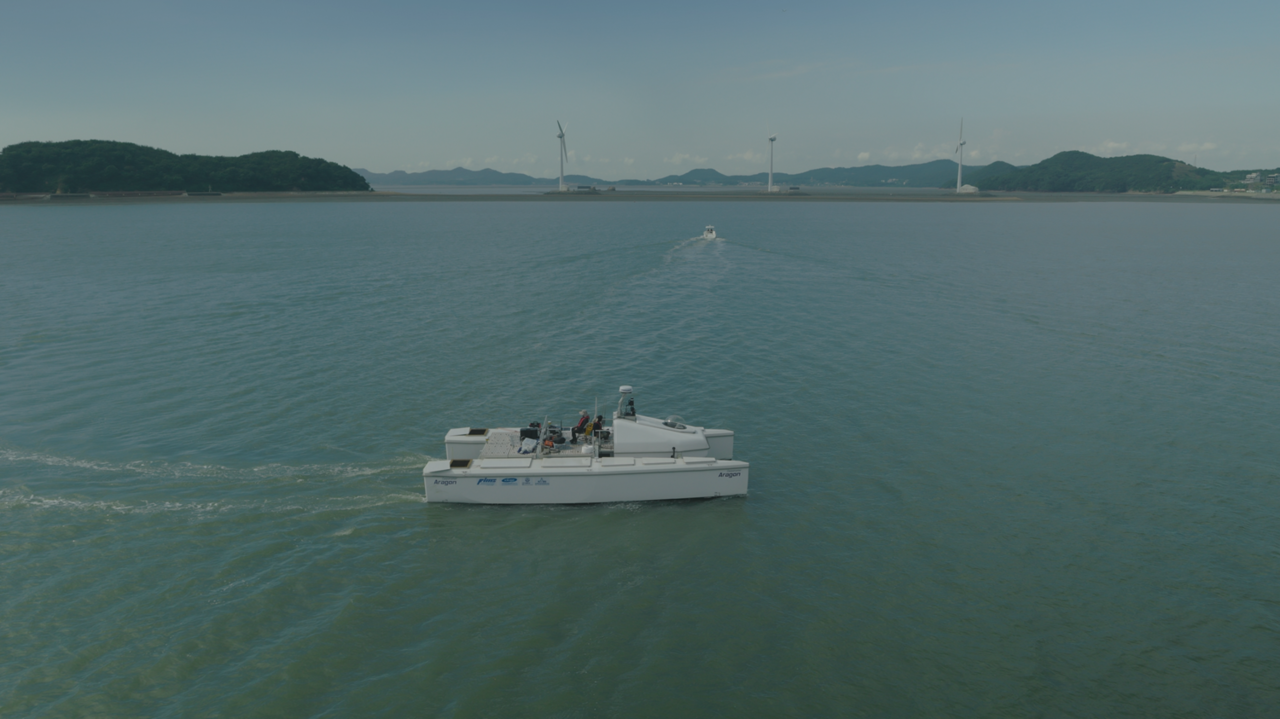
A domestically developed technology that automatically keeps a vessel on a fixed position despite waves, wind and ocean currents has completed performance verification at sea. The achievement marks a step toward localizing dynamic positioning technology, a field where South Korean operators have long depended heavily on foreign suppliers.
The Korea Research Institute of Ships and Ocean Engineering, known as KRISO, announced Thursday that it had conducted the country's first open-sea demonstration of a dynamic positioning, or DP, system it developed in-house, fitting the technology to an actual vessel.
DP technology automatically controls a ship's thrusters to maintain a set position and heading when wind, waves or currents push the vessel off course.
It is used on vessels that require precise station-keeping — including ocean survey ships, offshore wind turbine installation and maintenance vessels, and drilling ships. The technology is considered essential for a wide range of maritime operations because it allows a ship to hold position without dropping anchor.
South Korea's DP sector currently relies heavily on products and technology from foreign specialist firms.
KRISO researchers have developed a homegrown DP system that integrates the control algorithms governing vessel movement, thrust allocation technology that distributes the required force among multiple thrusters, sensor data processing, and a real-time control system.
The team first verified the technology's performance by reproducing various sea conditions in tank tests using a scaled-down model vessel. From 2024, researchers installed the in-house DP system aboard the KRISO-owned catamaran Aragon 4-2 to carry out trials in actual sea conditions.
During the demonstration, the team analyzed the vessel's station-keeping performance and control characteristics under combined real-world wind, wave and current conditions. The trials yielded operational data from a full-scale vessel and allowed researchers to refine the control technology.
It was the first time a domestically developed DP system had been applied to an actual vessel and verified through an open-sea demonstration in South Korea.
KRISO has also developed two proprietary evaluation programs — KDPCAP and KDPSIM — capable of precisely assessing DP performance.
KDPCAP analyzes ocean environmental conditions and thruster performance to evaluate the limits within which a vessel can maintain its position. KDPSIM simulates vessel movement and thruster operation under time-varying waves, wind and currents to verify control performance.
The research team plans to incorporate data gathered during the sea trials into the performance evaluation programs and conduct further demonstrations to improve the technology's reliability.
"Through the open-sea demonstration, we confirmed the DP system's performance and control characteristics, and raised the level of technical completeness so that the findings can be reflected more precisely in future vessel design," said Jo Seok-gyu, a principal researcher at KRISO.
"DP is a technology with high application value in future maritime mobility, including unmanned surface vessels," said Jeong Jong-jin, director general of KRISO. "We will continue to proactively develop the core technologies the shipbuilding and ocean industries need, and support their real-world deployment through demonstration."
nbgkoo@heraldcorp.com