British outlet The Observer evaluated 57 cities across 36 countries in its AI Cities Index
Seoul trails only San Francisco and New York, ranks first globally in AI adoption and use
Mayor Oh Se-hoon vows to make Seoul a global AI leader driving innovation in everyday life
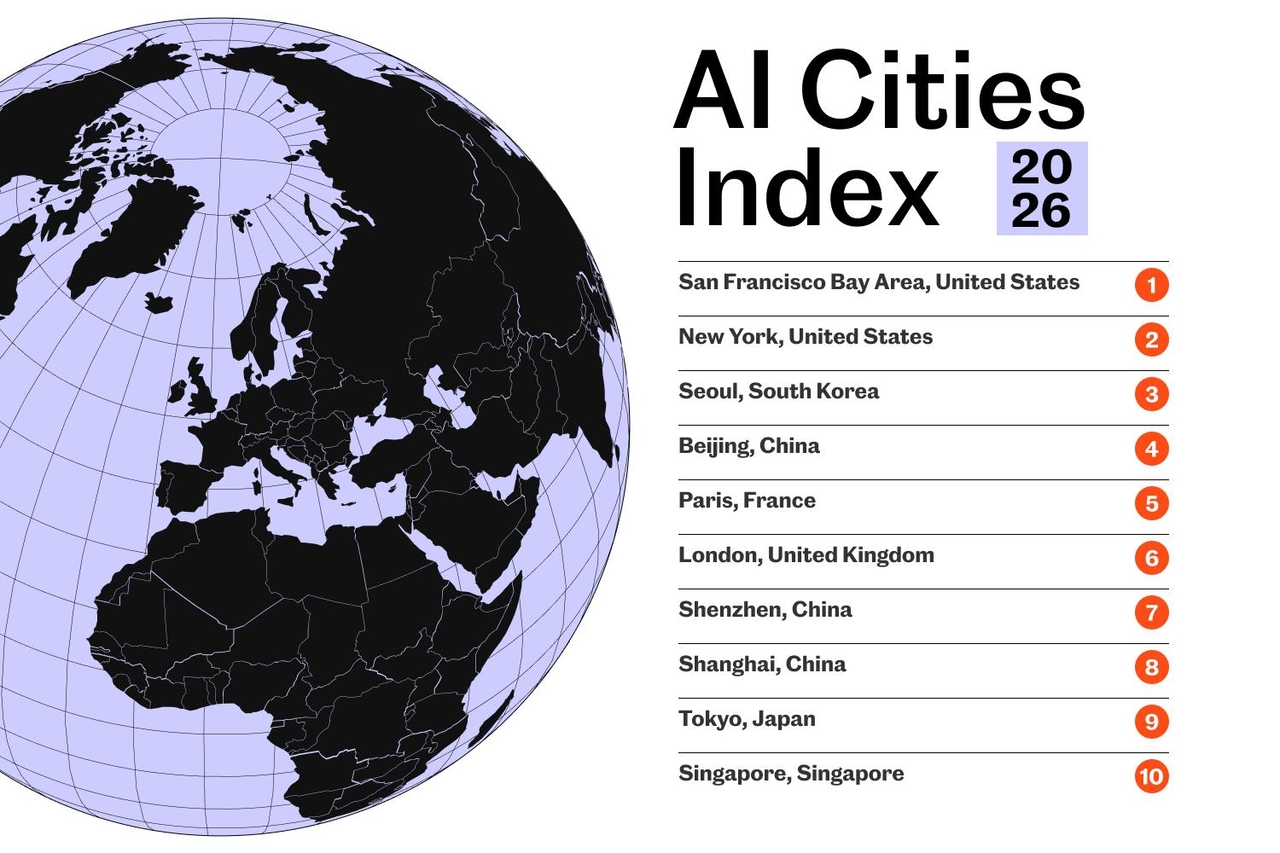
Seoul ranked third overall and first in AI adoption and use in The Observer's 2026 AI Cities Index, the Seoul Metropolitan Government announced Thursday.
The British outlet described Seoul as a standout AI city outside the United States, citing its strong institutional framework for deploying AI across the public sector and its well-developed support systems to help small and medium-sized enterprises adopt the technology.
Founded in 1791, The Observer is the world's oldest Sunday newspaper and one of Britain's most respected publications, with more than 230 years of history.
The 2026 AI Cities Index assessed 57 cities across 36 countries on 50 indicators spanning three categories: investment, innovation, and adoption and use. Seoul placed third overall, behind San Francisco (first) and New York (second), and ahead of Beijing (fourth), Paris (fifth) and London (sixth).
The Observer credited sustained government-led investment in AI research, infrastructure expansion and broader adoption as the foundation of Seoul's AI competitiveness. The city's ability to create environments where AI can be applied across business, public administration, education and local communities was also highlighted as a key strength.
The adoption and use category, in which Seoul ranked first, evaluates the infrastructure, institutional systems and skilled workforce needed to deploy AI across business, government, education and communities. The Observer noted that Seoul and other major Asian cities have built strong institutional foundations for spreading AI throughout the public sector.
For Seoul specifically, the index cited industry-academia partnerships that support small and medium-sized enterprises lacking the resources to independently secure AI talent and infrastructure. The city was also grouped alongside Paris and Abu Dhabi in the UAE as a leading example of a government-driven AI city. National-level investment in semiconductors, data centers and robot components, as well as the metropolitan area's semiconductor industry base, were identified as additional factors underpinning Seoul's AI competitiveness.
The Seoul Metropolitan Government unveiled its vision of becoming a "global AI innovation leader" in February last year and has since pursued talent development, investment expansion and AI transformation across industries. Initiatives include training 10,000 AI professionals annually through its Youth Employment Academy and university partnership programs, and establishing a 500 billion won ($377 million) AI fund.
In January this year, the city announced a "physical AI leader city" vision, opening urban spaces as testing grounds for technology and expanding policy support for companies to apply and scale AI solutions in real-world settings.
Seoul has also broadened AI use in public services. In March this year, the city launched the Seoul AI Committee and established a framework for 61 AI administrative projects involving 17 departments and affiliated agencies. Notable initiatives include an autonomous driving bus service for early-morning commuters and a smart care service that uses AI phone calls and analysis of telecommunications and electricity usage data to check on isolated households and connect them with welfare services.
In disaster and safety management, the city uses AI to predict flooding risks at 15 flood-prone road locations, enabling early detection and rapid on-site response.
The city is also preparing a "Seoul Youth AI Ladder" program to narrow the AI skills gap among young people. The initiative would provide access to generative AI tools along with education and workspace support to strengthen learning, employment and entrepreneurship capabilities, and the city is seeking to include it in next year's main budget.
The Seoul Metropolitan Government has also emphasized creating new jobs suited to the AI era. At a senior staff meeting Wednesday, Seoul Mayor Oh Se-hoon directed officials to dramatically expand the Mid-Career Employment Academy along the lines of the Youth Employment Academy and to actively identify new jobs that fit the AI age.
"We will ensure that the AI competitiveness Seoul has built translates into business growth and a better quality of life for citizens," Oh said. "We will strengthen talent development and corporate support, expand opportunities for all young people to use AI, and build Seoul into a global AI leader city that drives innovation across industry and everyday life."
ikson@heraldcorp.com