New sign-ups fall from 48,000 to 24,000; only 74% of maturing accounts receive full government match
New enrollments in a government savings program designed to help low-income working youth build financial assets have fallen by nearly half in three years. Among the 2023 cohort whose accounts matured this year, only 73.6% received the full government subsidy, and government support payments left unclaimed due to early withdrawals came close to 50 billion won ($37.7 million). Meanwhile, unspent deposits in the asset-building support project totaled 38.7 billion won last year, and as of the end of September this year, another 36 billion won remains unallocated.
According to data submitted to Democratic Party of Korea lawmaker Heo Jong-sik, a member of the National Assembly's Health and Welfare Committee, by the Korea Self-Sufficiency Promotion Agency, new enrollments in the Youth Tomorrow Savings Account program fell from 47,970 in 2023 to 43,484 in 2024 and 29,638 last year — a year-on-year drop of 31.8%. This year's new enrollment figure stands at 24,145, down 49.7% from 2023.
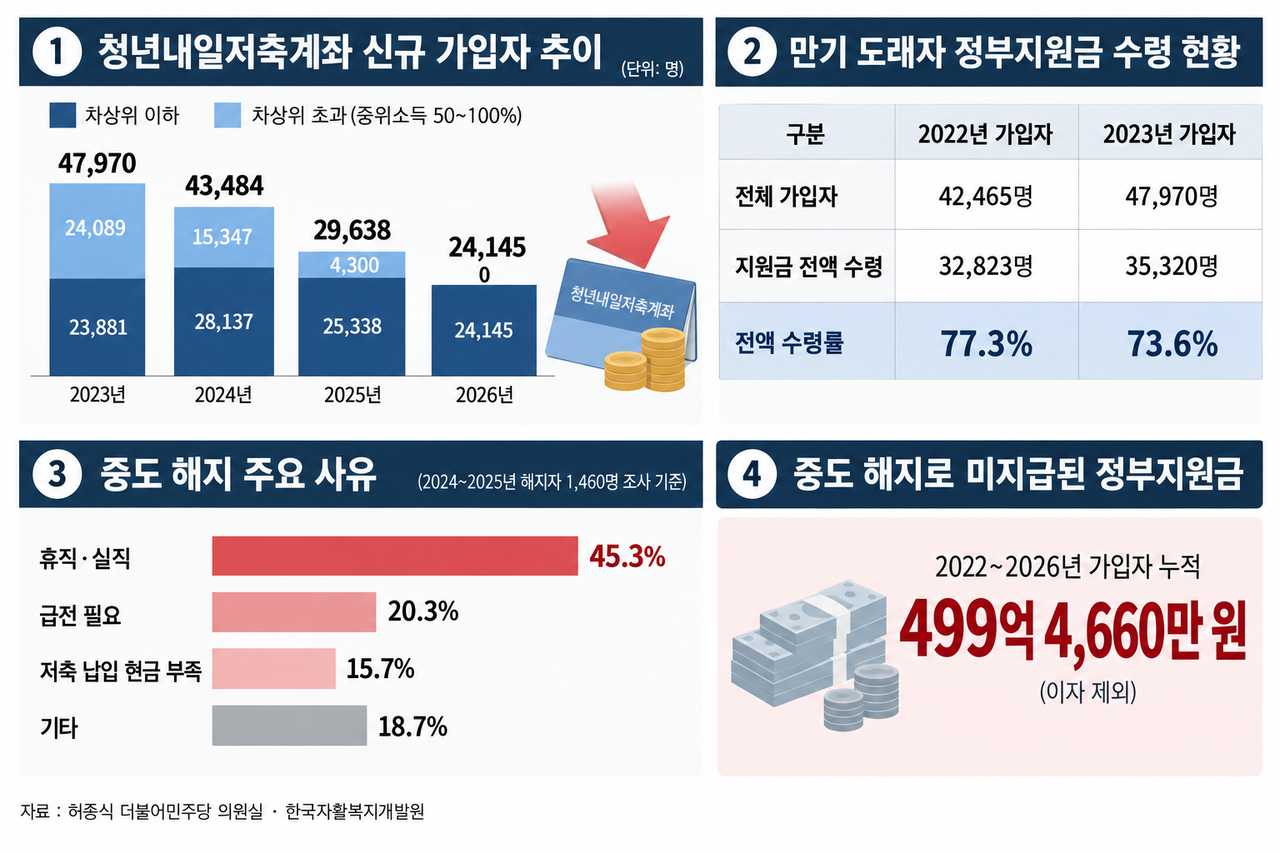
The steepest decline was among youth in households earning between 50 and 100 percent of the median income — those just above the near-poverty threshold. New enrollments in that income bracket plunged 82.1% in two years, from 24,089 in 2023 to 15,347 in 2024 and just 4,300 last year. This year, new recruitment for that group was discontinued entirely, leaving zero enrollees. Even among youth at or below the near-poverty threshold, enrollment fell 9.9%, from 28,137 in 2024 to 25,338 last year.
The agency said that last year it prioritized the most vulnerable groups — those earning 40 percent or less of the median income, as well as grandparent-headed households — within a limited budget. This year, it concentrated support on low-income youth at or below the near-poverty line because the Financial Services Commission's Youth Future Savings program overlaps in its target population.
Under the Youth Tomorrow Savings Account program, low-income working youth who save at least 100,000 won per month receive an additional government contribution of 100,000 to 300,000 won per month. Those who complete the three-year term can receive up to 14.4 million won plus interest.
Only 74% of 2023 enrollees receive full payout; early withdrawals leave 49.95 billion won unclaimed
Many participants failed to keep their accounts open until maturity. Of the 47,970 people who enrolled in 2023 and whose accounts came due this year, only 35,320 — or 73.6% — received the full government subsidy. Another 9,381 withdrew early, and 276 completed the term but collected only their own contributions. The remaining 2,993 have yet to receive any government support and are still holding their accounts; once a six-month grace period expires, those accounts will be closed and the subsidies forfeited.
A similar pattern emerged with the 2022 cohort, the first group to reach maturity: of 42,465 enrollees, only 32,823, or 77.3%, received the full government payout — meaning more than one in five fell short. Across all cohorts from 2022 through 2026, early withdrawals have left a total of 49.95 billion won in government subsidies unpaid, excluding interest.
A survey by the agency found that financial hardship was the primary driver of early withdrawals. Of 25,169 total early closures, 16,020 — or 63.6% — were classified as "voluntary." However, a separate agency survey of 1,460 people who withdrew in 2024 and 2025 found that 45.3% cited job leave or unemployment as the reason. Adding "need for emergency cash" (20.3%) and "insufficient cash to keep saving" (15.7%), fully 81.3% of withdrawals were linked to economic hardship. Nearly half — 48.9%, or 7,838 — of the 16,020 "voluntary" closures occurred within the first year of enrollment.
38.7 billion won unspent last year; 36 billion won still unallocated this year
Support budgets are also going unused. The asset-building support project works by having local governments deposit funds with the agency, which then credits them to participants' accounts. The project — which covers the Youth Tomorrow Savings Account, the Hope Savings Account I and II, and related programs — ended last year with roughly 38.7 billion won in unspent deposits, of which 38 billion won was returned to local governments. This year, as of the end of September, 36 billion won of the 267 billion won in total deposits remains unallocated. The budget for a specialized financial education and counseling service for enrolled youth was also cut 20 percent, from 400 million won last year to 320 million won this year.
"The Youth Tomorrow Savings Account is a ladder that keeps low-income working youth from falling into poverty," Heo said. "The fact that enrollment has dropped by a third in a single year, and that hundreds of billions of won in subsidies are being left over and returned, means the program is not reaching the young people it is meant to serve."
He added that because unemployment and financial hardship lie behind many withdrawals classified as "voluntary," the current structure — which forces people to cash out their accounts at their most vulnerable — must be urgently reformed. He called for a significant expansion of the conditions under which contributions can be paused or deferred when a participant loses a job, particularly for youth cycling through short-term employment. He also said the government should review whether youth above the near-poverty threshold who were dropped from the program have actually transitioned to the Youth Future Savings program. "The budget that goes unspent every year should be actively redirected toward expanding enrollment and preventing early withdrawals," he said.
fact0514@heraldcorp.com