Ministry of Land, Infrastructure and Transport approves regulatory exemptions at 9th Mobility Innovation Committee meeting
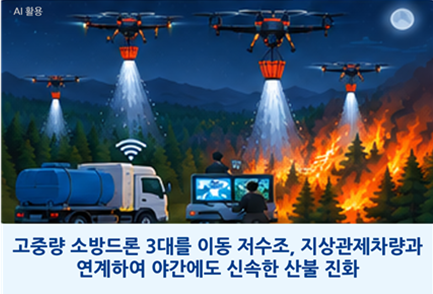
As large-scale wildfires continue to cause mounting casualties and property damage, authorities have cleared the way for drones to be deployed at night — a window during which firefighting efforts had previously been forced to a standstill.
The Ministry of Land, Infrastructure and Transport announced Tuesday that it convened the 9th Mobility Innovation Committee and approved regulatory exemptions covering 13 demonstrations of new technologies and services, including the nighttime drone deployment.
Regulatory exemptions allow new technologies and services restricted under existing law to be tested and verified in advance. Operators granted exemptions receive up to four years of demonstration opportunities, and technologies that prove safe and effective can transition to full commercial service through subsequent legislative revision.
Among the exemptions approved, the use of drones for wildfire suppression stands out. Helicopters are barred from flying at night due to poor visibility, meaning firefighters have frequently missed the critical early window for containing blazes. While drone use has been expanding, operations involving object drops, nighttime flight, beyond-visual-line-of-sight flight and swarm deployment had been permitted only on a limited basis due to safety concerns.
Under the newly approved exemption, nighttime and beyond-visual-line-of-sight wildfire suppression services will be permitted. Drones fitted with water bags will be dispatched to wildfire scenes inaccessible to helicopters at night to slow the spread of fires, and the technology is expected to complement the existing helicopter-centered suppression system.
The approvals also open the door to deploying autonomous mobile flagging robots at highway construction sites, where vehicles travel at high speed. Safety personnel currently enter live lanes directly before protective barriers are installed to perform manual signaling and other accident-prevention measures — a task that carries significant risk. Granting a road traffic law exemption for mobile robots is expected to reduce casualties and replace workers in high-risk roles.
In the traffic safety and eco-friendly transport sector, the approved demonstrations include an adjustable rear underride guard designed to reduce injuries when vehicles slide beneath trucks in rear-end collisions, and a plug-in hydrogen hybrid bus that runs on both a hydrogen fuel cell and a battery simultaneously.
In customized transport services, demonstrations will also begin for a demand-responsive transit bus connecting students and vulnerable residents to essential services, a replacement vehicle rental service for when freight or delivery trucks are involved in accidents, and a shared idle-vehicle platform for apartment complexes.
Park Jun-hyung, director general of the Ministry of Land, Infrastructure and Transport's Mobility and Automobile Bureau, said the exemptions "focused on advanced disaster-response technology and lifestyle-oriented mobility services that people can feel directly." He added that the ministry would "make safety management the top priority throughout the demonstration process and continue working to bring verified technologies into the regulatory framework as quickly as possible."
Meanwhile, the Mobility Innovation Committee was launched in 2022 and is composed of experts drawn from startups and large corporations alike, spanning autonomous driving, urban air mobility, digital logistics and mobility services.
smh@heraldcorp.com