Ministry designates area as public housing district; move-in targeted for 2032
Private construction firms to be brought in to accelerate project
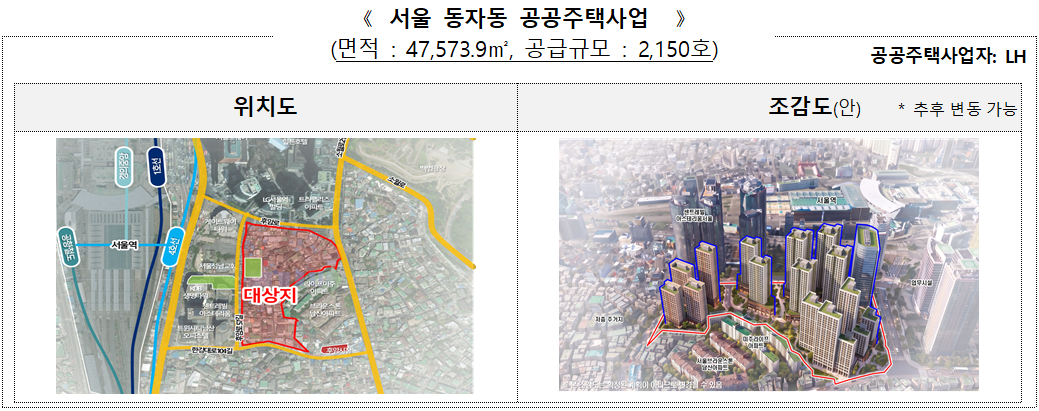
The Dongja-dong "jjokbangchon" (low-income single-room district) near Seoul Station is to be designated a public housing district, with plans to build 1,000 public rental units and 1,150 pre-sale units on the site.
The Ministry of Land, Infrastructure and Transport announced Tuesday it will officially designate and gazette 47,573.9 square meters of the Dongja-dong area as a public housing district, aiming to fundamentally improve the area's poor living conditions and supply quality housing in the city center. Korea Land and Housing Corporation (LH) will serve as the project operator.
The ministry plans to proceed with district planning, compensation and relocation procedures before breaking ground in 2029, targeting completion and move-in of all 2,150 units by 2032.
The Dongja-dong jjokbangchon is densely packed with aging buildings and lacks basic living facilities, making residential improvements an urgent priority. Its prime location adjacent to Seoul Station and surrounded by major business and commercial facilities means the project is also expected to transform the area into a high-density mixed-use district alongside the large-scale housing supply.
Existing residents will receive priority access to public rental housing of at least 21 square meters of exclusive use area per unit, each equipped with cooking facilities, a bathroom and toilet, and heating and cooling systems. During construction, temporary housing will be provided so current residents can maintain stable living arrangements, with support covering the entire process from relocation through resettlement.
The ministry said it revised its "implementation guidelines for privately led public housing construction projects" in September to allow private construction companies to participate as co-operators in public housing projects. It added that it is also pursuing regulatory reforms to expand private-sector involvement and strengthen compensation for landowners and other property holders.
To protect the property rights of existing residents, the ministry plans to allow households holding a single in-kind compensation pre-sale right to benefit from the long-term residency special deduction and similar provisions when transferring that right. Under the plan, the portion of the transfer value up to 1.2 billion won ($894,000) would be exempt from tax, while any amount above that threshold would receive a preferential rate of up to 80 percent. In-kind compensation status would also be transferable once to a buyer who is a non-homeowner, when the number of eligible in-kind compensation recipients does not increase, or when the buyer has acquired ownership from an existing resident.
In addition, a profit-sharing housing option is set to be introduced in November, allowing residents who lack the financial capacity to pay their share of project costs to receive in-kind compensation in that form. Under the plan, landowners and other property holders could negotiate with the project operator to receive units at 50 to 80 percent of the standard in-kind compensation pre-sale price.
Lee Jae-pyeong, the ministry's director general for housing supply policy, said pushing ahead with follow-up procedures without delay is critical now that the district designation has moved the Dongja-dong project into a concrete implementation phase. "We will support the stable resettlement of jjokbang residents, fully incorporate the views of the residents' consultative body, and work in close cooperation with relevant agencies," he said.
Meanwhile, the government this year amended related laws to expand public housing supply, including abolishing the cap on adjusting the public housing ratio within public housing districts and expanding the size threshold under which district planning can be approved simultaneously with district designation — from 1 million square meters to 3.3 million square meters, a 3.3-fold increase.
smh@heraldcorp.com