Ministry of Climate, Environment and Energy and deregulation panel unveil water industry reform plan; AI water treatment operating standards and ISO certification to be pursued
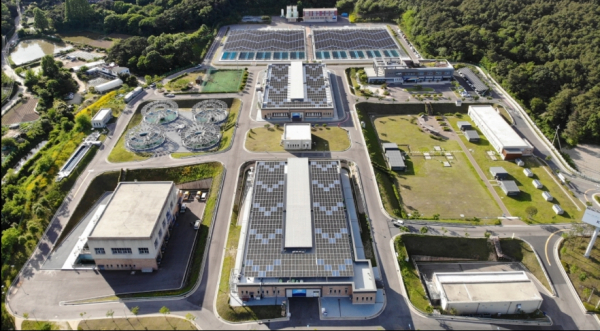
The government plans to establish operating standards and international ISO certification for AI-powered water treatment plants, while revising regulations to allow sewage to be used as a source of water thermal energy.
The Ministry of Climate, Environment and Energy and the Regulatory Rationalization Committee announced Monday they had drawn up a plan to strengthen the competitiveness of South Korea's water industry, titled "Regulatory Rationalization Measures for the Water Industry to Match Competitor-Country Standards."
Under the plan, the government will introduce new legal provisions governing AI water treatment plant operations and pursue universal design, construction and operating standards, AI certification and evaluation frameworks, and an international ISO standard for AI-based water management. Currently, no universal design standards, performance verification procedures or operating guidelines exist for such facilities.
The plan also calls for diversifying water thermal energy sources and expanding solar installations within water source protection zones to promote the use of untapped water-based energy.
Under current enforcement decrees of the renewable energy law, water thermal energy is limited to surface seawater and river water. The government intends to broaden that definition to include sewage and discharged groundwater, enabling a wider range of water thermal sources.
Solar installations are currently permitted only on building rooftops, urban and county planning facility sites, and residential lots. To expand solar capacity within water source protection zones, the government will lift site restrictions on land-based installations when they are operated by agricultural or livestock cooperatives, or resident cooperatives within protection zones, and contribute to local income. Floating solar installations on water surfaces will be permitted when local residents participate in the project under the supervision of water surface managers — including local governments, Korea Water Resources Corporation, Korea Hydro and Nuclear Power, and Korea Rural Community Corporation.
The government will also introduce legal provisions allowing the sale, lease and consignment management of facilities around dams, opening eco-friendly business operations in dam areas to private operators. Previously, such businesses could only be run directly by dam management authorities and their designated trustees, such as local governments and Korea Water Resources Corporation.
The scope of renewable energy support projects eligible for watershed fund financing will also be expanded.
The watershed fund's special support program for regulated areas has lacked explicit provisions for renewable energy projects, limiting efforts to promote deployment in those areas. Under the revised plan, the watershed committee will be able to allocate funding — up to 30 percent of the annual resident support budget — to expand the scale of special support projects.
thlee@heraldcorp.com