
AI sector uncertainty weighs on investor sentiment
Analysts see 5,000 as strong floor backed by PBR of 1x
Late October, November events may spark rebound
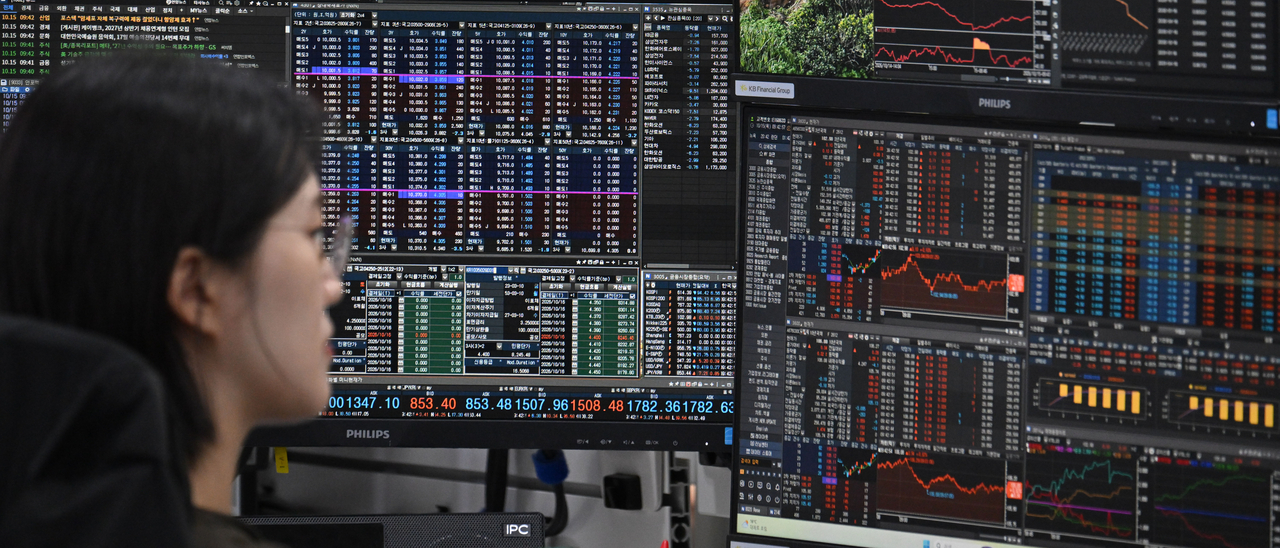
The Kospi has tumbled for several consecutive sessions as uncertainty surrounding the AI industry collides with heavy selling by foreign investors, spreading fear across the broader market. Analysts are advising investors to treat the selloff as a buying opportunity, arguing the index is approaching a short-term bottom — and that the 5,000 level could serve as a powerful floor against further declines.
According to Korea Exchange, the Kospi plunged roughly 21 percent over seven trading sessions from Oct. 6 through Thursday, with foreign investors driving the bulk of the decline. Foreign investors net sold approximately 18 trillion won ($13 billion) worth of Kospi-listed shares in just the first half of this month — a daily average that rivals the pace seen during the Iran crisis last March.
The selloff reflects a confluence of uncertainties hanging over the AI sector. Controversy over OpenAI's sales falling short of market expectations, followed by a string of AI companies postponing or scrapping their initial public offerings, has deepened doubts about the industry's profitability. Compounding the pressure are concerns about potential regulation stemming from a rise in AI-enabled cyberattacks, as well as fears of intensifying competition after Chinese chipmaker CXMT announced advances in next-generation DRAM technology.
A sharp drop in the share price of AI infrastructure firm CoreWeave has also weighed on sentiment. The yield on CoreWeave's corporate bonds maturing in 2032 surged to 15 percent, stoking concerns about the sustainability of a debt-heavy AI infrastructure investment model.
Despite the gloom, analysts at brokerages are beginning to question whether markets have overshot in pricing in uncertainty, given how rapidly the negative catalysts have piled up.
"Because multiple AI sector headwinds emerged simultaneously and drove a sharp drop in share prices, there is a good chance that near-term concerns are already substantially priced in," said Byeon Jun-ho, a researcher at IBK Securities.
The sheer rarity of the current decline also bolsters the case for a technical rebound. Since 2010, the Kospi has fallen for seven consecutive trading sessions on only 11 occasions. In those instances, the index averaged a gain of 0.9 percent over the five trading days following the end of the decline, and 3.7 percent over the subsequent 20 trading days.
The scale of the current drop — far exceeding past episodes — adds further weight to the rebound argument. Previous seven-session losing streaks typically involved declines of around 5 percent; this time the index has fallen 21 percent, approaching the 26 percent plunge recorded during the COVID-19 pandemic in March 2020.
"With the Kospi down 21 percent over seven trading sessions, price and valuation appeal is likely to overshadow the underlying news flow," Byeon said. "The probability of a short-term rebound over the next month appears increasingly high."
Analysts have identified the 5,000 level as a key support line. On a price-to-book ratio basis — which measures how much a stock trades above the net asset value of the underlying company — the Kospi has entered deeply undervalued territory.
According to IBK Securities, the Kospi's 12-month forward price-to-earnings ratio has fallen to 4.2 times, while its price-to-book ratio has dropped to 1.08 times. A PBR of exactly 1.0 times corresponds to roughly the 5,000 level on the index. Given that South Korean companies continue to benefit from strong export conditions and that growth forecasts are being revised upward, analysts consider it unlikely that the PBR will fall below 1.0 times.
Technical indicators also suggest the index is nearing a bottom. The Kospi's 20-day and 60-day disparity ratios — which measure how far the current index level has strayed from its moving averages — have recently fallen to around 83. The lower the reading, the further the index has dropped below its moving average.
The 20-day disparity ratio typically moves within a range of 80 to 120. Given that it fell to 76 during the COVID-19 pandemic and to around 80 during last summer's market rout, analysts say there is limited room for further downside.
"In valuation terms, the Kospi is likely to form a bottom in the mid-5,000-point range," Byeon said. "The 5,000-point level represents a powerful support zone where the PBR of 1x and the floor of the 60-day disparity ratio converge."
A series of major events scheduled from late this month through early next month could also provide a catalyst for a rebound. While the latest US inflation data for September came in above market expectations — fueling concerns about a Federal Reserve rate hike — analysts argue the market has already priced in much of that risk.
The probability of a rate hike at the Oct. 28 Federal Open Market Committee meeting briefly climbed to around 50 percent before retreating to roughly 30 percent. Byeon said he expects monetary policy uncertainty to ease around the time of the FOMC meeting.
The upcoming US midterm elections are another variable to watch. South Korean stocks have historically tended to rebound after the elections following a period of caution in the run-up. The Kospi rose in November in all six years that US midterm elections were held since 2000.
While foreign selling may continue, analysts expect the selling pressure to ease as the Kospi approaches the mid-5,000 range.
"As the index approaches a technically and valuationally strong support zone, selling intensity is expected to diminish from around the mid-5,000-point level," Byeon said. "The current short-term plunge into the mid-5,000s — driven by a combination of AI concerns and inflation fears — should be used as a buying opportunity targeting a November rebound."
th5@heraldcorp.com




