
7 consecutive sessions of losses — longest losing streak in about 2 years
Kospi closes at 5,554, lowest since April
Samsung Electronics, SK hynix drop 9–11%
Foreign investors net sell 3.6 trillion won; circuit breakers triggered on both markets
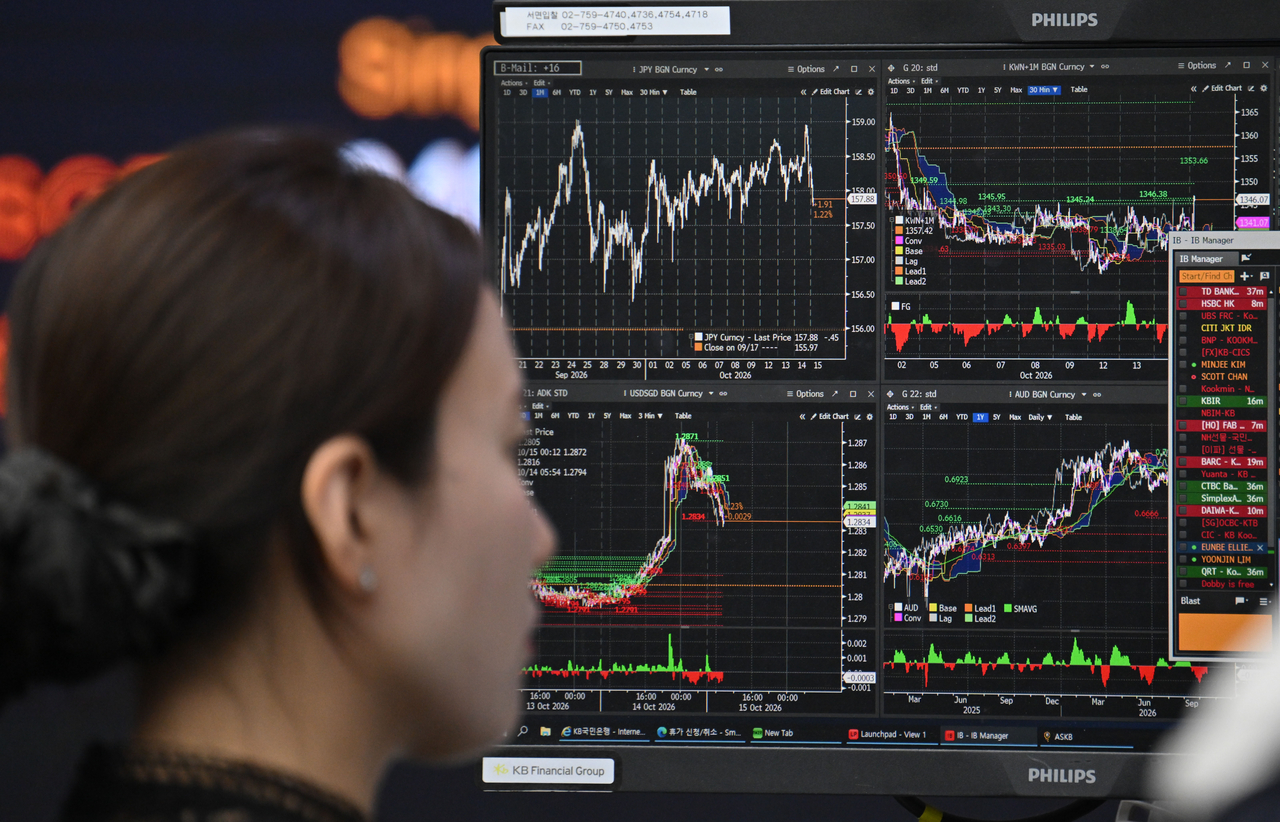
Renewed concerns over the profitability of artificial intelligence investment triggered a mass exodus of foreign investors from South Korean equities Thursday. Foreign investors net sold more than 3.6 trillion won ($2.69 billion) on the main bourse, sending the Kospi tumbling more than 7 percent.
The Kospi fell for a seventh consecutive session, shedding 21 percent over that stretch. Large-cap semiconductor stocks led the decline, and circuit breakers were triggered on both the Kospi and Kosdaq markets, halting trading temporarily.
The Kospi closed at 5,554.22, down 454.59 points, or 7.57 percent, from Wednesday, according to Korea Exchange. The closing level was the lowest since April 7, when the index finished at 5,494.78. Both the point decline and the percentage drop were the steepest since July 28, when the index lost 732.09 points, or 10.84 percent.
The Kospi has now fallen for seven consecutive sessions dating back to Oct. 6, shedding a total of 1,449.52 points, or 21 percent, over that period. The seven-session losing streak is the longest since a similar run from Sept. 3 to Sept. 11, 2024 — the first such streak in about two years.
The index opened down 335.80 points, or 5.59 percent, at 5,673.01, and at one point in the afternoon slid as far as 5,450.81, a drop of 9.29 percent that briefly pushed it below the 5,500 level. It recovered some ground to close just above that threshold.
The early plunge triggered sell-side sidecars on both the Kospi and Kosdaq markets in succession — the first time both markets activated sidecars on the same day since July 29, roughly two and a half months ago. As both indexes extended their losses beyond 8 percent, circuit breakers were triggered on each market, suspending trading for 20 minutes. That, too, was the first occurrence since July 29.
Foreign investors drove the decline. They recorded net selling of 3.63 trillion won on the main market by the close of the regular session, extending their net selling streak to eight consecutive sessions. Retail investors and institutional investors were net buyers of 1.29 trillion won and 1.69 trillion won, respectively.
The sell-off was partly attributed to a chill from Wall Street overnight. All three major US indexes fell, with the Dow Jones Industrial Average and the S&P 500 losing 0.09 percent and 1.11 percent, respectively, while the tech-heavy Nasdaq Composite dropped 1.88 percent.
A stronger-than-expected US consumer price reading for September heightened inflation fears, while concerns resurfaced that big tech companies' fierce competition to build out AI infrastructure may not generate sufficient returns relative to the scale of investment.
The US September consumer price index, released by the Ministry of Employment and Labor, rose 3.7 percent year-on-year, exceeding market forecasts. Gasoline prices surged 9.1 percent from the previous month, but price pressures were broad-based, with non-energy items also rising across the board.
Doubts about AI profitability continued to weigh on sentiment. Research firm Gartner projected that around $1 trillion in AI infrastructure investment would be made in 2026, followed by an additional $6 trillion between 2027 and 2030. To cover the associated capital and financing costs and achieve an adequate return on invested capital, the industry would need to generate $8.5 trillion in revenue by 2030 — yet actual data center-related revenue is estimated to reach no more than $3.6 trillion.
Major technology and semiconductor stocks fell in tandem. South Korea's two dominant chipmakers each dropped between 9 and 11 percent, weighed down by a combination of factors: the recent rise of China's CXMT and the supply expansion from its capacity scale-up, concerns about financing bottlenecks for AI infrastructure investment, and continued weakness in US technology and semiconductor shares.
Samsung Electronics fell 9.48 percent to close at 210,000 won, at one point dipping to 204,500 won, a drop of 11.85 percent that threatened to push the stock below the 200,000-won mark. SK hynix fell 11.06 percent to close at 1.26 million won, briefly touching 1.24 million won, a decline of 12.76 percent, during the session.
Samsung Electronics' decline Thursday was the steepest since July 28, when it fell 13.39 percent; SK hynix's drop was likewise its largest since that same day, when it lost 14.65 percent. Over the past seven sessions, Samsung Electronics shed 66,000 won, or 24 percent, while SK hynix lost 579,000 won, or 31 percent.
Other top market-cap stocks also fell, including SK Square, down 10.21 percent; LG Energy Solution, down 4.62 percent; and Samsung Electro-Mechanics, down 15.36 percent. A handful of stocks bucked the trend, with Samsung Biologics rising 5.50 percent, Celltrion gaining 1.28 percent and Hana Financial Group edging up 0.66 percent.
The Kosdaq also closed sharply lower, falling 63.06 points, or 7.65 percent, to 760.82. The point decline was the largest since June 23, when the index lost 76.88 points, and the percentage drop was the steepest since July 28, when it fell 7.72 percent. From Oct. 7 through Thursday, the Kosdaq plunged a total of 159.10 points, or 17 percent, over six sessions.
The Kosdaq opened down 39.43 points, or 4.79 percent, at 784.45, immediately surrendering the 800 level, and continued to extend its losses throughout the day, at one point sliding to 745.43, a drop of 9.52 percent. On the Kosdaq, retail investors and institutional investors were net sellers of 66.7 billion won and 163.2 billion won, respectively, while foreign investors were net buyers of 217.7 billion won.
Every stock ranked first through 73rd by market capitalization on the Kosdaq fell, including Alteogen, down 4.90 percent; Ecopro, down 8.18 percent; Ecopro BM, down 9.10 percent; Jusung Engineering, down 14.97 percent; and Rainbow Robotics, down 9.44 percent.
The won weakened against the dollar amid the foreign sell-off. As of 3:30 p.m., the won-dollar exchange rate in the Seoul foreign exchange market stood at 1,344.6 won per dollar, up 6.3 won from Wednesday's base rate.

th5@heraldcorp.com




