
10-year Treasury yield falls as much as 0.15 percentage point intraday
Hits 3-week low despite inflation beating forecasts
CoreWeave credit risk surges on AI debt concerns
German bonds also rally as risk-off sentiment spreads globally
![Stock market data is displayed on an outdoor screen outside the Nasdaq MarketSite in New York on Thursday (local time). [Reuters]](https://wimg.heraldcorp.com/news/cms/2026/10/16/rcv.YNA.20261016.PRU20261016066201009_P1.jpg)
US government bond yields tumbled to their lowest level in three weeks even as inflation came in above market expectations, as growing anxiety over the scale of AI investment and rising debt levels drove investors into the safety of Treasuries. Concerns about AI spending overwhelmed the usual upward pressure on yields that higher inflation tends to produce.
The yield on the 10-year US Treasury note fell as much as 0.15 percentage point during trading Thursday (local time) to 5.04 percent annually, its lowest in about three weeks, according to the Financial Times. It later pared losses to trade at 5.09 percent.
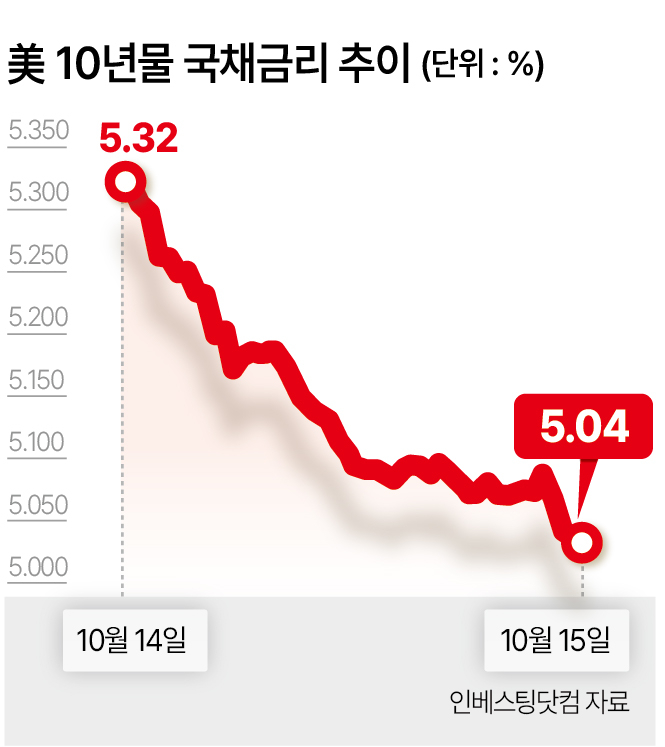
Higher inflation typically reduces the likelihood of Federal Reserve rate cuts, pushing bond yields up. This time, however, a broad selloff in technology stocks sent investors rushing into Treasuries as a safe haven. Because bond prices and yields move in opposite directions, stronger buying pressure pushed yields lower.
"Inflation came in well above expectations, but risk-off sentiment overwhelmed everything," said Ales Koutny, head of international rates at Vanguard.
At the center of the market unease is the enormous amount of borrowed money poured into AI data center construction. AI companies have been committing vast sums to expand computing capacity, but doubts are growing over whether actual revenues can justify the scale of that investment.
The credit risk of AI cloud company CoreWeave surged sharply this week. Its five-year credit default swap spread surpassed 11 percentage points, meaning investors must pay more than $11 a year to insure against default on every $100 of principal. A widening CDS spread signals that the market views a company's default risk as elevated.
CoreWeave has financed a significant portion of its data center buildout through borrowing. Concerns have emerged that if demand for AI computing falls short of expectations, the company could face a mounting debt repayment burden.
Signs of slowing growth at AI companies also weighed on investor sentiment. AI startup Anthropic said its third-quarter sales this year reached approximately $16.8 billion, up 50 percent from a year earlier, but the pace of growth slowed from earlier in the year and fell short of some investors' expectations.
![An illustration of the Nasdaq logo. [Reuters]](https://wimg.heraldcorp.com/news/cms/2026/10/16/rcv.YNA.20261016.PRU20261016016201009_P1.jpg)
The Nasdaq 100 index fell as much as 1.8 percent intraday before paring losses. Nvidia and Intel shares dropped 1.8 percent and 2.8 percent, respectively. South Korea's SK hynix and Samsung Electronics tumbled 11.1 percent and 9.5 percent, respectively, while Japan's SoftBank Group fell 9.3 percent.
Worries about AI investment spread beyond chipmakers to data storage and related infrastructure companies. US firms Western Digital and SanDisk fell 2.1 percent and 0.6 percent, respectively, while Japanese chipmaker Kioxia tumbled 12.3 percent. Dutch semiconductor equipment maker ASML dropped more than 4 percent.
Losses in technology stocks narrowed considerably in the latter part of the session, however. The Nasdaq 100 closed down less than 0.1 percent. CoreWeave, whose surging credit risk had triggered the broader alarm, rebounded 5.9 percent. Bargain hunters stepped in even as wariness over the financial health of AI-related companies remained elevated.
The risk-off move spread to European bond markets as well. The yield on Germany's 10-year government bond fell 0.06 percentage point to 3.41 percent, as investors in Europe also shifted funds into relatively safe sovereign debt.
Short sellers who had previously bet on falling bond prices also accelerated the yield decline by unwinding their positions. Investors who had expected high oil prices and inflation following the Iran war bought Treasuries to limit losses as bond prices rose.
Bond market participants are watching closely whether the sharp drop in yields represents a temporary flight to safety or something more lasting. With US inflation pressures still present, a resurgence of inflation concerns could push yields back up. On the other hand, analysts say that if anxiety over AI companies' debt burdens and profitability persists, demand for safe-haven assets could continue.
The Financial Times said the flow of capital in global financial markets is shifting as concerns over AI industry debt and profitability grow, even as inflation pressures persist.
sjy@heraldcorp.com




