Foreign investors continue selling even as shares edge up
Future earnings, shareholder returns seen as key
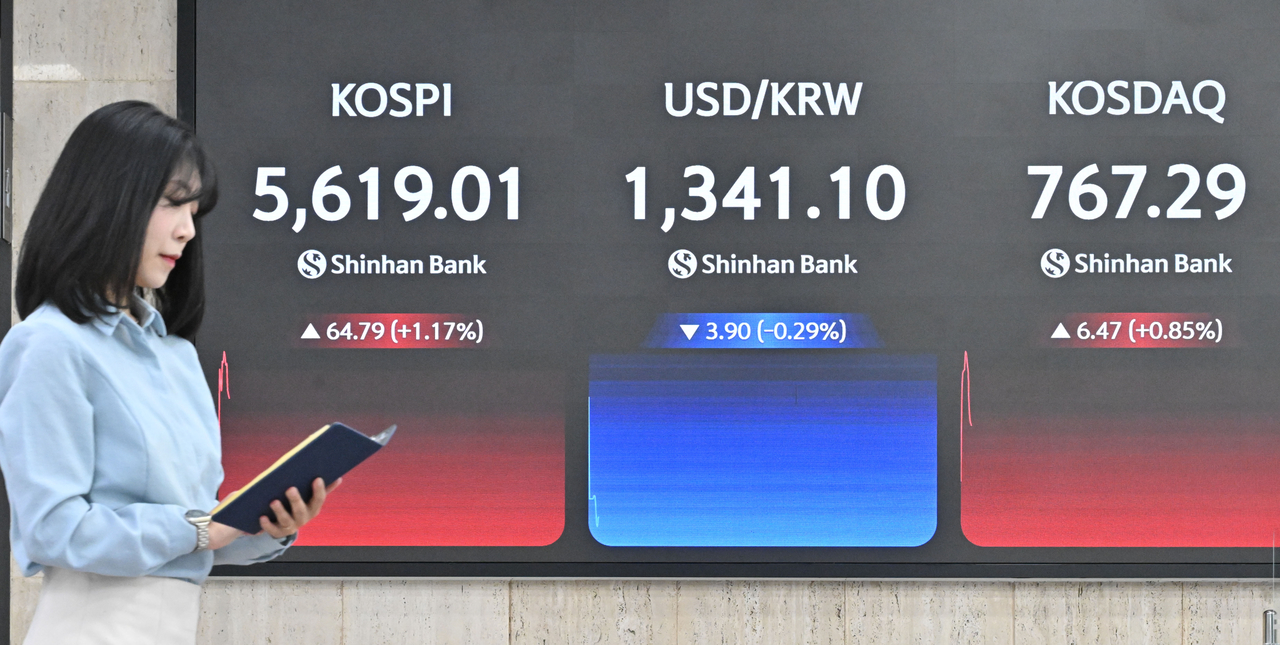
Samsung Electronics and SK hynix broke a streak of sharp declines Friday, rising about 2% in early trading.
Samsung Electronics was up 2.38% at 215,000 won ($159) as of 10:45 a.m. on the Kospi.
SK hynix was trading 2.69% higher at 1,296,000 won at the same time.
Wall Street closed higher overnight, with all three major indexes finishing in positive territory.
The Dow Jones Industrial Average rose 1.08%, while the S&P 500 and the NASDAQ Composite gained 0.33% and 0.08%, respectively.
Nvidia (-1.84%), Micron (+1.87%) and SanDisk (-0.61%) pared early losses as the session progressed, though the Philadelphia Semiconductor Index still ended down 0.88%.
The rebound appears driven by bargain hunters who view the steep sell-off in AI and semiconductor stocks over the past several trading sessions as overdone.
Foreign investors, however, continued their "sell Korea" trend Friday.
Foreign investors were net sellers of 333.8 billion won on the Kospi, while retail investors and institutions were net buyers of 45.2 billion won and 72.3 billion won, respectively.
Other corporations were net buyers of 222.8 billion won, even as SK hynix's share buyback program nears its end.
Lee Jae-won, an analyst at Yuanta Securities Korea, said foreign selling has been concentrated in Samsung Electronics and SK hynix, while the buyback program that had been propping up the index has also begun to wind down. "There are not enough buyers to absorb the selling pressure, so falling prices are triggering further sell-offs," he said.
The Kospi fell 16.2% from Oct. 8 through Thursday. During that period, foreign investors were net sellers of 11.5 trillion won ($8.53 billion) on the Kospi.
Growing concerns about the semiconductor industry outlook have weighed on the market. News of credit risks at AI infrastructure firm CoreWeave and CXMT's plans to launch server memory products raised fears of a slowdown in AI investment and intensifying competition in the memory chip supply market.
Lee noted, however, that an actual reduction in capital expenditure or large-scale mass production by CXMT has not yet been confirmed. He added that a slowdown in foreign selling and the emergence of buyers to absorb that pressure are the first conditions needed to stabilize the sell-off, and that a sustained rebound will depend on stabilization of AI-related credit risks, the maintenance of semiconductor earnings forecasts, and the announcement and actual execution of shareholder return plans expected at the end of October.
Some analysts argue the plunge in memory-related stocks has created a buying opportunity.
Han Dong-hee, an analyst at SK Securities, said Samsung Electronics and SK hynix are trading at 12-month forward price-to-earnings ratios of 3.3 times and 3.0 times, respectively — both below their post-2010 lows of 5.0 times and 3.0 times. "Current share prices of Korean memory suppliers are already pricing in an extreme downturn," he said.
Han said earnings forecasts for next year are being revised upward, driven by a deepening memory supply shortage that is exceeding expectations and an anticipated rise in HBM prices next year — even despite a weaker won against the dollar. He added that he maintains his view that long-term supply agreements will sustain high profitability, strengthen structural cash generation and lead to enhanced shareholder returns.
"Now is the right time to buy memory stocks," Han said, adding that "despite macroeconomic uncertainty, memory will continue to prove itself through earnings and shareholder returns."

jiyun@heraldcorp.com