Rebound to 8,300–9,000 expected
'Weak first half vs. strong first half' debate splits analysts
Profit growth to spread beyond semiconductors
Value-up execution to separate winners from losers

South Korea's stock market, which endured an unprecedented roller-coaster ride this year, is approaching a new inflection point as the year draws to a close. Kospi broke above the 9,000 mark for the first time in history on the back of the AI boom, only to be pushed back to the mid-5,000 range in the second half as doubts about AI profitability and concerns over peak valuations mounted. Investors who have watched the market through the year are now wrestling with what comes next.
Securities firms expect Kospi to rebound to the 8,300–9,000 range next year, shaking off an extreme undervaluation phase. Analysts are divided, however, on the trajectory within the year — some forecasting a weak first half followed by a strong second half, others the reverse. Experts broadly agreed that the era of gains driven purely by vague AI optimism is over, and that next year's winners will be determined by rigorous stock-picking based on earnings durability, cash generation and shareholder-return execution.
Hyundai Motor Securities, Korea Investment: weak H1, strong H2 — 'escaping extreme undervaluation'
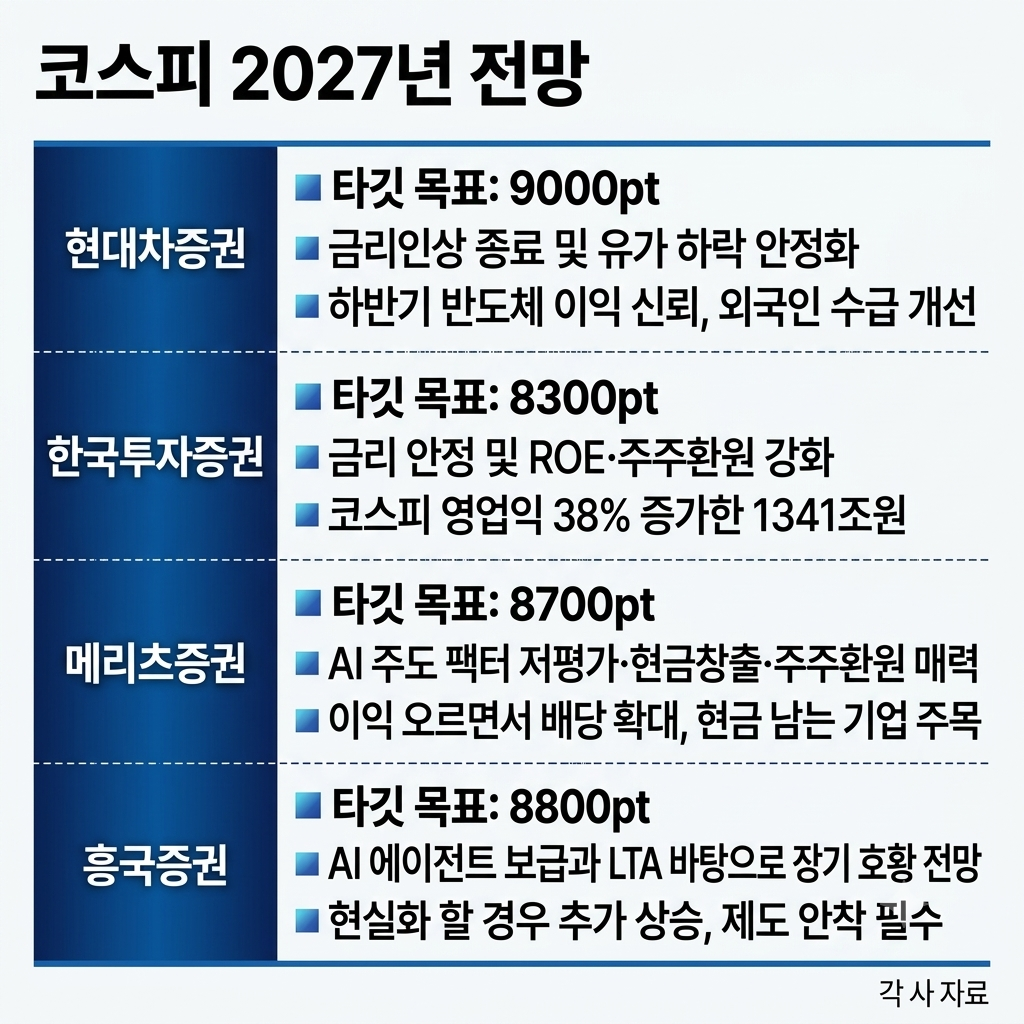
Hyundai Motor Securities projected Kospi will recover to the 7,000 level in the first half of next year before reaching a year-end target of 9,000 points — the most bullish call on the Street — with an annual trading band of 6,000 to 10,500 points.
The firm identified three key shifts that will reshape the market next year: macroeconomic improvement, including the end of the US Federal Reserve's rate-hike cycle in the first half and a stabilization of oil prices; improved foreign investor flows, as mega-IPOs such as SpaceX and Anthropic wrap up and AI concentration within US equities eases; and a recovery in confidence in the durability of semiconductor earnings.
Domestic semiconductor stocks are expected to remain volatile through the first half amid fears of a profit peak-out, but from mid-next year onward the market is forecast to regain trust in earnings sustainability beyond 2028, triggering a bull-market revival alongside net foreign buying.
On investment strategy, the firm stressed the need for positions that can reduce volatility. It recommended watching banks, insurers and large-cap healthcare stocks — sectors with limited AI exposure — as well as export plays that stand to benefit from a won recovery, including automakers, shipbuilders and cosmetics companies. For semiconductors, a full-scale rally is expected from the second half of next year, while robotics also warrants attention ahead of projected mass production in 2028.
Korea Investment & Securities set a Kospi target of 8,300 points for next year — based on a 12-month forward price-to-earnings ratio of 6x and earnings per share of 1,380 points — and forecast a weak-first-half, strong-second-half pattern as the market passes through a trough in the fourth quarter of this year before embarking on a gradual recovery.
The firm noted that the current 12-month forward PER of 4.3x sits in extreme undervaluation territory, and argued that as the Fed's rate-hike cycle nears its end and market volatility eases, a price-to-book ratio of 1x — underpinned by high return on equity and strengthened shareholder returns — will serve as a powerful downside support level.
Korea Investment & Securities forecast Kospi operating profit will rise 38.4 percent year-on-year to 1,341 trillion won ($1 trillion) next year, while cautioning that investors should focus on companies capable of protecting margins as base effects fade and oil-price pressures from the Middle East weigh on profitability.
For the first half, the firm highlighted refining, chemicals and banking stocks; for the second half, it favored autos and auto parts along with pharmaceuticals and biotech.
Jeong Hyeon-jong, a researcher at Korea Investment & Securities, put forward an "all-round portfolio" as the core strategy for next year. Where existing portfolios have been "all-in" on AI growth, next year calls for broadening the asset mix beyond the core AI value chain to include short-duration high-yield bonds, US government bonds and physical assets such as gold as a risk hedge.
To manage volatility in AI-related stocks, the firm also recommended diversifying equity holdings beyond semiconductors into systems software and application software.
Meritz, NH Investment: strong H1, weak H2 — 'AI investment-to-production transition'
Not all analysts share the weak-first-half view. A competing camp warns that after a first-half rebound, investors should brace for slowing growth momentum and rising macroeconomic cost pressures in the second half.
Meritz Securities set a year-end Kospi target of 8,700 points for next year — applying a 12-month forward PBR of 1.2x, with a trading band of 7,250 to 9,400 points — and characterized the market's relative appeal as a strong-first-half, weak-second-half story.
"Next year will be a transition period as the market waits for what comes after the AI infrastructure investment cycle," said Hwang Su-uk, a researcher at Meritz Securities. "As the year progresses into the second half, the focus is expected to shift from AI 'investment' to application companies capable of 'producing' new value. The fact that the next AI early-cycle leaders are not yet visible domestically is a risk."
That said, Hwang noted that the late-cycle drivers of AI infrastructure investment — undervaluation, cash generation and shareholder returns — remain attractive in the first half, and named semiconductors and utilities as top sector picks, with construction, transportation and chemicals as secondary preferences.
The firm particularly emphasized selecting stocks where rising earnings leave room to increase dividends while still generating surplus cash.
NH Investment & Securities similarly defined next year's economy as a "bottleneck economy" constrained by four forces — capital, AI infrastructure, supply chains and corporate value — and forecast a strong-first-half, weak-second-half trajectory for Kospi.
In the first half, NH Investment & Securities expects the Fed to lean toward long-term disinflation driven by AI productivity gains, pushing real interest rates and inflation expectations lower. This, combined with the actual implementation of the first through third rounds of Commercial Act amendments — improving dividend payout ratios — and increased Korean weightings by global pension funds, is seen lifting the market.
In the second half, however, the firm warned that legislative gridlock following France's presidential election in May, a prolonged US debt-ceiling standoff and massive corporate bond issuance by hyperscalers — estimated at $400 billion — could combine to push capital costs, or interest rates, higher again.
The firm also predicted that the AI bottleneck will shift from memory chips this year to power and grid infrastructure next year, with sandbox usage — environments where AI-written code is executed — expanding rapidly and driving a surge in the ratio of CPUs to accelerators. It recommended watching the supply chains of data centers, CPUs, substrates and power equipment as demand and installation volumes grow.
NH Investment & Securities also argued that as US-China competition and global supply-chain restructuring intensify, Korean companies that have secured production capacity and overseas bases in strategic industries — semiconductors, batteries, defense and robotics — stand to see their valuations rise.
The firm also pointed to next year as the moment when a re-rating tied to the resolution of the Korea Discount could become visible. "The effects of the 2025–2026 amendments to the Commercial Act, tax law and Capital Markets Act are expected to materialize in earnest from next year," said Kim Byeong-yeon, a researcher at NH Investment & Securities, adding that cumulative voting, expanded separate election of audit committee members and electronic general meetings will strengthen board independence and protect the rights of ordinary shareholders.
Shinyoung Securities framed next year's global market as a "race between interest rates and the productivity J-curve," and set a base-case scenario of Kospi retesting its previous high in the first half.
"The roughly 40 percent decline in four months from the June peak this year was not an earnings-driven bear market but a 'price bear market' driven by multiple compression," said Lee Sang-yeon, a researcher at Shinyoung Securities. "In past bull markets, absolute earnings also peaked within a year of the share-price high — but this time, the quarterly operating profit peak for the two major semiconductor companies is not expected until the first half of 2028, leaving a gap of about 21 months. That supports a strong rebound attempt in the first half."
The path in the second half, however, will hinge on the direction of 2028 earnings estimates, Lee said. If long-term supply agreements and sovereign AI demand push those estimates higher, a "best-case scenario" opens up in which Kospi breaks through its previous high and gains spread to secondary beneficiary sectors. But if spot DRAM prices fall and drag estimates lower, or if US equities enter a recession-driven bear market, the index could breach a secondary trough in a "worst-case scenario."
'Institutional support essential as Korea Discount resolution gathers pace'
Heungkuk Securities applied a 35 percent discount to market-wide earnings forecasts — reflecting the average earnings adjustment seen in past semiconductor cycles — and a three-year average PER of 9.0x to arrive at a fair-value Kospi target of 8,800 points for next year.
Lee Yeong-won, a researcher at Heungkuk Securities, said that if the spread of AI agents and long-term supply agreements bring about an unprecedented prolonged boom, further upside is possible alongside a valuation recovery.
Institutional support is essential for the index to consolidate at higher levels, Lee stressed. "Low dividend payout ratios, a closed decision-making structure centered on controlling families, the use of circular shareholding and treasury shares to entrench control, and opaque merger and spin-off practices remain unresolved issues," Lee said. "If past gains in Korean equities relied heavily on earnings growth and export expansion, future sustainable bull cycles will require a combination of capital allocation efficiency, shareholder returns, management transparency and minority shareholder protection."
Shinhan Securities focused on sector differentiation. The firm forecast Kospi operating profit will grow to 1,338 trillion won next year, a gain of 38.2 percent, before the growth rate slows to 9.5 percent in 2028.
Semiconductor operating profit growth is expected to decelerate from 49.3 percent in 2027 to 9.0 percent in 2028, while non-semiconductor profit growth rises from 10.6 percent to 11.2 percent over the same period — marking a shift in which non-semiconductor sectors outpace chips on growth.
With Kospi's 12-month forward PER currently at 4.2x near its historical floor, Shinhan Securities identified IT appliances — including a battery turnaround — IT hardware centered on Samsung Electro-Mechanics, shipbuilding, machinery including power equipment, and cosmetics as core investment candidates where both sustained earnings growth through 2027–2028 and upward EPS estimate revisions over the past three months can be confirmed simultaneously.
"Kospi net profit growth will continue next year but at a slower pace, and while 12-month forward net profit remains solid, the earnings revision ratio is expected to decline from its July peak," said Lee Jeong-bin, a researcher at Shinhan Securities. "With profit growth concentrated in a narrow set of sectors, sector selection becomes increasingly critical."
jiyun@heraldcorp.com