
Grain self-sufficiency rate stands at 22.2%; wheat at 1.1%, corn at 0.8%
KREI researcher calls for contingency plans covering total supply failure
Japan enacted a food supply emergency law last year
A new warning has emerged that if a global food crisis strikes, South Korea may be unable to secure grains such as wheat and corn even with the financial means to buy them. While the risk of grain import disruptions caused by war or export restrictions is growing, the country's food security measures remain heavily focused on preparing for price spikes rather than physical supply failures, according to a new report.
A report released Saturday by the Korea Rural Economic Institute titled "Food Security Crisis Scenarios and Response Framework" found that past food crises were largely driven by rising international grain prices as inventories shrank due to surging demand or extreme weather — situations where paying a premium was enough to secure needed supplies. The study was led by Seung Jun-ho, an associate research fellow at the institute.
In recent years, however, the risk of failing to secure food supplies — even when a country can afford to pay — has grown as international conflicts, export restrictions and supply chain disruptions converge. Seung said that to address this shift, crisis management frameworks must go beyond price surges to account for scenarios where physical procurement becomes impossible.
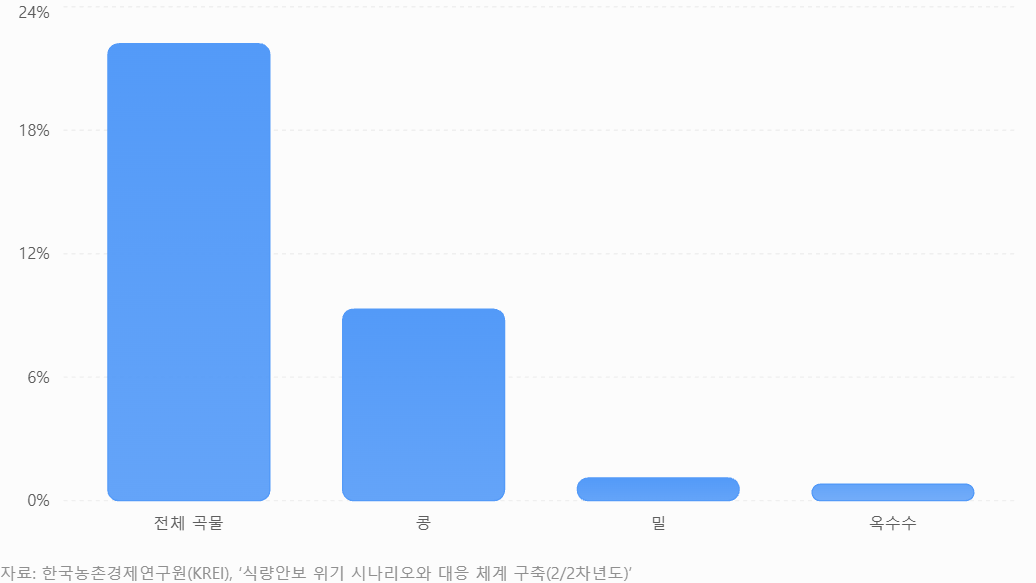
South Korea is particularly vulnerable to supply disruptions given its heavy reliance on grain imports. Its domestic grain self-sufficiency rate stood at just 22.2 percent in the 2023 crop year. Soybeans reached only 9.3 percent, while wheat was limited to 1.1 percent and corn to 0.8 percent — meaning the vast majority of domestic consumption depends on overseas supply.
The scale of imports is substantial. In 2023, South Korea spent 8.86 trillion won ($6.62 billion) importing wheat, corn and soybeans — equivalent to 14.9 percent of total agricultural output. A prolonged halt in international grain supplies could affect not just prices but the domestic food supply itself.
South Korea's existing food crisis response system remains oriented toward monitoring international grain prices as the primary risk indicator. The government operates an international grain early-warning system and crisis response manuals, but Seung said these have limitations in handling prolonged crises that involve actual procurement failures.
Policies to expand domestic production capacity, build up stockpiles and develop overseas agricultural resources are also under way. However, the report found that an integrated system and manual capable of linking these individual policies in a coordinated way — and responding to extended supply disruptions — remains insufficient.
Other countries are moving toward managing food crises with a focus on physical supply volumes. Japan enacted its Food Supply Difficulty Emergency Measures Law in April last year, establishing a tiered response framework covering everything from early signs of supply disruption to severe food shortages.
Under the law, Japan can pursue measures including expanding domestic production based on caloric supply calculations, rationing and distributing limited food stocks, and stabilizing prices to ensure citizens receive a minimum level of nutrition during a serious shortage. The framework treats the actual volume of food that can be delivered to the public — not just price — as the core benchmark for crisis response.
Seung proposed that South Korea broaden its food crisis assessment criteria beyond international grain prices to include actual supply volumes and available caloric supply. He also said the country needs to build a pan-government response framework that links production, stockpiling, overseas procurement and domestic distribution, based on scenarios in which imports are cut off for an extended period.
adastra@heraldcorp.com



