
Property premiums totaled 3.1 trillion won last year, accounting for 29.3% of contributions as of June this year
Nam In-soon calls for shift from dual employment-regional system to single income-based regime
![[Getty Images Bank]](https://wimg.heraldcorp.com/news/cms/2026/10/16/news-p.v1.20251101.ec7d97e2e59447a4893071c549cfa0ba_P1.jpg)
Property-based premiums still account for nearly 30% of the national health insurance contributions paid by self-employed subscribers, data show, leaving unemployed workers and retirees with little income facing a persistent financial burden. Although the share has declined following expansions of property deductions and the abolition of vehicle-based premiums, the underlying structure — which assesses contributions based on assets rather than earnings — remains intact. Calls are growing to merge the separate contribution regimes for employed and self-employed subscribers into a single income-based system.
According to national audit materials submitted to Democratic Party of Korea lawmaker Nam In-soon of the National Assembly's Health and Welfare Committee by the Ministry of Health and Welfare and the National Health Insurance Service, property premiums totaled 3.1 trillion won ($2.32 billion) out of 10.4 trillion won in total contributions collected from self-employed subscribers last year, representing 29.9%. Income-based premiums accounted for 7.3 trillion won, or 70.1%.
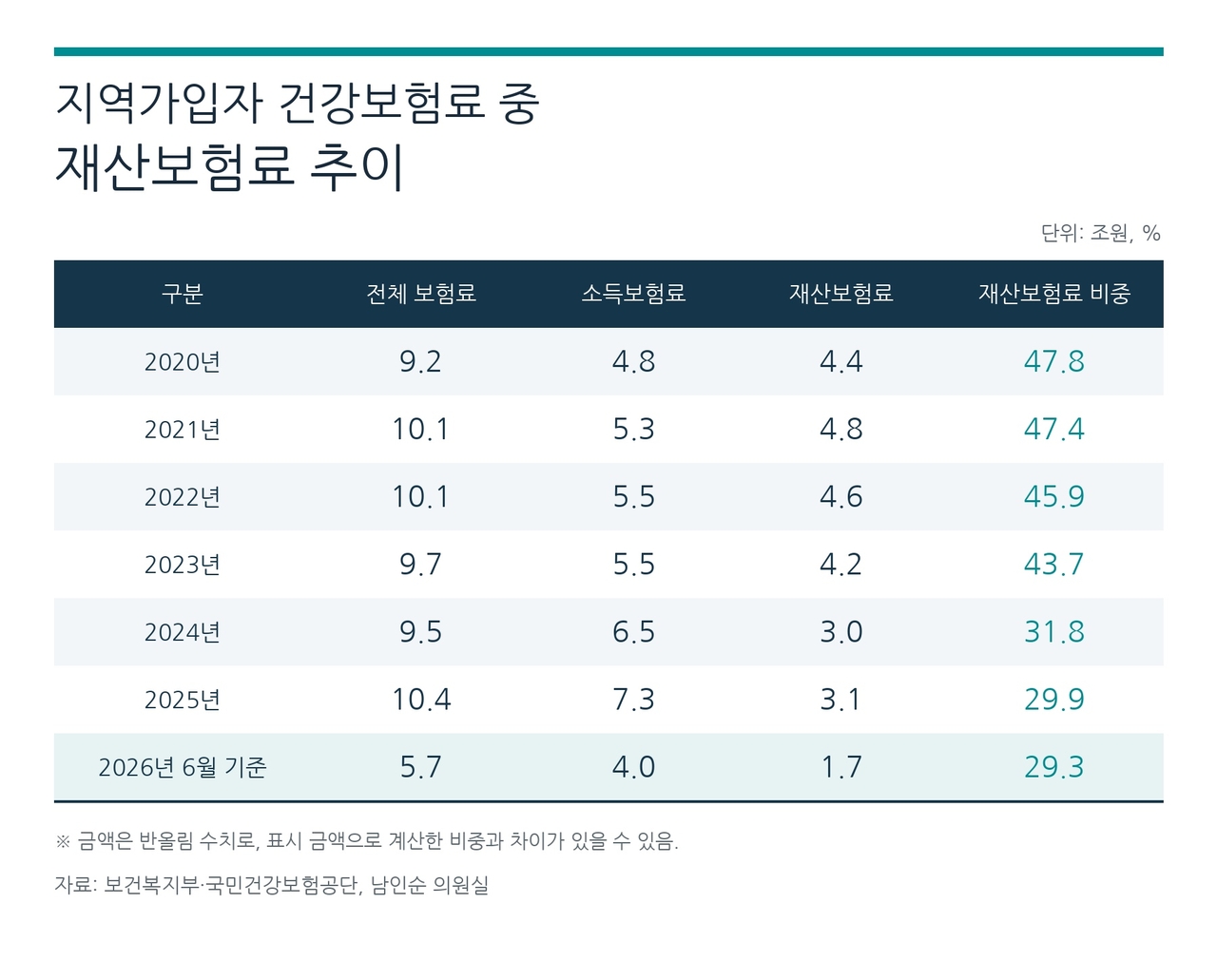
As of June this year, property premiums stood at 1.7 trillion won out of 5.7 trillion won in total self-employed contributions, representing 29.3%. In effect, roughly three out of every 10 won paid by self-employed subscribers is assessed on assets rather than income.
The property premium share has been on a downward trend following a series of phased reforms. It stood at 47.8% in 2020, edged down to 47.4% in 2021, then fell to 45.9% in 2022 and 43.7% in 2023, before dropping more sharply to 31.8% in 2024 and 29.9% last year — a decline of 17.9 percentage points from 2020.
The government began phasing in reforms in July 2018, when it introduced tiered property deductions ranging from 5 million to 12 million won. In September 2022, the basic deduction was raised to 50 million won, and in February 2024 it was expanded further to 100 million won. Vehicle-based premiums were also abolished entirely.
The core problem, however, is that subscribers who lose income or retire still face premium burdens as long as they hold assets. Under the current system, premiums for employed subscribers are calculated based on wages and non-wage income, while those for self-employed subscribers are based on both income and property. Employers cover half of the wage-based premiums for employed subscribers, but self-employed subscribers must pay their full assessed amount out of pocket.
"Despite the reforms, the property premium share for self-employed subscribers remains high, and dissatisfaction among unemployed workers and retirees with no income is considerable," Nam said. "It would be hard to accept a situation where health insurance premiums are actually higher after losing a job or retiring than they were while earning an income."
Nam argued that the dual-track system — originally justified by the difficulty of tracking self-employed income — should be revisited. With credit card and cash receipt usage now widespread and income verification improved through tax audits and other means, she said, the reliance on property as a basis for premium assessment can be reduced.
Nam said South Korea and Japan are the only OECD member countries that levy health insurance premiums on property. She proposed either capping the property premium share at below 10%, as Japan does, or fundamentally shifting to a single income-based contribution system.
Calls also emerged for a new body to deliberate on contribution system reform. A premium assessment reform committee established in October 2018 to improve the contribution regime was dissolved in July 2024 following a legal revision that reorganized committees attached to administrative agencies.
"There is a need to reconstitute the premium assessment reform committee or establish a separate body to continue discussions on overhauling the contribution system," Nam said. "The health insurance premiums of self-employed and employed subscribers should be integrated into a single income-based system to improve the fairness of the premium burden."
fact0514@heraldcorp.com




