
General account support rate at 12.5%, below the legally mandated 14%
Health insurance posts 364.4 billion won deficit through July; lawmaker calls for expanded state funding
![A branch of the National Health Insurance Service in Seoul [Yonhap]](https://wimg.heraldcorp.com/news/cms/2026/10/16/rcv.YNA.20260729.PYH2026072903460001300_P1.jpg)
The government has allocated a record amount of state funding for national health insurance next year, but the general account support rate will still fall short of the legally mandated level. With health insurance spending rising amid efforts to strengthen regional, essential and public healthcare — and an aging population driving up demand — critics say the government must at minimum comply with the statutory support rate.
According to Nam In-soon, a Democratic Party of Korea lawmaker on the National Assembly's Health and Welfare Committee, the government's 2027 budget allocates 13.8 trillion won ($10.3 billion) in state subsidies for national health insurance. That amounts to 14.6 percent of projected premium revenue of 94.52 trillion won next year.
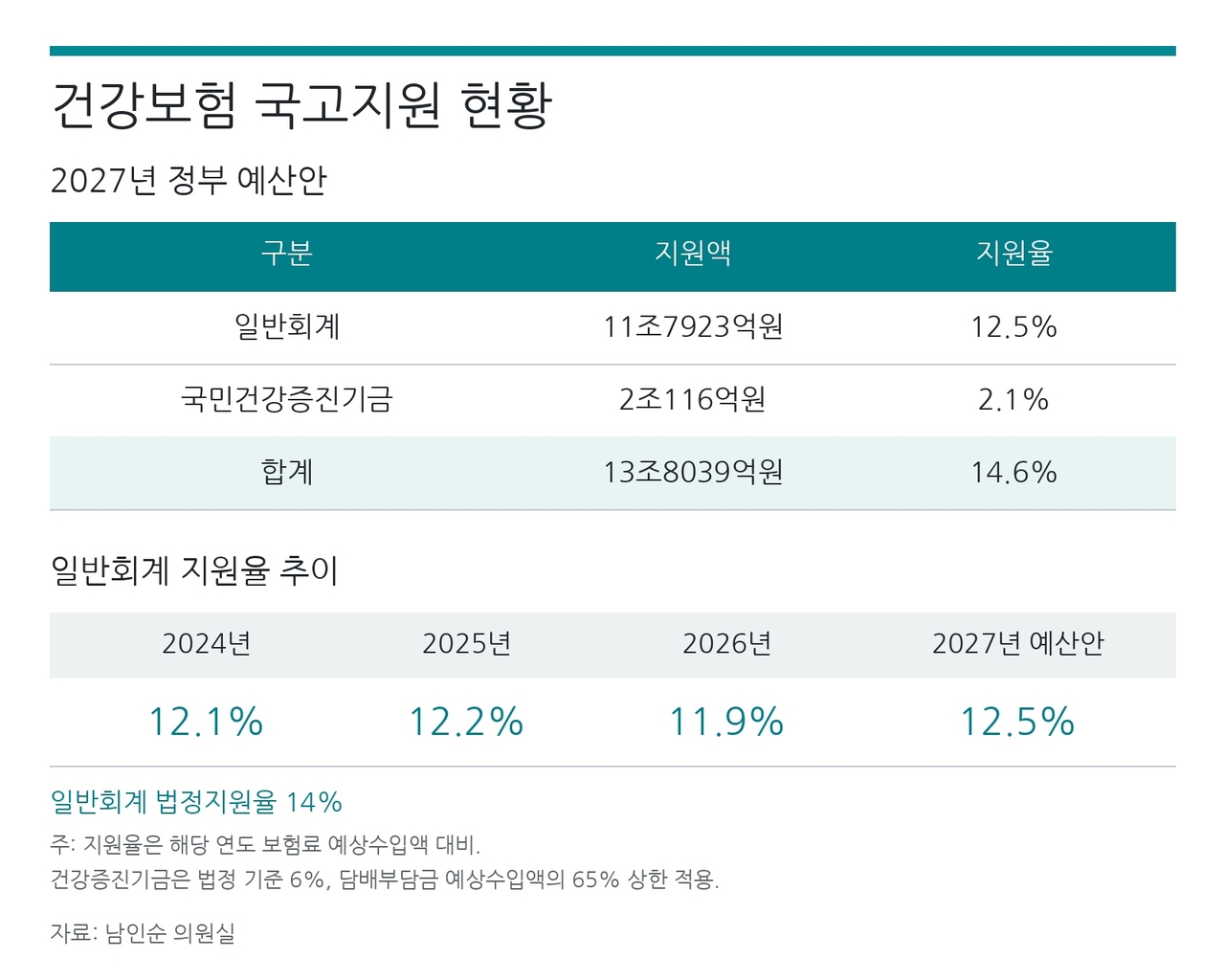
Of that total, the general account contribution comes to 11.79 trillion won — an increase of about 1.1 trillion won from this year. The general account support rate will rise from 11.9 percent this year to 12.5 percent next year, but will still fall short of the legally required 14 percent. The rate has missed the statutory benchmark every year, standing at 12.1 percent in 2024 and 12.2 percent in 2025.
The National Health Promotion Fund contribution is set at 2.01 trillion won, equal to 2.1 percent of projected premium revenue next year. Current law requires 14 percent of projected premium revenue to come from the general account and 6 percent from the health promotion fund, though the fund contribution is capped at 65 percent of projected tobacco surcharge revenue.
The health insurance finances are expected to swing to an annual deficit this year. Data submitted by the National Health Insurance Service to Nam show that total revenue through the end of July stood at 63.02 trillion won against total expenditure of 63.38 trillion won, leaving a deficit of 364.4 billion won. Revenue grew 13.66 percent year-on-year over the same period, while expenditure rose 9.67 percent.
If the deficit persists through year-end, it would snap a streak of annual surpluses that has held since 2021 — the first reversal in five years. The accumulated reserve stood at about 30.2 trillion won at the end of last year, a record high, but the service expects the deficit to widen going forward.
Factors driving up spending include the push to strengthen regional, essential and public healthcare, a restructuring of the healthcare delivery system, and rising medical demand from an aging population. The service plans to commit 3.6 trillion won annually to measures including the introduction of regionally weighted fee schedules, enhanced emergency end-stage care, the establishment of maternal and pediatric care systems, and expanded compensation for essential primary care.
Annual support of 3.3 trillion won will continue for the structural transformation of tertiary hospitals, and 700 billion won for comprehensive secondary general hospitals. An additional 800 billion won per year will go toward reducing the medical cost burden on patients with severe and rare diseases and expanding their access to treatment. The natural rate of increase in benefit costs next year is projected at 5.3 percent, driven by aging and the rise in chronic diseases.
The service said it plans to cut spending through adjustments to drug prices and procedure fees.
The reimbursement rate for generic drugs will be lowered from 53.55 percent to 45 percent, and prices of already-listed drugs will be revised in line with new criteria, with projected annual savings of 270 billion won. Adjustments to overcompensated fees for laboratory tests, CT scans and MRI procedures are expected to yield annual savings of 2.6 trillion won.
The service is also pursuing annual savings of 80 billion won through tighter management of false and improper claims, and 7.3 billion won by strengthening tiered cost-sharing requirements for excessive healthcare users.
On the revenue side, the health insurance premium rate has been frozen at this year's level of 7.19 percent for next year, but the service expects about 3.8 trillion won in additional premium income, driven in part by expanded performance bonuses at companies including Samsung Electronics and SK hynix.
"Given that the government's surplus tax revenue this year is projected at 63.2 trillion won, the 2027 budget should comply with the legally mandated 14 percent general account support rate — if only symbolically," Nam said. She added that the statutory state funding rate must be observed "to support benefit costs for health insurance subscribers and premiums for vulnerable groups, stabilize health insurance finances, and ensure access to healthcare for all citizens."
fact0514@heraldcorp.com




