Minister visits private housing site in Seoul's Gangil district on Thursday
First social media post after taking office pledges responsibility for housing supply
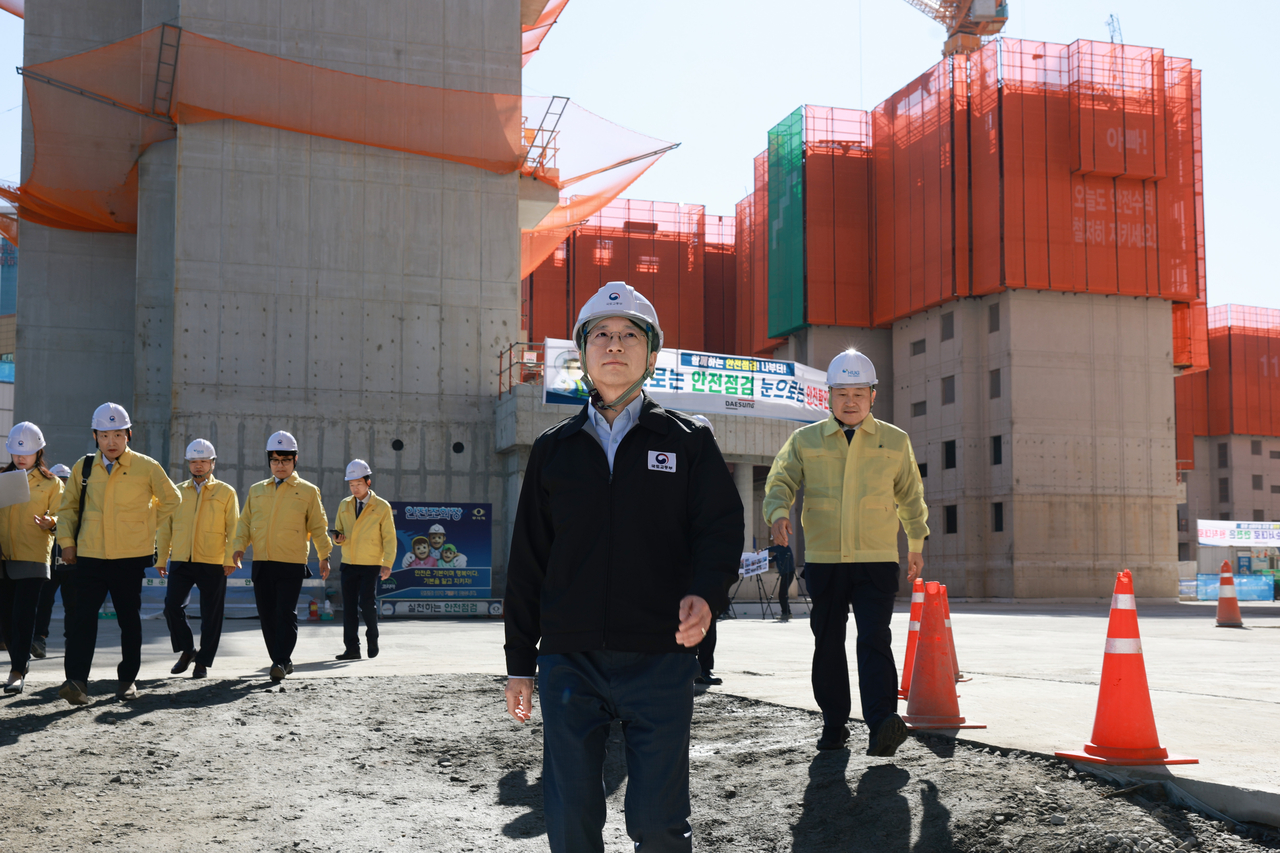
"For the greater Seoul area to achieve the target of breaking ground on 1.5 million or more units, the role of the private sector is more important than anything else."
Land, Infrastructure and Transport Minister Hong Ji-seon made the remarks Thursday during a visit to the Daesung Berhill private housing development in Seoul's Godeok Gangil district. It was her second visit to a housing construction site since taking office; her first was to the third-generation new town project in Bucheon Daejang district.
The visit signals that the government believes its aggressive supply push — informally dubbed "just supply it" — can only be fully realized if the private sector joins the public sector in accelerating housing construction.
Hong said the private sector, which has historically accounted for more than 80 percent of housing supply in the greater Seoul area, is indispensable to delivering on the government's five-year pledge of 1.5 million or more housing starts in the metropolitan area. She said the government had put together an Aug. 13 rapid housing supply plan to quickly reverse the private-sector supply slump that has continued since 2022, and that follow-up steps are proceeding on schedule.
She added that the government's easing of urban and architectural regulations, along with financial and tax relief measures, is beginning to show results, and that local governments and the industry are responding to the administration's pro-supply stance. Building permits — a leading indicator of housing supply — are recovering, particularly in regulated areas such as Seoul, she said. "We will marshal the full strength of the pan-government effort to ensure that the recovery in permits translates into actual ground-breakings and completions, so that people can feel the real impact of increased housing supply," Hong said.
She also called on the Korea Housing and Urban Guarantee Corporation to ensure that project financing guarantees are extended swiftly and without disruption, so that construction finance does not become an obstacle to housing supply. Under the Aug. 13 measures, the government plans to expand Korea Housing and Urban Guarantee Corporation and Korea Housing Finance Corp. project financing guarantees to provide 86 trillion won ($64.2 billion) from this year through 2028.
Hong also noted that even in regulated areas of the greater Seoul area where housing is urgently needed, a significant number of projects have received permits but have yet to break ground due to financing and regulatory hurdles. She said that while several support bodies are already operating to help individual housing projects resolve difficulties, the government plans to soon launch a cross-ministry integrated support agency. The new body will provide close, stage-by-stage assistance covering the pre-permit, post-permit pre-construction, and post-construction phases.
Hong's emphasis on private-sector housing supply reflects her determination to push follow-up measures from the Aug. 13 plan more forcefully at a time when meeting this year's supply targets is proving difficult. At a National Assembly audit of the Ministry of Land, Infrastructure and Transport held Wednesday, Hong acknowledged that the metropolitan area's ground-breaking target of 268,000 units this year would likely fall short. Responding to a question from People Power Party lawmaker Jeong Hee-yong, she said, "It is true that our supply performance is slightly below what the government originally planned," adding that she expected to achieve roughly 80 to 88 percent of the target. That would translate to approximately 214,000 to 236,000 housing starts.
Meanwhile, Hong also used her first social media post since taking office on Thursday to pledge a large-scale housing supply push in the greater Seoul area. Writing on her X account, she said the president had recently directed the ministry to actively pursue a rapid expansion of housing supply in the metropolitan area and to promote the provision of long-term public rental housing for young people and the middle class. She outlined plans to supply up to 53,000 units by 2030 through public housing sites including third-generation new towns, to push stalled projects that have received permits to break ground, to address permit delays, and to provide long-term public rental housing for young people, newlyweds and middle-income households.
smh@heraldcorp.com