Fiscal stabilization reserves of 14 non-Greater Seoul cities and provinces fall from 754.6 billion to 346.7 billion won; local co-funding obligations for national projects rise 23.4% in four years
Emergency fiscal reserves set aside by non-Greater Seoul regional governments have fallen to less than half their level of three years ago, while the amount local governments nationwide must contribute to nationally funded projects has climbed to nearly 45 trillion won ($33.5 billion) this year. With crisis buffers shrinking and co-funding obligations growing, calls are mounting for measures to strengthen local governments' ability to manage fiscal shocks on their own.
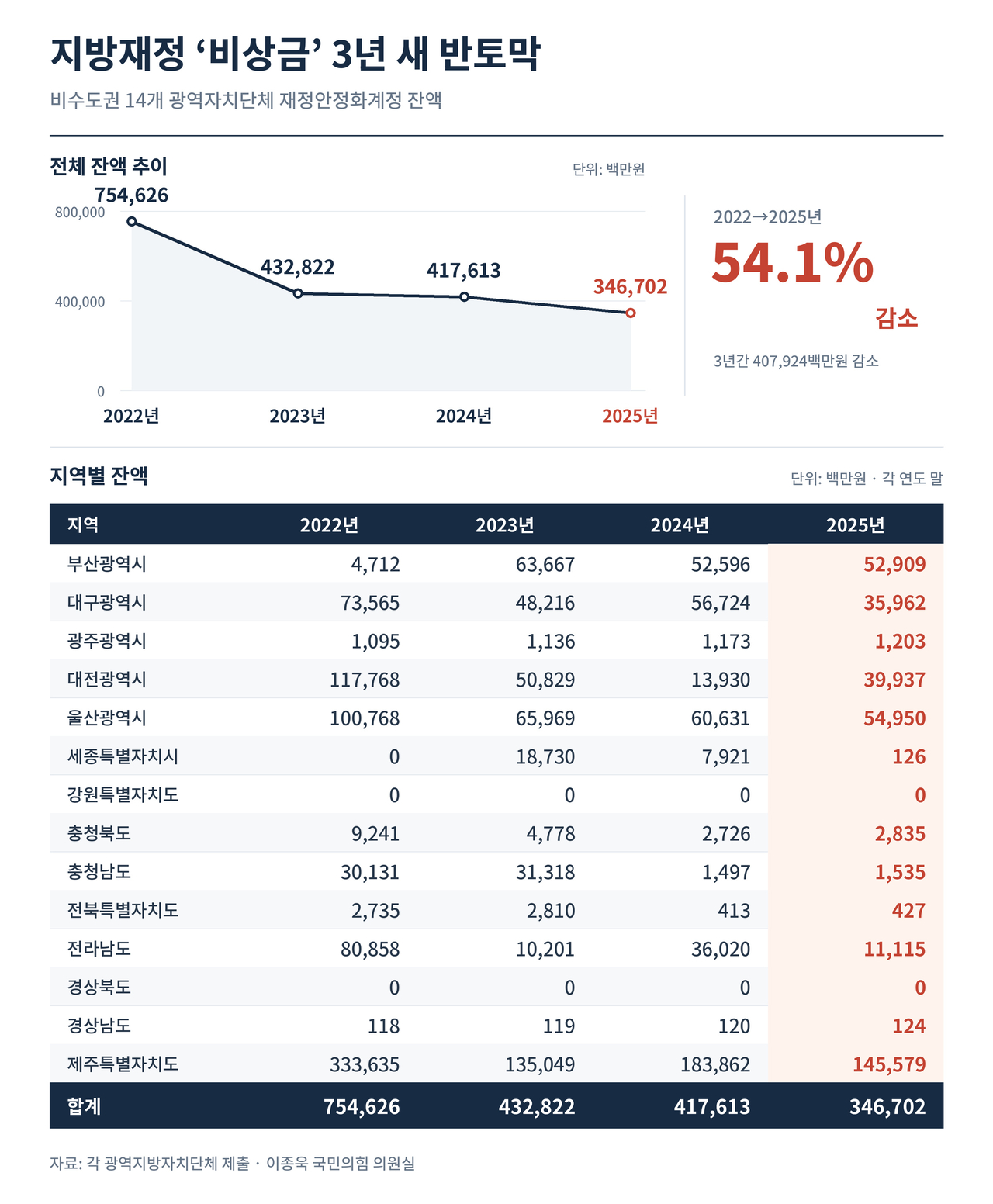
According to data compiled by People Power Party lawmaker Lee Jong-wook of the National Assembly's Finance and Economy Planning Committee from 14 non-Greater Seoul metropolitan and provincial governments, the combined balance in their fiscal stabilization accounts fell from 754.6 billion won at the end of 2022 to 346.7 billion won at the end of 2025 — a drop of 407.9 billion won, or 54.1%, over three years.
Fiscal stabilization accounts function as a form of local emergency fund, built up from surplus tax revenue and budget settlement surpluses. Local governments draw on them when unexpected fiscal demands arise — such as during an economic downturn — or when they need to service local bond principal and interest.
Among regions, South Chungcheong Province recorded the steepest decline. Its balance fell from 30.1 billion won at the end of 2022 to 1.5 billion won at the end of last year, a drop of 94.9%. Over the same period, South Jeolla Province saw its reserves fall from 80.9 billion won to 11.1 billion won, down 86.3%, while North Jeolla Province's balance dropped from 2.7 billion won to 400 million won, a decline of 84.4%. North Chungcheong Province also saw its reserves shrink from 9.2 billion won to 2.8 billion won, down 69.3%.
As these buffers outside the greater metropolitan area have eroded, the financial burden on local governments from nationally subsidized projects has grown. Local co-funding obligations require municipalities to share the cost of projects that the central government supports.
Data from the Ministry of Interior and Safety show that local co-funding obligations for national subsidy projects nationwide rose from 36.4 trillion won in 2022 to 44.9 trillion won this year — an increase of 8.5 trillion won, or 23.4%, in four years. Education-related obligations more than tripled, from 1.4 trillion won to 4.5 trillion won, while social welfare obligations expanded from 18.2 trillion won to 20.9 trillion won.
The introduction of a future response fund reflected in next year's government budget proposal is also tied to the debate over local fiscal resilience. A formula change resulting from the fund's introduction means next year's proportional local allocation tax has been set at 30.5 trillion won less than it would have been under the existing formula.
The government maintains that the future response fund is designed to reduce volatility in local allocation tax transfers and to support local governments whose fiscal conditions have deteriorated.
However, concerns have emerged that if the central government strengthens its control over the scale and timing of support through the fund — at a time when local governments' own mobilizable resources are shrinking — local crisis response could become increasingly dependent on central government decisions. Observers argue that alongside after-the-fact central government support, local governments must secure sufficient general revenue and fiscal buffer capacity to absorb shocks on their own.
"The sharp drop in fiscal stabilization account balances among non-Greater Seoul local governments is a signal that their capacity to handle fiscal shocks independently is weakening rapidly," Lee said. "Before relying on central government support through the future fund, local governments must be given enough general revenue and fiscal buffer capacity to prepare for crises on their own."
fact0514@heraldcorp.com