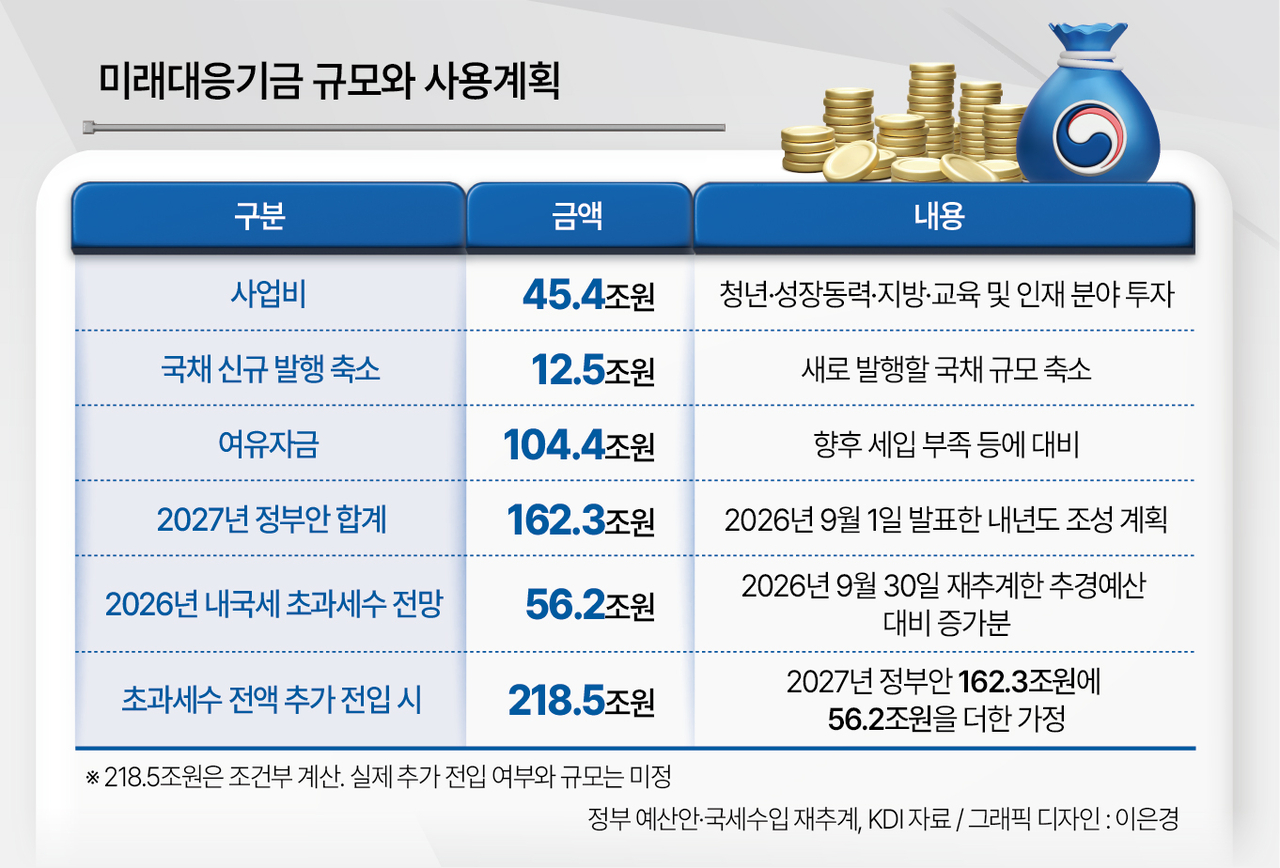
Adding this year's surplus domestic tax revenue to the government's 162.3 trillion won plan puts the total at 218.5 trillion won
With 45.4 trillion won earmarked for projects and 104.4 trillion won held in reserve, the balance between investment and emergency savings is key
Ireland separates long-term savings from cyclical stabilization funds — how to distribute local governments' share is also unresolved
![Democratic Party of Korea leader Kim Min-seok (center) speaks at a ruling party-government consultation on the future response fund at the National Assembly members' office building. [Yonhap]](https://wimg.heraldcorp.com/news/cms/2026/10/07/news-p.v1.20260929.87a99d5ea3d640ec8d1d6ee2c1be166c_P1.jpg)
As the future response fund approaches the 200 trillion won ($149 billion) mark, the central question is where, when and how much of the accumulated money will actually be spent.
The government plans to pool tax revenues swelled by a semiconductor boom and use them to invest in growth while building a cushion against downturns. Because money for near-term projects and money to be drawn down when tax receipts eventually fall will sit inside a single fund, the priority given to each purpose has become a critical design question.
The government's bill specifies which taxes will flow into the fund and identifies key investment areas — youth, growth engines, regional development, education and talent. During National Assembly deliberations, lawmakers will need to weigh which projects should receive funding first, how much should be kept as an emergency reserve, and under what conditions withdrawals would be permitted. How the fund's accumulation at the center affects the share flowing to local governments is a related issue that will also need to be addressed.
The government's fiscal 2027 budget proposal, released Sept. 1, includes a plan to build a 162.3 trillion won future response fund next year. The idea is to channel into the fund revenues that exceed the long-term trend in tax growth, based on next year's projected tax intake. That plan was announced before the government released its revised estimate of this year's national tax revenue on Sept. 30.
Since then, this year's tax revenue has been projected to come in higher than expected, opening the possibility of additional resources flowing into the fund. The Ministry of Economy and Finance revised its estimate of this year's national tax revenue upward to 478.6 trillion won on Sept. 30 — 63.2 trillion won more than the 415.4 trillion won reflected in the supplementary budget. Of that increase, 56.2 trillion won comes from domestic taxes.
Adding the full 56.2 trillion won in projected additional domestic tax revenue this year to the 162.3 trillion won fund-building plan for next year produces a combined figure of 218.5 trillion won. That said, this is simply an arithmetic sum of two separate amounts. The actual size of the fund will depend on how much tax is ultimately collected and how much of it is transferred into the fund. The fund establishment law, related amendment bills and next year's budget must all clear National Assembly review.
45 trillion won for projects, 104 trillion won in reserve — the criteria for when and where to spend are what matter
The government has outlined three uses for the 162.3 trillion won.
Some 45.4 trillion won will be invested in youth self-reliance, future industry development, regional growth, and education and talent cultivation. Another 12.5 trillion won will be used to reduce government bond issuance — effectively cutting the amount the government needs to borrow.
The remaining 104.4 trillion won will be held within the fund and managed as a buffer against future shortfalls in tax revenue. The government calls this the "surplus funds" portion. Roughly 28 percent of the total is earmarked for project spending, while about 64 percent constitutes the surplus reserve.
For this reason, comparing the fund's total with already-accumulated assets such as the national pension can be misleading. The 162.3 trillion won figure represents a plan for future accumulation and disbursement. How much actually remains in the fund will depend on how much is collected and how much is spent.
The government's bill also sets out the fund's spending categories and operating procedures.
The fund would be divided into a general account and sub-accounts covering youth, growth engines, regional development, education and talent. Money could be transferred to other accounts or used to support programs in those areas to promote fiscal stability. Each ministry would submit an annual fund-use plan, and a fund management deliberation council would review and approve major operational decisions.
Questions have also arisen about whether specific projects align with the fund's stated purpose. According to reports citing project descriptions submitted to the National Assembly, next year's proposed expenditures include 5.67 billion won for securing ministerial residences and 100 billion won in special allowances and incentives for public institution employees. Critics worry that a fund created for growth investment and crisis preparedness could end up covering routine ministerial operating costs.
Concerns have also been raised that the National Assembly's ability to control spending could be weakened. The government's proposed amendment to the National Finance Act would allow spending under major fund categories to be adjusted by up to 30 percent without resubmitting a revised plan to the Assembly — a wider margin than the 20 percent allowed for ordinary project-type funds. The government maintains that the fund operating plan itself goes through Assembly review and approval, and that any changes must follow legally prescribed procedures.
Expanding multi-year programs during a boom makes it difficult to cut spending later when tax revenues fall. At that point, the question becomes whether to use the fund to cover the revenue shortfall or to sustain programs already underway. This is precisely why the amount set aside as a rainy-day reserve must be calculated alongside any increase in project spending.
The 104.4 trillion won earmarked as a reserve can be benchmarked against recent tax shortfalls. In 2023, national tax revenue came in 56.4 trillion won below budget; in 2024, the shortfall was 30.8 trillion won. The combined two-year gap of 87.2 trillion won means the planned reserve is about 1.2 times that amount.
If the money is accumulated as planned, the government would have room to absorb a downturn in semiconductor-driven tax revenues. Drawing on the fund to cover shortfalls would reduce the need to abruptly cut programs or take on additional debt. That said, the 104.4 trillion won is still a target figure in a plan. The fact that it exceeds the combined shortfalls of the past two years alone is not sufficient grounds to conclude it would be adequate to handle a similar crisis in the future.
Once money enters the fund, it must also be accessible when needed. The government's bill would allow surplus funds to be deposited with financial institutions or invested in financial assets such as shares and bonds. Even assets capable of generating long-term returns can produce losses if they must be sold quickly at depressed prices. For the reserve to function as an emergency buffer, a portion must be kept in a form that can be converted to cash on short notice.
Ireland offers a useful reference. It too relies heavily on corporate tax revenue from a small number of multinational companies. According to estimates by Ireland's Fiscal Advisory Council, the top three corporate groups accounted for 46 percent of corporate tax receipts in 2024 — a figure that excludes one-off revenue from the Apple ruling. A shift in the earnings or business structure of a handful of companies can cause significant swings in national tax income.
To guard against that risk, Ireland established two separate funds in 2024, each calibrated to a different spending purpose and time horizon. The Future Ireland Fund is designed to meet long-term fiscal pressures, while the Infrastructure, Climate and Nature Fund is intended to support government spending during economic downturns. The two funds separate money meant for the distant future from money meant to cushion near-term shocks.
The Future Ireland Fund is a long-term savings vehicle built to cover spending pressures expected to grow from aging and climate change. The baseline rule is to contribute 0.8 percent of GDP each year from 2024 through 2035. Contributions can be reduced if fiscal conditions deteriorate sharply, but accumulated funds cannot be withdrawn before 2041. The restriction serves as a safeguard against raiding long-term savings to meet immediate spending demands.
The Infrastructure, Climate and Nature Fund functions more as an emergency reserve against economic shocks. It is designed to support government spending when economic or fiscal conditions deteriorate significantly or are expected to do so — preventing sharp cuts to infrastructure investment when tax revenues fall. Between 2026 and 2030, it can also be used for designated environmental projects. Withdrawals must follow legally prescribed procedures and limits.
The investment strategy for each fund is also matched to its intended time horizon. The Future Ireland Fund, managed over the long term, holds a higher share of equities. The Infrastructure, Climate and Nature Fund, which may need to be tapped during a downturn, is managed primarily in low-risk, liquid assets such as cash and high-grade bonds.
South Korea's 104.4 trillion won surplus reserve is functionally similar to Ireland's cyclical stabilization fund in that both are intended to cover revenue shortfalls. However, unlike Ireland's structure, the South Korean government's plan does not include a separate long-term savings vehicle with withdrawal restrictions extending far into the future.
When funds pool at the center, what goes to local governments? The gap between statutory allocation and fund grants
Another contested issue surrounding the fund's use is support for local governments. Some of the money slated to enter the fund would, under current law, be distributed to local governments. Pooling that money in a central fund and determining local support separately would change how local governments receive their share.
The local allocation tax is a mechanism by which the central government distributes a portion of its tax revenue to supplement local government finances. The primary source is 19.24 percent of domestic tax revenue after legally specified deductions. When the tax base grows, the amount flowing to local governments grows with it.
The government's proposed amendment to the Local Allocation Tax Act would exclude money transferred into the future response fund from that calculation — effectively removing the fund contribution from the tax base before computing local governments' share.
To illustrate the structure simply: if the tax base subject to the allocation formula is 100 won, local governments currently receive 19.24 won. If 30 won is transferred to the fund and excluded from the base, the remaining 70 won yields about 13.47 won — a reduction of nearly six won even though the allocation rate itself is unchanged. Shrinking the tax base reduces the local share regardless of the distribution ratio.
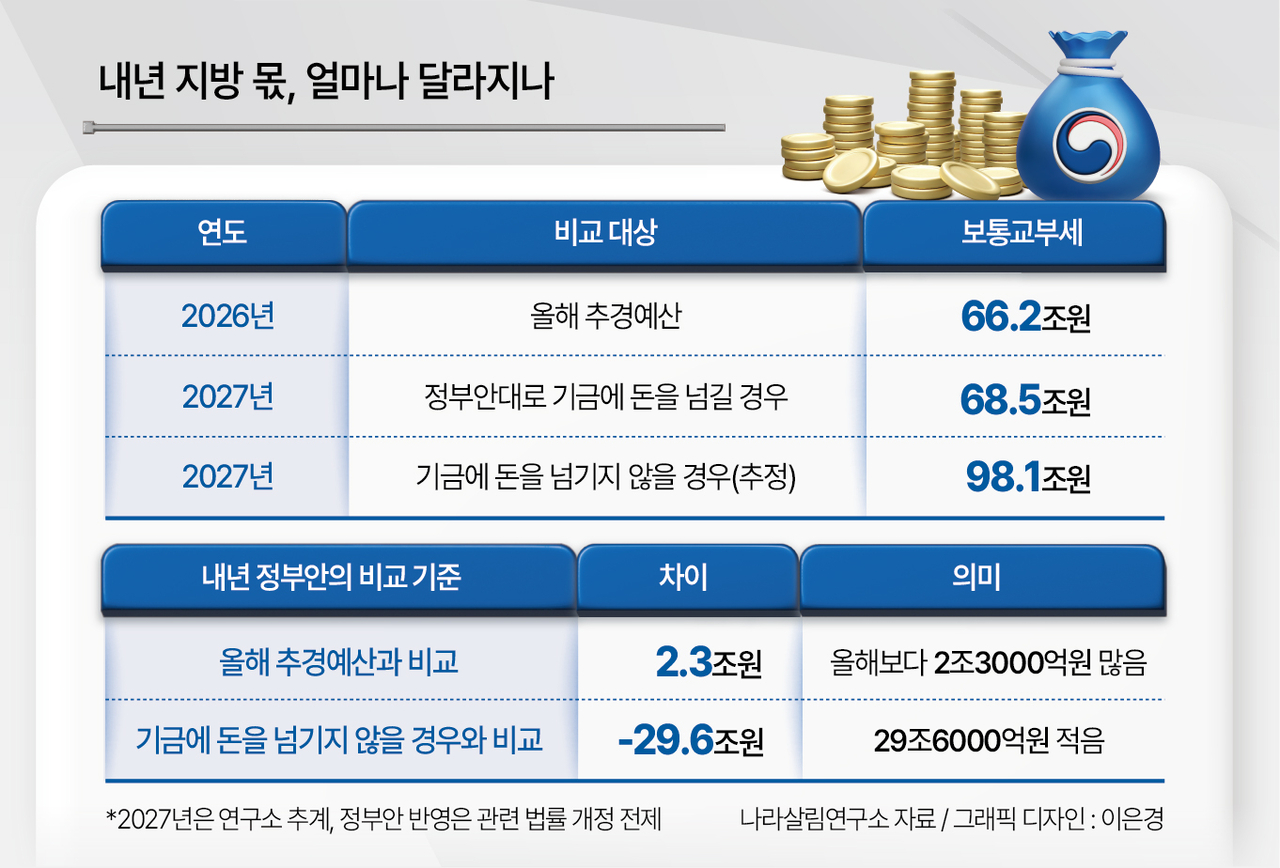
An analysis of next year's budget by the Narasallim Research Institute found a similar gap. The ordinary local allocation tax — the portion local governments can spend according to their own needs — was estimated at 98.1 trillion won next year without any fund transfer, and at 68.5 trillion won under the government's plan. The difference between the two scenarios is 29.6 trillion won.
This does not mean local governments would receive 29.6 trillion won less than this year. The 68.5 trillion won figure is still 2.3 trillion won more than the 66.2 trillion won reflected in this year's supplementary budget. Local governments would receive more than this year in absolute terms, but less than they would have received had the additional tax revenue been distributed under the existing formula.
A separate issue is the "additional settlement" — the process of distributing to local governments the portion of any surplus tax revenue collected this year. When the government draws up a budget, it estimates tax revenue and allocates local allocation tax accordingly. If actual collections exceed that estimate, the corresponding additional local share must be settled afterward.
In a report released Sept. 30, the Narasallim Research Institute estimated that if this year's domestic tax revenue comes in 56.2 trillion won above the supplementary budget level, the additional ordinary local allocation tax settlement would amount to about 10.5 trillion won ($7.82 billion). If the entire surplus is transferred into the fund and excluded from the allocation formula, local governments could lose access to that additional amount.
This, too, does not mean already-budgeted local spending would be cut. The gap arises from the difference between what local governments could additionally receive because more tax was collected than expected. The actual figures will depend on final tax collections, the amount transferred into the fund, and the content of any legislative amendments.
The government also plans to channel support to local governments through the fund itself. It intends to provide 3.5 trillion won in local future growth grants next year, which local governments would be free to spend as they see fit. The proposed amendment to the Local Allocation Tax Act also includes a provision allowing additional support from the fund to local governments when their finances come under strain.
However, the rules governing existing allocation tax and fund grants differ in important ways. The allocation tax is determined by how much tax is collected and a formula set in law. The fund grant amount is decided each year through the budget and the fund operating plan.
From a local government's perspective, this creates uncertainty about how much they can expect to receive. Even if grants are freely spendable, the amount is not guaranteed in advance. A provision allowing additional support when finances are difficult is also not the same as a commitment to fully replace any reduction in allocation tax.
It is also difficult to calculate local governments' net gain or loss by simply subtracting next year's 3.5 trillion won grant from the roughly 10.5 trillion won in estimated surplus settlement for this year. One figure represents the distribution of additional tax collected this year; the other is a fund grant plan for next year. The reference year, the basis of calculation and the distribution method all differ and must be examined separately.
Which taxes are channeled into the fund also determines how the proceeds are split between the center and local governments. What the government calls "additional tax revenue" refers to the portion exceeding the long-term trend in tax growth, while "surplus tax revenue" refers to collections above the government's own budget estimate.
The surplus figure is also affected by the accuracy of the government's forecast. If actual collections are 100 won and the government projected 90 won, the surplus is 10 won; if it projected 80 won, the surplus is 20 won. The same amount of tax collected produces a different surplus depending on the forecast.
The Narasallim Research Institute said that if such surplus revenue is transferred into the fund and excluded from the local allocation tax formula, the government's forecasting errors could end up reshaping the split between central and local governments. The institute said that alongside the goal of accumulating funds during boom years, the criteria for deciding how much to transfer into the fund also need scrutiny.
Money distributed to local governments can also be set aside as a buffer against downturns. The institute suggested that local governments could deposit funds into their integrated fiscal stabilization funds — which function as local emergency reserves — or use them to pay down local debt. Assessing the country's overall resilience to a tax revenue shock requires looking not only at the central fund balance but also at what local governments have saved and what debt they have reduced.
As the fund grows larger, the criteria for determining how money is spent must become as concrete as the formula for accumulating it. The questions of which projects to prioritize, how much to hold in reserve and how to distribute funds to local governments are all interconnected. Only by resolving them can the government sustain investments begun during a boom while retaining the capacity to respond when conditions deteriorate.
Lee Tae-seok, head of the fiscal and social policy research division at the Korea Development Institute, said at a forum on the fiscal 2027 budget and the future response fund held Sept. 11 that the government should first secure funds available for use in a crisis, then reduce debt risks and pursue well-prepared growth investments as fiscal conditions allow. He called for objective criteria governing how much to accumulate and when to draw down the fund, independent evaluation of its performance, and National Assembly oversight.
fact0514@heraldcorp.com