![Kospi and Kosdaq readings are displayed on a board at Hana Bank's dealing room in Seoul on Wednesday. [Yonhap]](https://wimg.heraldcorp.com/news/cms/2026/10/07/rcv.YNA.20261007.PYH2026100701850001300_P1.jpg)
The share buybacks by Samsung Electronics and SK hynix, which have served as a reliable source of buying in the domestic stock market, are entering their final stages.
Samsung Electronics has already exceeded its planned purchase volume, and SK hynix is on track to complete its buyback more than a month ahead of schedule if the current pace holds. The market views the conclusion of both companies' large-scale buyback programs as a turning point for the "other corporations" investor category, which has been underpinning the Kospi in recent weeks.
According to Korea Exchange data, Samsung Electronics had purchased 55.8 million shares through Tuesday, surpassing its target of approximately 53.29 million shares announced Aug. 21. The execution rate by share count stands at 104.72%, meaning the company has already exceeded its goal, and its buyback is considered to be effectively winding down.
In terms of spending, however, a small amount of room remains. Samsung Electronics set a total buyback budget of 15 trillion won ($11.2 billion), of which it has spent approximately 14.7 trillion won, leaving roughly 300 billion won. The company is expected to continue purchasing shares until cumulative spending reaches the full 15 trillion won.
The market is paying even closer attention to when SK hynix will wrap up its buyback. Of the 24.07 million shares SK hynix announced it would repurchase on Aug. 19, the company had bought back 18.85 million shares through Tuesday, for an execution rate of 78.31%. About 5.22 million shares remain.
At the recent pace of purchases, the remaining shares are estimated to be absorbed in roughly seven to eight trading days. SK hynix had originally set Nov. 19 as the buyback completion date, meaning the program could finish about a month ahead of schedule if the current trend continues.
Once SK hynix follows Samsung Electronics in completing its buyback, the supply-demand dynamics of the domestic stock market could shift considerably.
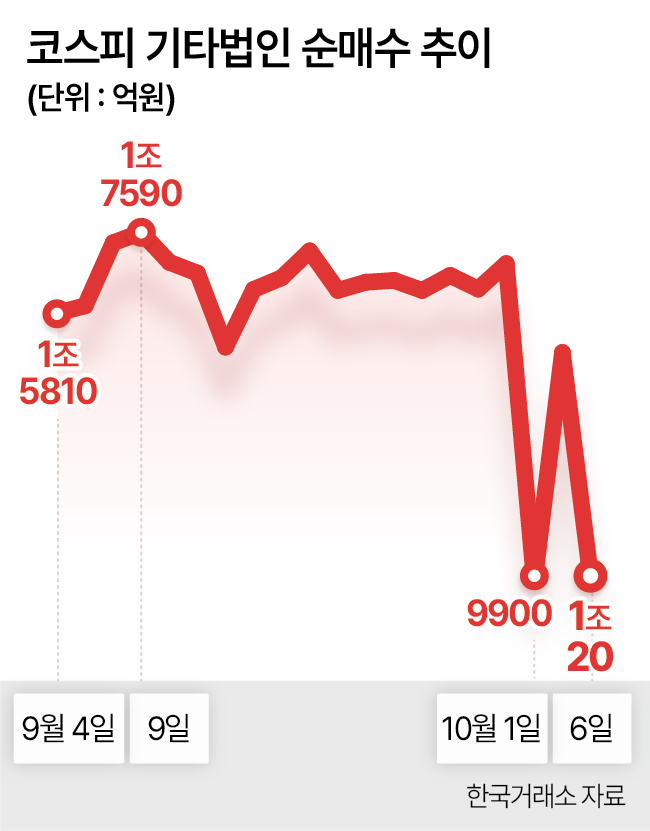
Corporate share buybacks are typically recorded as net purchases by the "other corporations" category in Korea Exchange trading data. The heavy net buying by that category on the main board in recent weeks is widely attributed in large part to the buyback activity of Samsung Electronics and SK hynix.
On Tuesday, other corporations posted net purchases of approximately 1 trillion won on the Kospi — still a sizable figure, but well below the daily average of roughly 1.58 trillion won recorded over the preceding month from Sept. 4 through Tuesday.
Once both buybacks conclude, the center of gravity in market supply and demand is expected to shift back to the three traditional investor groups: retail investors, foreigners and institutions. Where other corporations have been absorbing selling pressure from foreigners and institutions — cushioning the index from below — that buffer role will weaken going forward.
Particularly concerning is the recent instability in foreign investor flows. On Tuesday, retail investors net bought 740.5 billion won worth of Kospi shares, but foreigners net sold 1.75 trillion won.
Other corporations absorbed much of that foreign selling with 1 trillion won in net purchases, but once the buybacks end, buying of that scale may be difficult to replicate. That means foreign investor trading direction could have a greater influence on Kospi swings than before.
Because foreign investors react sensitively to external variables such as US interest rates and the dollar's value — not just domestic corporate earnings — the Kospi itself may become more directly exposed to the broader macroeconomic environment. As the steady stream of buyback-driven demand fades, fewer market participants will be able to absorb foreign selling during periods of rising rates or risk aversion.
Tuesday's session illustrated the dynamic. Even as US equities rose, the yield on the 10-year US Treasury bond surged to as high as 5.347% during trading over the holiday period, prompting foreigners to net sell more than 1.7 trillion won in Kospi spot shares and post net selling of 455 billion won in KOSPI 200 futures.
Analysts say that once both buybacks are fully complete, the impact of foreign capital flows — driven by US Treasury yields and exchange rates — on the index will be greater than before.
The role of institutional investors will also grow in importance. If foreigners continue to be net sellers after the large-scale other-corporation buying disappears and institutions join in selling as well, retail investors would be left as virtually the only buyers supporting the index. Conversely, if institutions such as pension funds step in as buyers, they could partially fill the supply-demand gap left by the end of the buybacks.
"Given how large a role the big semiconductor stocks' buybacks have played in other-corporation net purchases recently, we need to see how much that buying shrinks once SK hynix also wraps up," a securities industry official said. "From that point on, whether foreigners and institutions are net buyers will have a bigger influence on the index's direction than before."
th5@heraldcorp.com