'Yeollin Uri Party suffered after National Security Law dispute'
'Hardliners have gotten most of what they demanded on prosecution reform — and then some'
'Once reform goals are met, focus must shift to livelihoods' — finance, housing highlighted
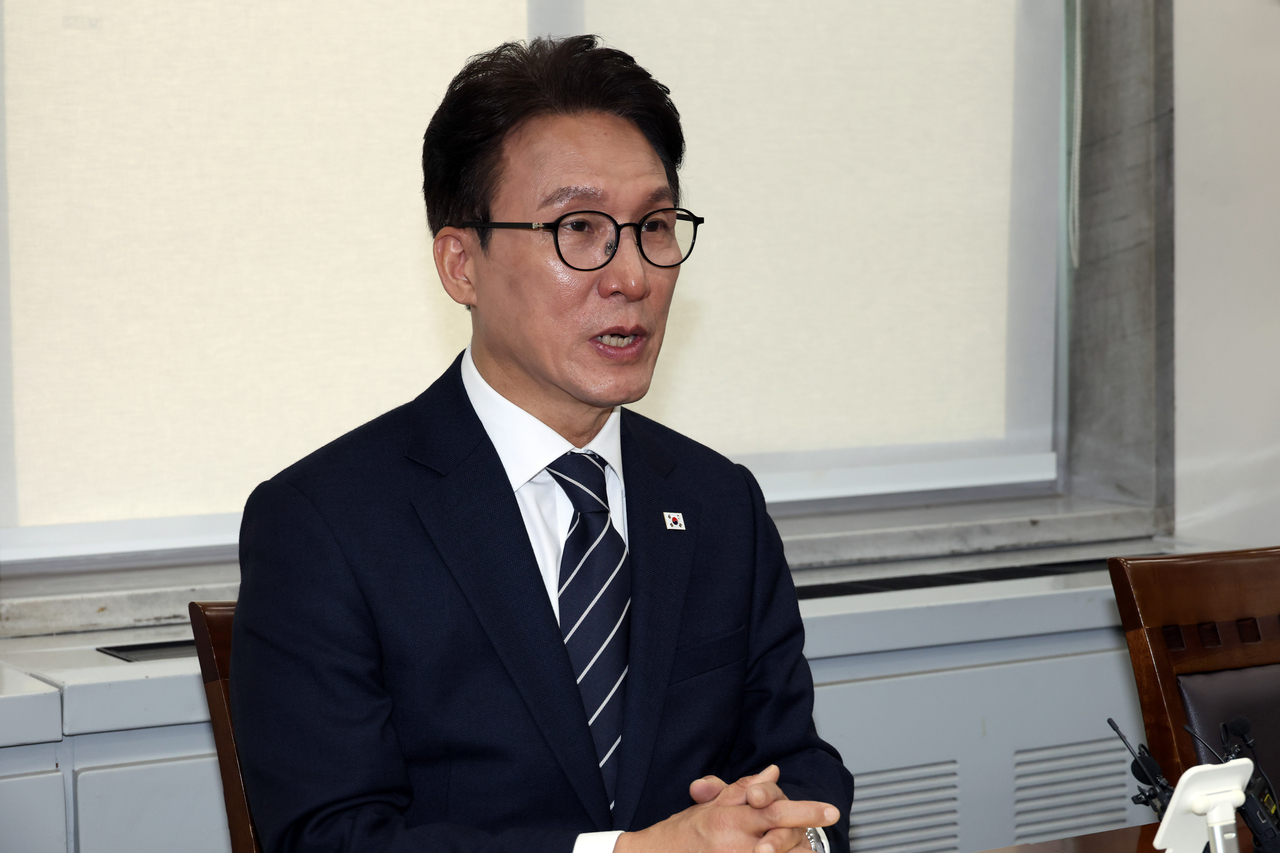
Democratic Party of Korea leader Kim Min-seok said Tuesday that "the substance of results matters just as much as the clarity of reform goals," invoking the controversy over the National Security Law during the Roh Moo-hyun administration. He also said the party should now "exercise some restraint" when excessive demands risk undermining President Lee Jae Myung's leadership.
Speaking on the Democratic Party's YouTube channel "Minti 07" that day, Kim said the tension "between the clarity of a goal and the reality of what gets achieved" was illustrated by the debate over revising or abolishing the National Security Law during the Yeollin Uri Party era — a case he said the president himself had recently referenced.
"When that issue wasn't resolved cleanly, it ended up going nowhere," Kim said. "And it wasn't just that the issue itself failed — the Yeollin Uri Party, starting from that point, went on to face sustained political difficulties."
President Lee had raised the same episode at a meeting with Korean diaspora members during his state visit to Mexico on Sept. 24 (local time), pointing to how a proposal to remove certain toxic clauses from the National Security Law — short of full abolition — was derailed by opposition from those demanding complete repeal.
Lee said at the time that "being principled may look impressive, but actually producing good outcomes is not easy," adding that "moving too fast, too far, too urgently invites a backlash." Observers inside and outside the ruling camp interpreted the remarks as directed at Kim Ji-yong, the inaugural head of the new Serious Crimes Investigation Agency, and writer Yoo Si-min.
Kim also said that those who had most loudly demanded prosecution reform "have had most of their demands met — and more." He said that with the focus now needing to shift to livelihood reform, "if excessive demands or claims risk damaging the broader reform front, the overall direction, or the president's own leadership — as happened in the past — I think the party now needs to exercise some restraint."
The remarks were widely read as an indirect rebuke of hardliners within the ruling camp who have continued to push back against Kim Ji-yong's nomination as the first head of the Serious Crimes Investigation Agency, labeling him as aligned with former President Yoon Suk Yeol, and as a signal of Kim's intent to refocus on people's livelihoods.
"We cannot hold on to each individual reform indefinitely," Kim said. "Once we have moved past the stage of producing tangible results, it seems right to keep shifting focus toward issues directly tied to people's lives." He added that the president's three major social reforms and three mega growth projects form two pillars of the agenda, with reducing polarization remaining central.
On the tone of the national audit beginning that day, Kim said the priority should be "measures addressing finance, employment — particularly youth employment — and housing, which could be overlooked amid the focus on growth." He said the ruling party and the National Assembly should play their proper roles in checking whether the government is missing anything or falling short in its broader direction.
addressh@heraldcorp.com