Ruling party, FSC agree on governance overhaul for financial firms
Third-term CEO renewals to require three-quarters approval from nomination panel, shareholders
Independent director nomination rights, clawback provisions among key measures
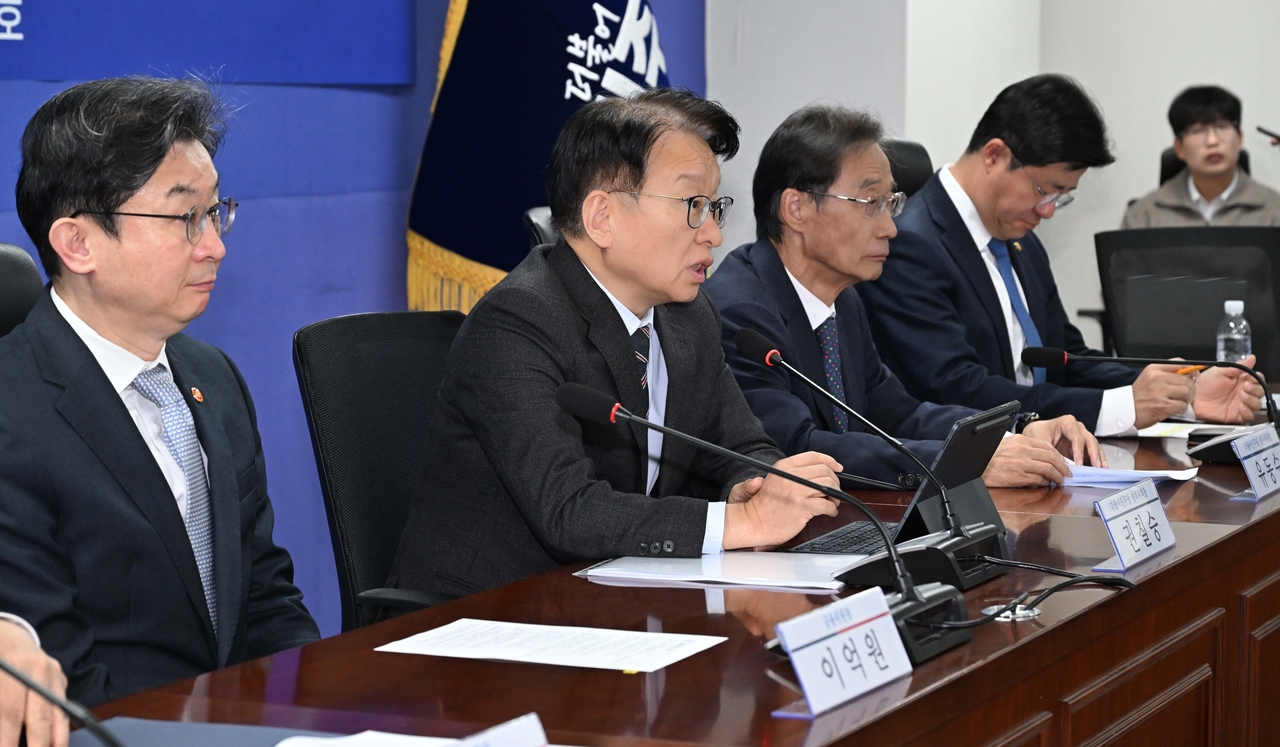
The ruling party and the government said Thursday they will require executive candidate recommendation committees — the bodies that nominate CEOs of financial holding companies — to be composed entirely of independent directors, and will progressively tighten the approval thresholds required for CEO renewals. Shareholders will also be given the right to nominate independent directors and to exercise greater control over executive compensation.
The Democratic Party of Korea and the government held a consultative meeting at the National Assembly on Thursday to discuss governance reform at financial companies, announcing plans to introduce an independent director system for financial holding firms. Democratic Party Policy Committee Chairman Kwon Chil-seung, National Assembly Financial Services Committee Chairman Yoo Dong-su, FSC Chairman Lee Eok-won and Financial Supervisory Service Director General Lee Chan-jin attended the meeting.
Kwon said some financial company CEOs had repeatedly engaged in what he called "self-renewal" — stacking their boards with close associates who would then nominate the same CEO for another term. "The voices of shareholders and institutional investors have not been adequately reflected, and there has been a persistent practice of receiving high pay tied to long-term performance without being held accountable for the results," Kwon said.
Kwon said the reform package was "not management interference — quite the opposite." "It is about returning power concentrated in a single CEO back to the board and shareholders, enabling the market, including institutional investors, to provide checks on its own, and establishing the principle that performance brings reward and losses bring accountability," Kwon said.
Under the plan, shareholders including institutional investors will be granted the right to nominate independent director candidates. Closed-door sessions composed solely of independent directors will be made mandatory so they can monitor and check management, and CEOs will be prohibited from improperly interfering in board composition or management succession procedures.
Financial Supervisory Service Director General Lee Chan-jin said the agency would move quickly to revise its governance best-practice guidelines and disclosure formats, including requirements to disclose CEO nomination details — covering non-financial criteria — and to publish records of advertising and promotional expenditures.
Approval requirements for CEO appointments and renewals will also be tightened to curb the practice of long-term incumbency. An initial appointment will require the support of at least two-thirds of the executive candidate recommendation committee, while a first renewal will require three-quarters. At the general shareholders meeting, an initial appointment will require a majority vote and the support of at least one-quarter of total issued shares. A second renewal will require approval from at least two-thirds of shareholders and one-third of total issued shares, while a third renewal will require at least three-quarters of shareholders and one-half of total issued shares.
The ruling party and the government also agreed to introduce a "say on pay" requirement, under which companies must explain their executive compensation plans to shareholders at the general meeting. Shareholder oversight will be strengthened by extending the deferral period and ratio for performance-based pay and introducing a clawback provision. National Assembly Financial Services Committee Chairman Yoo Dong-su said the measures were designed to create "a rational compensation system where performance brings reward and losses bring accountability."
FSC Chairman Lee Eok-won said the reform package "carries significance as a shift away from a closed, CEO-centric governance structure toward a more open and accountable structure centered on the board and shareholders." "Through this, we expect financial companies' decision-making to become fairer and more transparent, and the financial industry's sustainable competitiveness to grow on the basis of public and market trust," Lee said.
Financial Supervisory Service Director General Lee Chan-jin said the agency would work to ensure the independent director nomination system takes root now that an institutional foundation for active shareholder rights has been established. "We will continuously monitor implementation to prevent the reforms from being applied in a merely formalistic manner or in ways that deviate from their original intent, and will respond with strict sanctions against any violations of relevant regulations," Lee said.
addressh@heraldcorp.com