NPS's Kosdaq share surges from 3.9% to 40.6% in four years
Civil servant, private school and military pension funds remain at 1–2%
Pension funds step up buying as Kosdaq rebounds toward 1,000-point mark
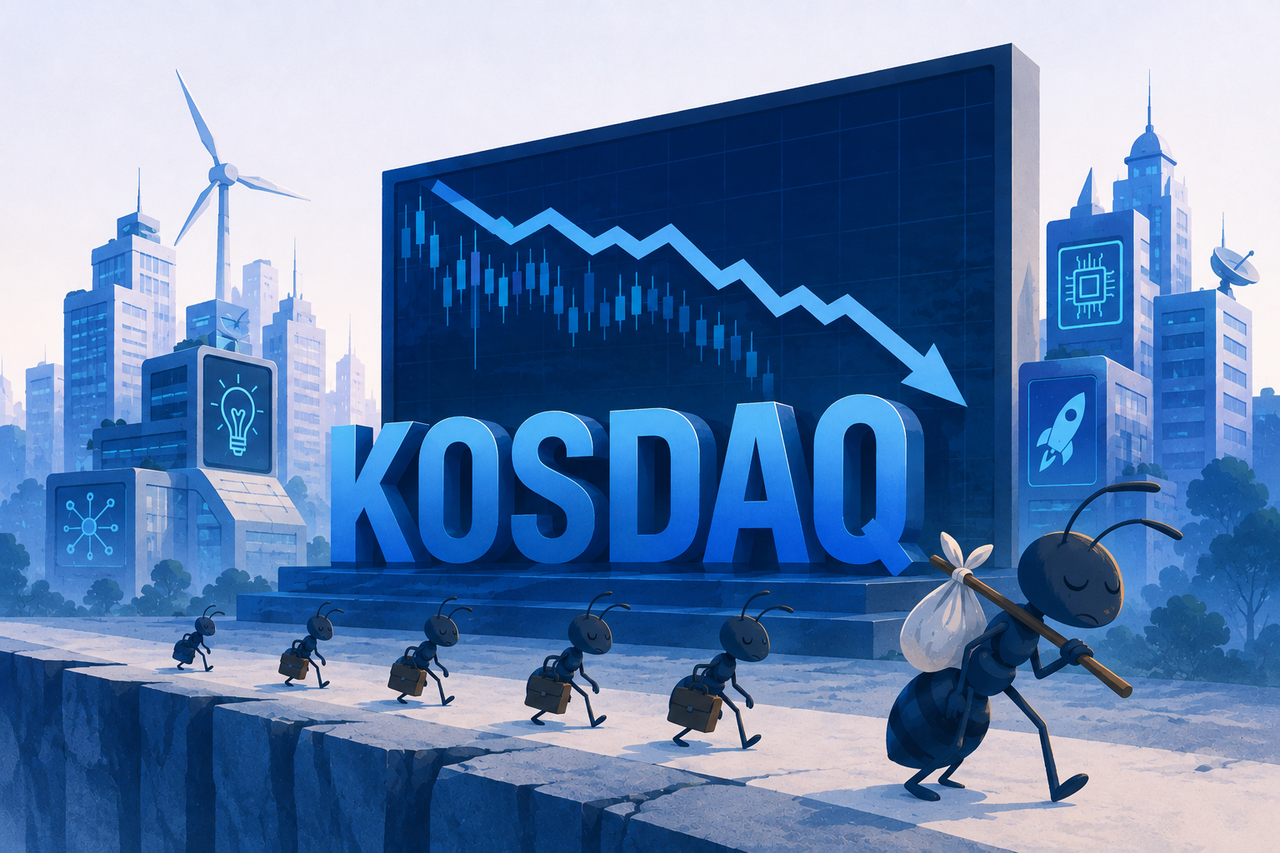
The National Pension Service's investment in the Kosdaq market surpassed 100 trillion won ($73.6 billion) for the first time last year, with Kosdaq's share of the fund's combined domestic equity holdings expanding more than tenfold — from 3.9 percent to 40.6 percent — over four years. By contrast, the civil servant, private school and military pension funds still allocate just 1 to 2 percent of their domestic equity portfolios to Kosdaq, highlighting a sharp divergence in investment strategy among South Korea's major public pension funds.
According to data submitted to Democratic Party of Korea lawmaker Park Min-gyu of the National Assembly's Political Affairs Committee by the four major public pension institutions, the NPS's Kosdaq holdings stood at 106.22 trillion won at the end of last year.
The NPS's total domestic equity investment — combining Kospi and Kosdaq — reached 155.42 trillion won, with Kosdaq accounting for 40.6 percent of that figure.
The NPS has sharply expanded its Kosdaq exposure in recent years. Its investment stood at about 6.4 trillion won in 2021, then surged more than fivefold to 34.7 trillion won in 2022. It dipped to 27.6 trillion won in 2023 before rising to 31.3 trillion won in 2024, and crossed the 100 trillion won threshold last year.
As a result, Kosdaq's share of the NPS's combined Kospi and Kosdaq holdings jumped from 3.9 percent in 2021 to 40.6 percent last year.
The contrast with other public pension funds is stark. The civil servant pension fund's Kosdaq investment fell to 31 billion won last year from 58.8 billion won in 2021, and its Kosdaq allocation as a share of total domestic equity dropped from 4.6 percent to 1.8 percent over the same period.
The private school pension fund's Kosdaq holdings also declined, from 206.8 billion won in 2021 to 160.4 billion won last year, with its Kosdaq share slipping from 4.7 percent to 2.9 percent. The military pension fund saw its Kosdaq investment shrink from 3.8 billion won to 1.4 billion won over the same period, with its allocation falling from 6.3 percent to 2.5 percent.
However, all three funds did increase their Kosdaq investment slightly last year compared with 2024, though none has recovered to its 2021 level.
"Unlike the National Pension Service, which has significantly expanded its Kosdaq investment, the civil servant, private school and military pension funds still maintain a low allocation," Park said. "Pension funds need to channel long-term, stable capital into the market to help nurture the growth of quality and innovative companies and contribute to revitalizing Kosdaq."
With Kosdaq staging a recent rebound, attention is turning to whether pension funds will continue buying. Pension funds and similar institutional investors net purchased 149.1 billion won in Kosdaq in September. Their cumulative net purchases from the start of this year through Friday reached 226.4 billion won — a sharp contrast to the broader institutional sector, which recorded net selling of 1.01 trillion won over the same period.
Kosdaq closed at 893.29 on Friday. During trading, the index climbed as high as 903.88, briefly reclaiming the 900-point level for the first time in about three months since July 2.
Market analysts say the index could reclaim the 1,000-point mark before year-end if gains continue in semiconductor materials, components and equipment, as well as biotech. "Both the semiconductor materials, parts and equipment sector and biotech need to rise together for Kosdaq to stably break through 1,000," said Lee Geon-jae, head of the Kosdaq Research Center at IBK Investment Securities.
Han Yu-geon, head of the future industries team at Hana Securities, also said earnings growth among Kosdaq-listed companies has not been fully reflected in the index, leaving room for further gains.
fact0514@heraldcorp.com