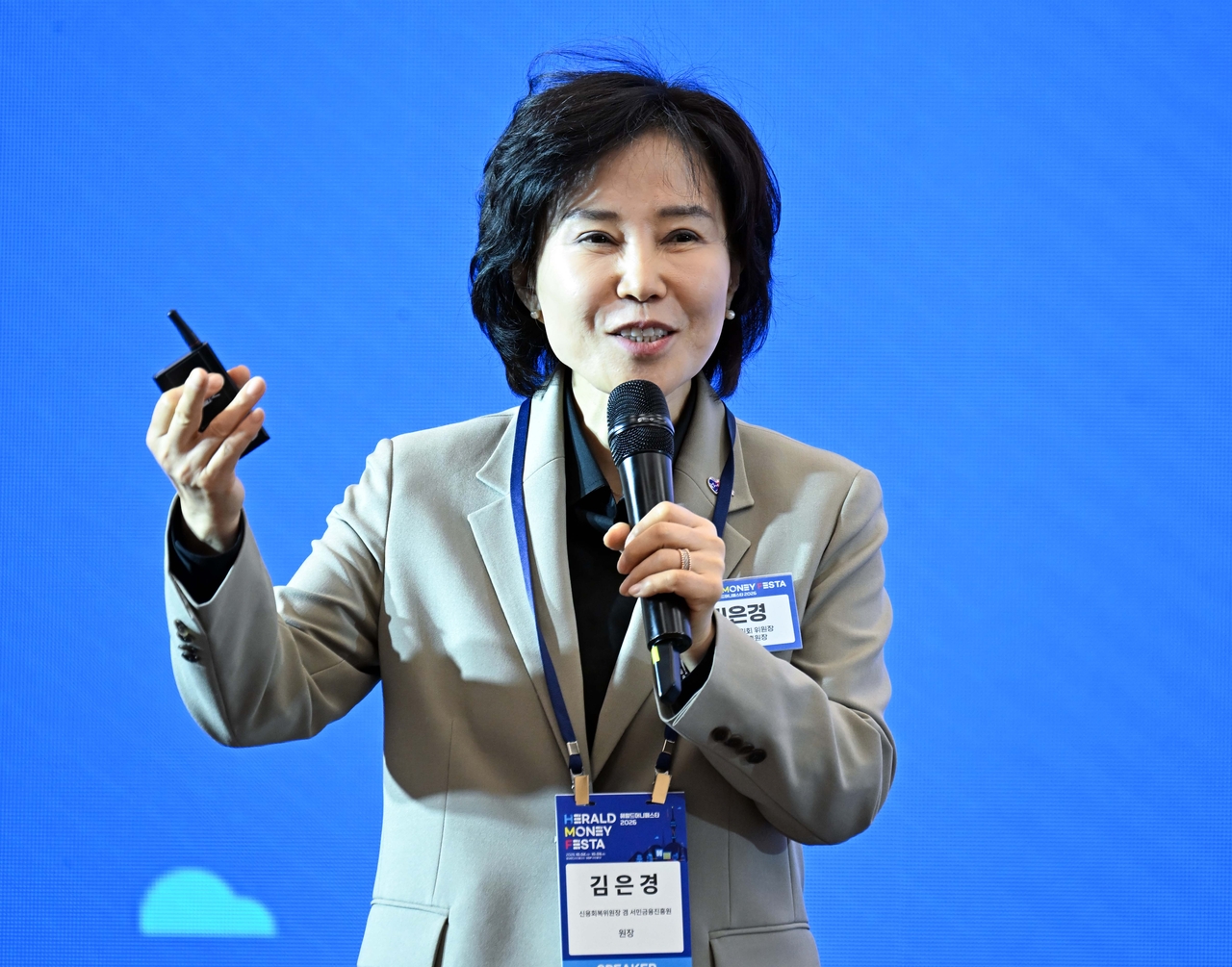
Kim Eun-kyung, chair of Credit Counseling & Recovery Service and head of Korea Inclusive Finance Agency, delivers lecture
Automated transfers key to building savings habit
Know your investment profile before putting money to work; avoid debt-fueled investing
Never missing a payment is the cornerstone of credit management

"The habit that matters is not saving whatever is left after spending — it is spending whatever is left after saving."
Kim Eun-kyung, chair of the Credit Counseling & Recovery Service and head of the Korea Inclusive Finance Agency, made the remarks Friday while delivering a lecture titled "The First Step in Financial Management, Credit Rebalancing: Building the Right Financial Habits to Change Your Future" at Herald Money Festa 2026, held at Art Hall 1 of Dongdaemun Design Plaza in Seoul.
Kim identified "save first, spend later" as the foundation of sound financial habits. "My father used to ask me: if you have 100 won, would you spend 80 and save 20, or save 20 and spend 80?" she said. "It sounds like the same thing, but it absolutely is not. You have to save the 20 won first and then live on the remaining 80."
She recommended separating accounts by purpose and setting up automatic transfers as practical tools to achieve that goal — maintaining distinct accounts for salary and daily expenses, savings, pension and investment, and emergency funds. "Willpower matters when it comes to building wealth, but what matters more is setting up an automated system," Kim said. "I have practiced this my whole life — on payday, my individual retirement pension, installment savings and insurance premiums are all set to transfer out automatically."
She also stressed the importance of assessing one's seed capital and investment temperament before putting money to work. "When you hear that someone made a lot of money in stocks, the anxiety you feel is the FOMO — fear of missing out — phenomenon, and it leads to chasing purchases," Kim said. "To start investing, you need the staying power to hold on, and that staying power comes from how much seed capital you have." She went on to say that investors should ask themselves what kind of person they are before deciding where to put their money. "Instead of FOMO, try JOMO — the joy of missing out, the ease of being fine with sitting things out — and start investing in a healthier way," she said, also encouraging the audience to take an investment-profile assessment available at banks.
Kim sounded a note of caution against debt-fueled investing. "If you have 10 million won ($7,360) of your own and take out a 10 million won loan, the money you see in front of you is 20 million won — but 10 million is yours and 10 million is debt," she said. "When share prices are cut in half, the situation of someone who invested only their own money and someone who used leverage is completely different." She explained that once collateral value falls below a certain threshold, margin calls and forced liquidation follow, potentially magnifying losses far beyond the initial position.
In credit management, she named never missing a payment as the single most important principle. Kim introduced six credit management practices: never falling overdue even by a single day; using credit cards within 30 to 50 percent of the credit limit in a planned manner; banking primarily with the institution where salary deposits, card spending and savings are concentrated; making use of non-financial data such as phone bills, national health insurance premiums and utility payments; checking one's credit score at least once every three months; and borrowing only as much as is truly needed. "If your credit rating is low, you end up paying far more interest even when borrowing the same amount," she said. "Poor credit management can shut you out of mainstream banks entirely, pushing you toward savings banks, lenders charging higher interest rates, loan companies and ultimately illegal private lenders."
Kim also shared real counseling cases. She cited a student who borrowed money at an annualized interest rate of around 6,000 percent due to a gambling problem, and an accountant carrying interest exceeding 250 percent, saying, "Being a professional is no exception." She added that many people who accumulate multiple debts through credit card juggling end up searching online for small loans, only to fall victim to smishing and voice phishing scams or slide into illegal private lending.
"Don't struggle alone — come to us," Kim said, referring to the Credit Counseling & Recovery Service and the Korea Inclusive Finance Agency. The Credit Counseling & Recovery Service accepts reports of illegal private lending, helps with paperwork and coordinates with related agencies including the Financial Supervisory Service and the Korea Legal Aid Corporation to resolve cases.
For younger audiences, Kim recommended using the Youth Future Savings Account — whose second round of sales opens Oct. 7 — to build seed capital. "Make sure you know what your investment profile is," she said, "and learn to manage yourself so that you can move toward a life that is comfortable and at ease."

Those who have been exposed to illegal private lending can report their case to the Financial Supervisory Service (☎1332) for assistance. Those struggling with excessive debt can seek help from the Korea Inclusive Finance Agency (☎1397) or the Credit Counseling & Recovery Service (☎1375). Loan contracts with an annual interest rate exceeding 60 percent are void in both principal and interest.
won@heraldcorp.com