Ministry of Land says project passed Korea Development Institute's private investment viability assessment
A project to build a second expressway linking Gangnam-gu in Seoul and Yongin in Gyeonggi Province has cleared a private investment viability review, paving the way for full-scale development. Residents of new towns in Yongin, Hwaseong Dongtan and surrounding areas — long plagued by chronic congestion — are expected to see faster and more convenient commutes to Seoul.
The Ministry of Land, Infrastructure and Transport announced Friday that the second Yongin-Seoul private expressway project, planned as a deep underground route beneath the existing Yongin-Seoul Expressway, passed the private investment viability assessment conducted by the Korea Development Institute's Public and Private Infrastructure Investment Management Center. The review confirmed both the project's feasibility and the appropriateness of pursuing it through private investment.
In response, the ministry said it will immediately launch follow-up procedures — including a strategic environmental impact assessment, a third-party proposal notice, and negotiations leading to a concession agreement — with the aim of advancing the project without delay.
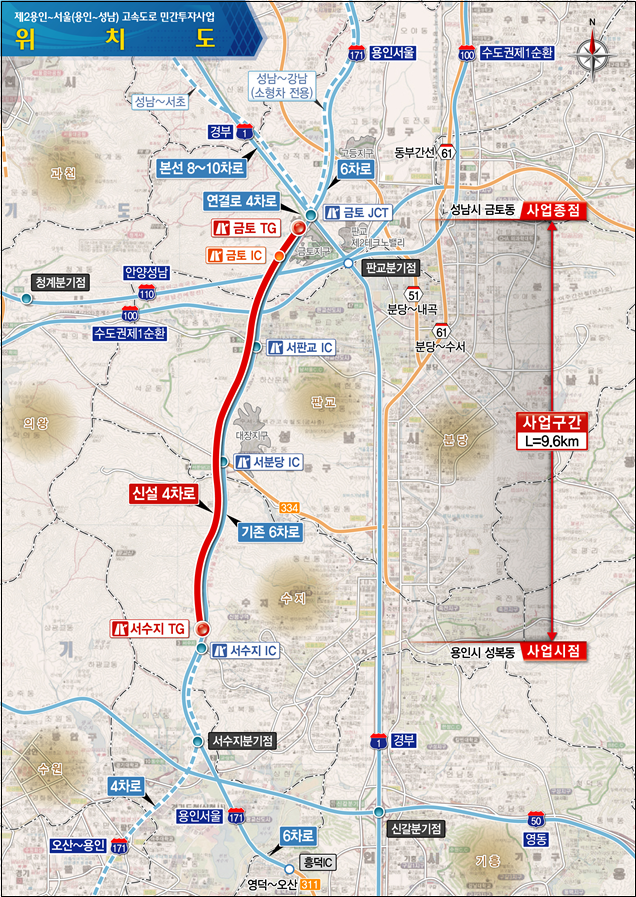
The second Yongin-Seoul Expressway will be an approximately 9.6-kilometer deep underground expressway restricted to passenger vehicles, running from the Seo-Suji tollgate in Suji-gu, Yongin, to the Geumto tollgate in Sujeong-gu, Seongnam. The deep underground section spans about 7.2 kilometers.
Once complete, the ministry expects the project to separate long-distance traffic through the underground route and ease surface-level flow for short-distance users, cutting commute times between Gangnam in Seoul and Yongin from roughly 23 minutes to around six — a reduction of more than 17 minutes.
Hyundai Engineering & Construction proposed the project as a private investment initiative in December 2023, with total costs estimated at 848.2 billion won ($624 million). The originally proposed construction period is 60 months.
"Now that the second Yongin-Seoul private expressway has passed the viability review, we will carry out all follow-up procedures without gaps to dramatically improve access from southern Gyeonggi Province to Seoul," said Kim Hyo-jeong, director general of the ministry's road bureau.
smh@heraldcorp.com