
Ministry of Land flags 678 suspicious transactions in direct real estate deals, Seoul-Gyeonggi apartment trades

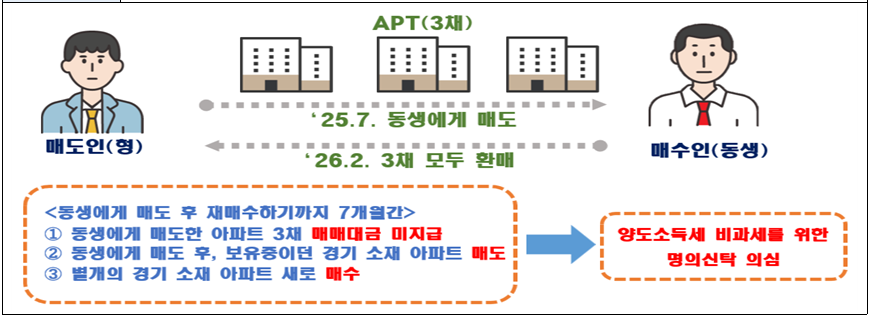
A property owner identified as "A" sold three apartments in North Gyeongsang Province to a younger sibling in a direct transaction in July 2025, then bought them back seven months later in February — with no money actually changing hands either time. In between, A sold a separate apartment in Gyeonggi Province to a third party. The government suspects A used the sibling as a nominee to qualify as a single-home owner and avoid capital gains tax, and plans to refer the case to the Korean National Police Agency for investigation.
The Ministry of Land, Infrastructure and Transport said Thursday it had uncovered 678 suspected illegal transactions in total, including A's case. The National Tax Service and police will follow up with investigations and tax collection measures.
The probe covered direct housing transactions reported nationwide from March 2025 through March 2026, as well as Seoul and Gyeonggi Province apartment trades in the first quarter of this year. Of the 678 flagged cases, 351 came from the nationwide direct-transaction review and 327 from the Seoul and Gyeonggi apartment survey.
The ministry has conducted regular targeted probes of direct housing transactions since the second half of 2022. This round screened 741 suspicious cases from direct deals involving apartments, multi-unit homes, townhouses, detached houses and multi-family dwellings, using an AI-based screening system. Of those, 351 transactions were found to involve a combined 424 suspected violations — including disguised gifts, excessive loans from related parties, false price reporting and misuse of loan funds.
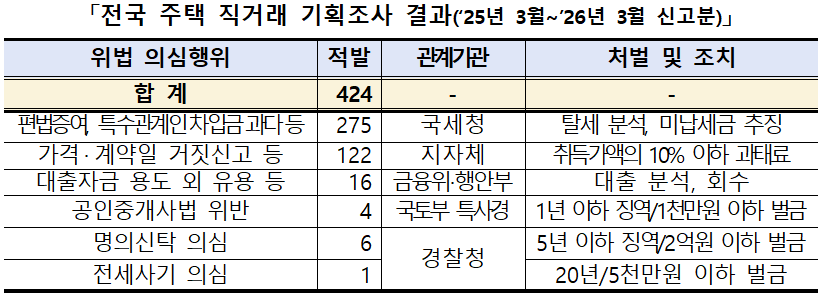
The National Tax Service will analyze 275 cases for tax evasion — including suspected disguised gifts and excessive related-party loans — and pursue collection of unpaid taxes. An additional 122 cases involving false reporting of prices or contract dates may face fines of up to 10 percent of the acquisition price, to be imposed by the relevant local governments.
By region, Seoul accounted for 224 of the 351 flagged direct-transaction cases, or 64 percent of the total. Particularly notable was the concentration in the three Gangnam-area districts — Gangnam, Seocho and Songpa — which together accounted for 140 cases, or 40 percent of the national total and 63 percent of Seoul's share.
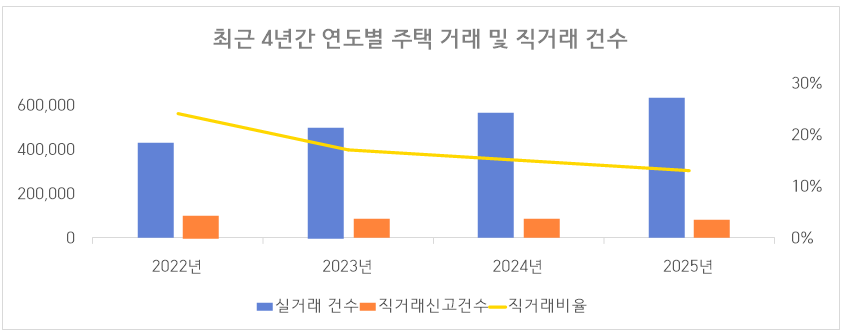
The ministry noted that while the annual number of referrals to relevant agencies has remained steady at around 300, the share of direct transactions among all housing deals dropped sharply — from 24 percent in 2022 to 13 percent in 2025, an 11 percentage-point decline. Yet the ratio of cases referred out of those investigated rose significantly, from 23.4 percent in 2022 to 51.9 percent in 2025. The ministry said it would step up monitoring, noting that suspected violations have not decreased even as direct transactions have become less common.
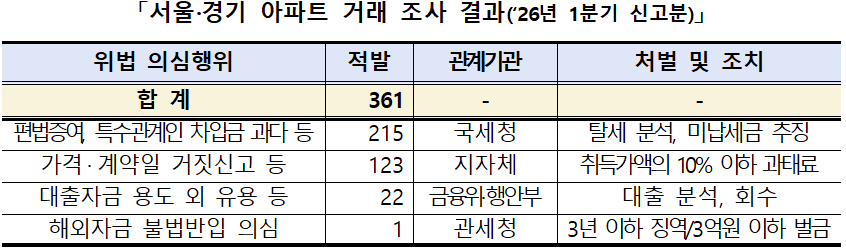
Among the suspicious transactions flagged this round, 327 cases from Seoul and Gyeonggi Province involved deals reported in the first quarter of this year, selected from 845 anomalous transactions. A total of 361 suspected violations were identified within those cases — disguised gifts and excessive related-party loans again topped the list at 215 cases, followed by false reporting at 123 cases.
Kim Young-guk, director general of the ministry's Housing and Land Bureau, said the ministry would notify all relevant agencies whenever a single transaction is found to violate multiple laws. "We will continue to conduct targeted probes not only of brokered deals but also of direct transactions, and respond firmly to illegal trading to establish a sound real estate market order," Kim said.
smh@heraldcorp.com




