Lecture by Kwon Seok-jun, vice dean of Sungkyunkwan University's College of Engineering
Topic: 'AI semiconductor strategy in the age of intelligent production economics'
"AI must be assessed strictly through the lens of money and economics"
"AI firms struggle to generate cash commensurate with investment, creating financial instability"
"Korea's share in manufacturing AI is negligible — strategy must be rebuilt"
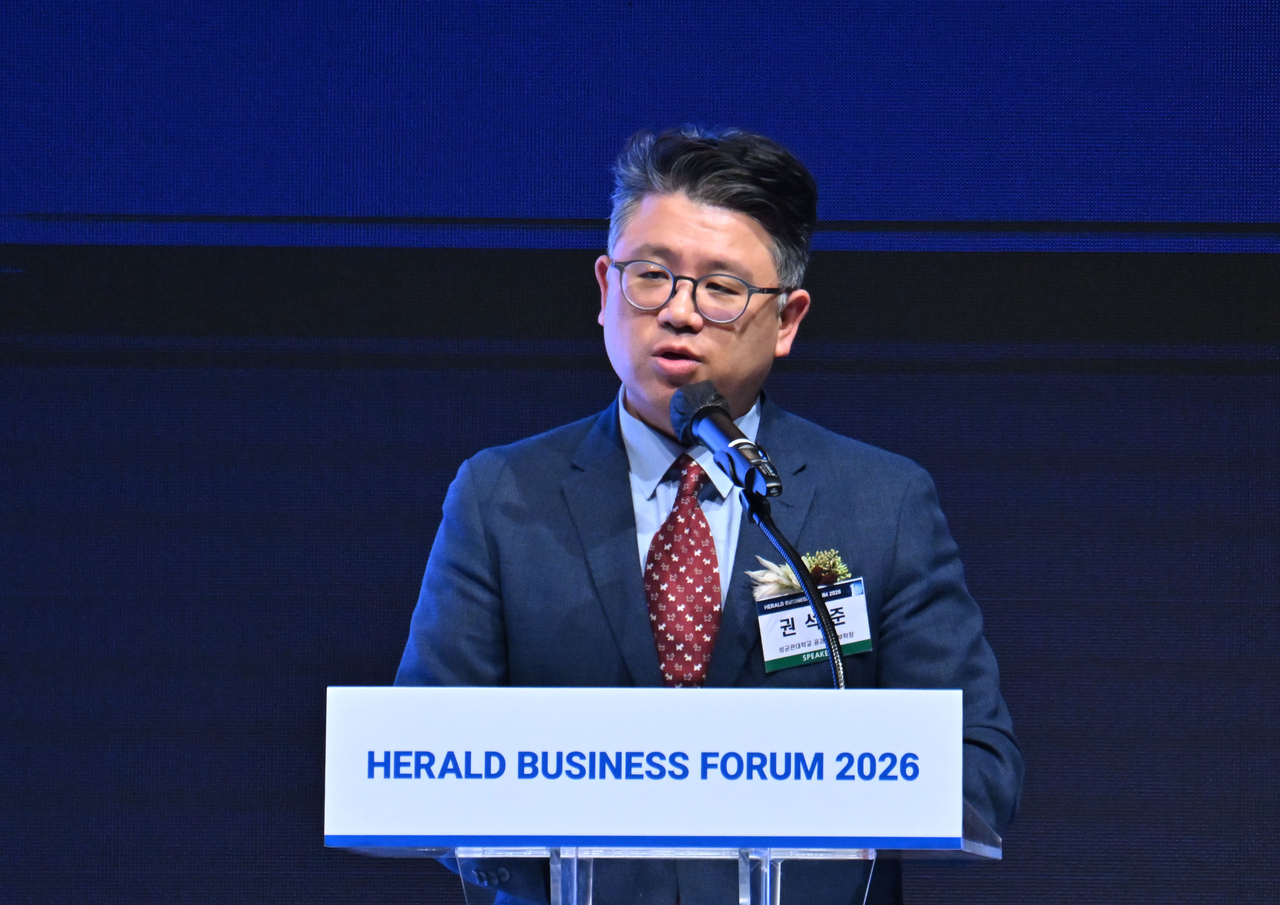
"We must now rigorously assess real added value strictly from the perspective of money, economics and dollars — from the perspective of token-generation efficiency per watt — and calibrate how much weight we give to AI."
As the global investment race surrounding AI and semiconductors accelerates, the world has entered an era of intelligent production economics. Kwon Seok-jun, vice dean of Sungkyunkwan University's College of Engineering, said Tuesday at the Herald Business Forum 2026, held at the Dynasty Hall of Shilla Hotel in Jung-gu, Seoul, that "we need to take a hard, clear-eyed look at how sustainable the intelligent production economy will actually be."
Kwon said he hopes AI will become "an important accelerator for our industries," but added that "with Korean semiconductors having ridden the big wave of global AI demand, we need to test the bridge in advance to make sure that wave does not become a tsunami." His point: rather than simply watching memory chip demand grow on the back of AI's spread, Korea must also examine the economic viability of the AI industry generating that demand.
Kwon said that as AI becomes a strategic asset directly tied to national security, a minimum sovereign AI foundation is necessary. However, he questioned whether blindly chasing the world's top "frontier models" by pouring in limited capital, power and talent is truly the best course. He noted a gap of roughly 0.9 to 1.2 years between Korea and the leading frontier models, but warned that "even if the gap is closed, it can widen again at any time — this is a war of money." Korea must therefore be selective about which domains it actually needs, he said.
Kwon also flagged the financial instability of AI companies as a factor to watch. He said a so-called "circular finance" structure has emerged in the AI industry, in which investment flows between companies and purchases of computing resources feed back into each other, keeping money cycling internally.
In particular, he said frontier AI companies raising enormous sums continue to pour capital into securing data centers and computing resources, yet the business models needed to generate stable cash flow have not been sufficiently validated. With no sign that vast sums can be recouped from the business-to-consumer market, the sector remains unstable from a sustainability standpoint, he said.
That said, Kwon said it is equally difficult to step back from an AI investment race that has already begun. "Nobody wants to get off the tiger's back, because the moment you do, the fear of being devoured dominates the market," he said. "The sense of crisis that even advanced nations could be pushed down to middle- or low-income status if they fail to get on board is what is sustaining the global AI investment race."
Korea, where expectations for AI run particularly high, needs a more detailed strategy for translating not only expanded memory chip demand but also physical AI and manufacturing AI into actual growth engines, Kwon said.
"Korea's share in the next-generation mobility and robotics supply chains being integrated with AI is surprisingly small — less than 1 percent in robotics, and only around 5 to 10 percent even in automobiles," he said. "The existence of a market and the ability to enter that market are entirely different things." He said Korea must rethink its strategy around what supplier position it can realistically occupy.
go@heraldcorp.com