Jusung Engineering Chairman Hwang Cheol-ju delivers keynote at Herald Business Forum 2026
'Move beyond catch-up growth to become the only one'
'In the AI era, focus on the 1% that creates new value'
'Leaders must go against their instincts and bear the risk to make innovation possible'
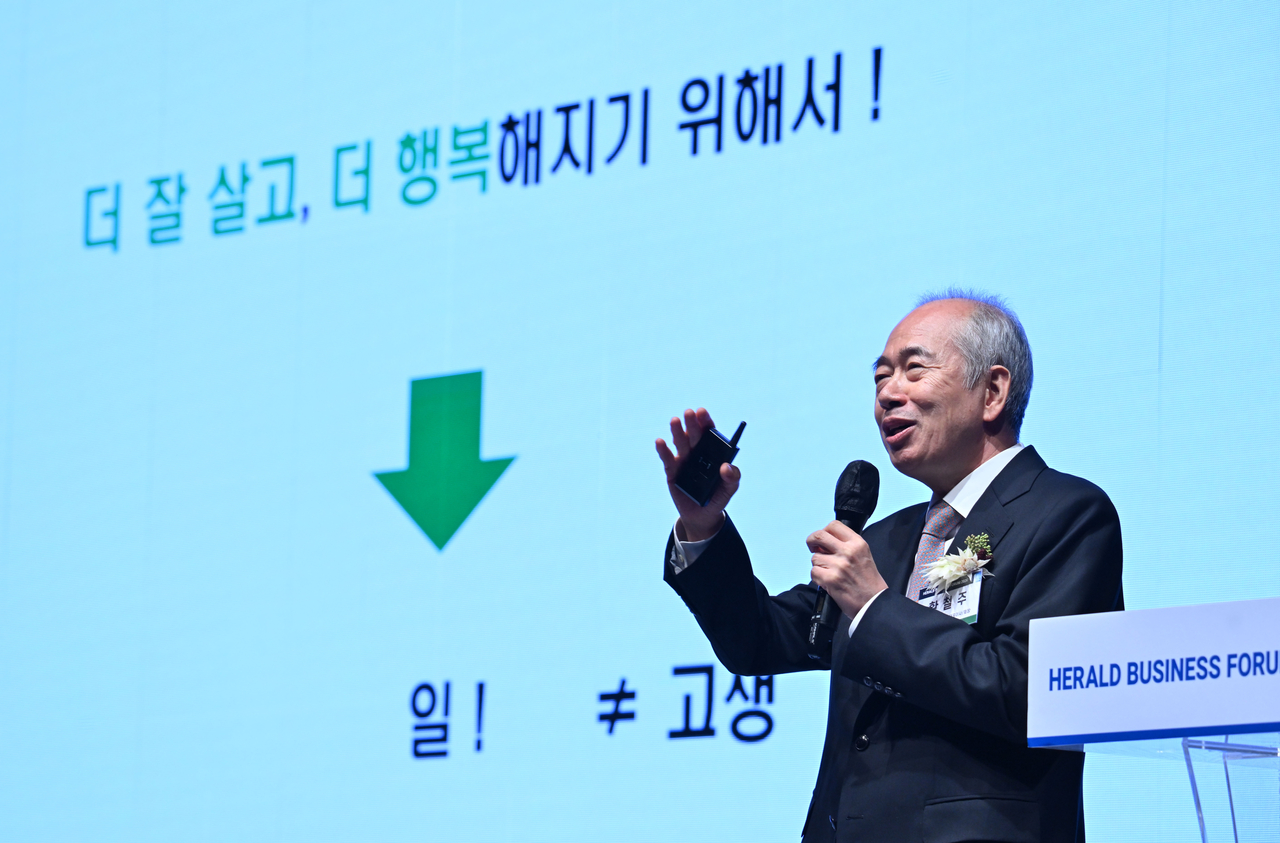
"We must abandon the fixed idea that only those who have already earned trust can innovate — and that innovation requires trust from the outset."
Hwang Cheol-ju, chairman of Jusung Engineering, said Tuesday that South Korea must break free from a "trust-first" mindset if it hopes to become a true innovation-driven economy. He made the remarks at the Herald Business Forum 2026, held at the Shilla Seoul hotel in Jung-gu.
Hwang argued that innovation and trust are fundamentally at odds: innovation is about creating new value from scratch, while trust is built slowly over time. Trying to satisfy both conditions simultaneously from the outset makes bold risk-taking nearly impossible, he said. What is needed instead, he added, is a leadership culture and a corporate collaboration structure willing to embrace new attempts rather than relying solely on proven people and technologies.
"Innovation has its greatest value the moment it is born, and that value diminishes over time — but trust is built precisely through the accumulation of shared time," Hwang said. "You cannot create innovation and trust in the same moment and the same place. If we cannot shed the fixed idea that trust must come before innovation, it will be very difficult for South Korea to become an innovation-driven nation."
It is this inherent contradiction, he said, that makes "collaboration" between large companies and startups essential in the innovation process. He drew a distinction between collaboration and mere cooperation, describing the former as a higher-order concept — one that goes beyond sharing capabilities to combining the best outputs each party can produce.
Demanding that those with new technologies and ideas also demonstrate long-accumulated trust from the very beginning means falling behind the pace of innovation, he said. Synergy must be created through collaboration instead.
Hwang also said South Korea's economic growth model must shift from "catch-up" to "creation." In the past, he noted, the country could rise to world-class levels by rapidly absorbing knowledge and technology developed by others. Future growth, however, will require Korea to set its own new standards, benchmarks and systems.
The difference between technology and innovation, he said, comes down to pricing power. Even the most advanced technology loses pricing control to buyers the moment a competitor enters the market — but whoever creates an innovation with no competitor gets to set the price.
"No matter how good a technology is, if there are competitors in the market, the buyer sets the price," Hwang said. "With innovation, even if it has some shortcomings, the creator can set the price if there are no competitors. That is why we must innovate."
He said this kind of innovation becomes even more critical in the AI era. "Even the greatest inventions and innovations are more than 99 percent built on what others have already thought of or created," Hwang said. "In the past, South Korea grew by following that 99 percent — but new growth comes from the 1 percent that no one else has thought of or done." He then added: "AI is absorbing and memorizing existing knowledge at an extraordinary speed. Going forward, people must focus not on the 99 percent that AI can replace, but on the 1 percent that creates new value."
Hwang doubled down on the need to distinguish between "work" and "unnecessary hardship." Spending time repeatedly absorbing existing knowledge or carrying out needless tasks must be reduced, he said, so that energy can be concentrated on creating new value.
"If you spend your effort on hardship you don't need to endure, you lose the room to do the work that actually matters," he said. "Standards are the way to start correctly; benchmarks are the way to eliminate unnecessary hardship; and systems are the way to reach your destination accurately and quickly."
Above all, Hwang said, the ultimate responsibility for innovation lies with leaders — not with the members of an organization. Asking individual employees to bear the uncertainty and risk of failure that innovation demands has clear limits, he argued.
"Improvement is something an organization's members can do, but innovation is the leader's job," Hwang said. "The person in an organization who can ultimately absorb the risk is the leader — and in a company, that role must be played by the founder and the CEO."
He went on to say that whether South Korea can move beyond its old catch-up growth formula ultimately depends on the choices leaders make. "It is human nature and instinct not to take on risk," he said. "But following only that instinct means you can never achieve innovation or become No. 1 in the world. Overcoming that instinct is the leader's role."
"If the competitive edge in the past was doing more than others and catching up faster, today it is being first and doing it better," Hwang said. "Only by overcoming difficult and grueling processes can you build something of greater value."
go@heraldcorp.com