Press conference marking one year since taking office
'Collusion sanctions justified, but scope needs adjustment'
Association to launch support center next month, eyes K-food competitiveness
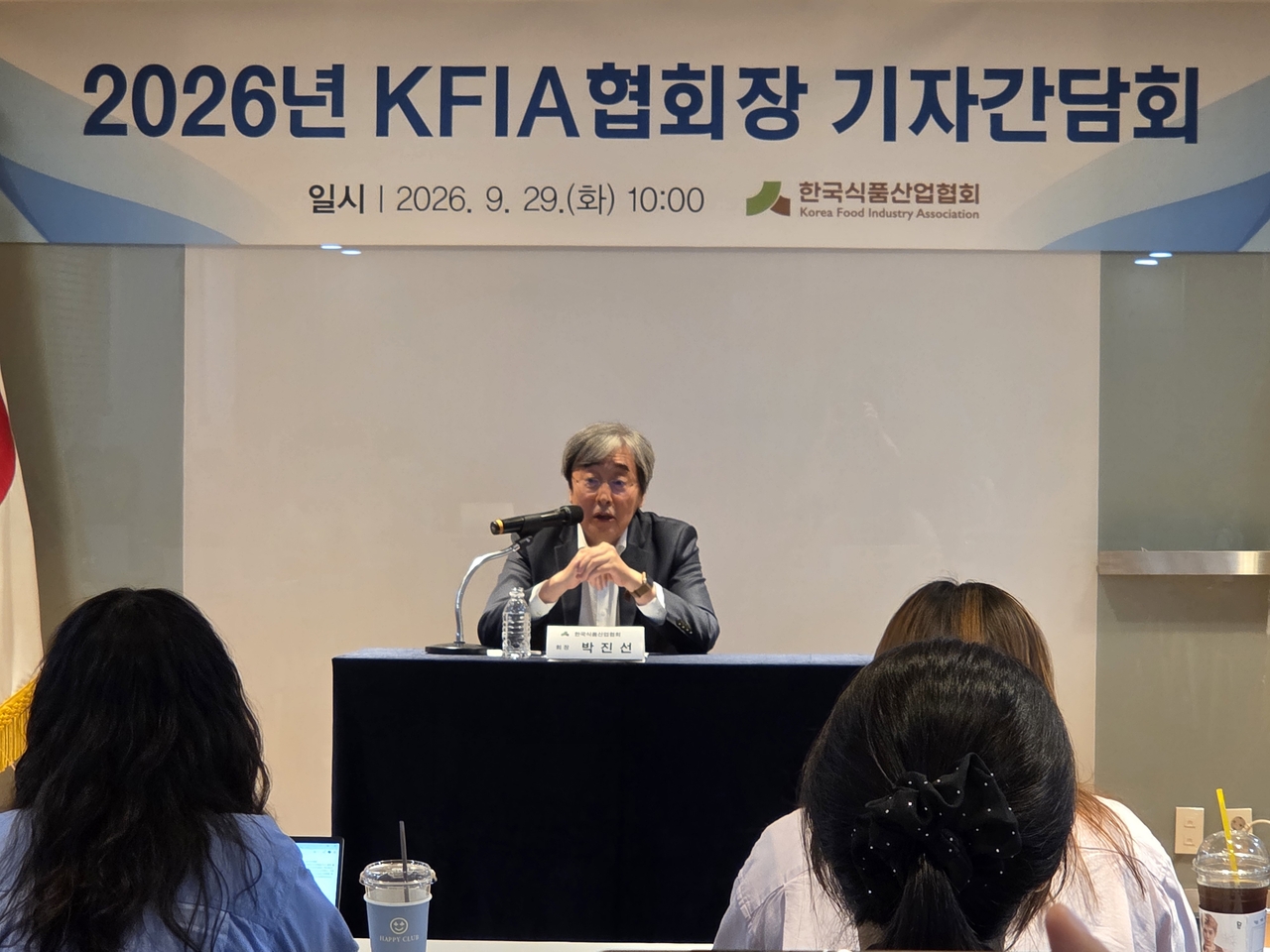
The chairman of the Korea Food Industry Association said Tuesday that recent price increases by food companies are unavoidable, arguing that raw material costs alone do not tell the full story. "Raw materials do not account for that large a share," Park Jin-sun said. "It is not just raw materials — all the other costs have gone up together, and that is why we have no choice but to raise prices."
Park made the remarks at a press conference marking the first anniversary of his inauguration, held Tuesday at the association's office in Seocho-gu, Seoul. He acknowledged widespread public frustration, saying: "Many people wonder why prices do not come back down when the exchange rate falls after having risen, or why prices should not drop again once raw material costs ease."
He stressed that the food industry is a manufacturing sector that requires heavy investment. "The food industry is manufacturing, and it takes substantial costs to build up facilities and technology," he said. "Labor costs, facility investment and research and development all account for a large portion of expenses — not just raw materials."
On the government and ruling party's recent push to tighten sanctions on price collusion, Park said the principle was sound but the boundaries needed work. "Sanctioning collusion is only natural," he said, "but I think the scope of what counts as collusion needs to be adjusted."
Park elaborated, saying he had heard that even conversations among sales staff who have no influence over pricing decisions could be classified as collusion — not just decisions made and carried out by management. "If the definition of collusion is broadened comprehensively and penalties are raised on top of that, the impact on the industry will be significant," he added.
The association said it plans to focus its efforts on converting global attention toward K-food into sustainable competitiveness for the domestic food industry as a whole. "As people around the world show growing interest in K-food, opportunities are emerging to open new markets and strengthen competitiveness," Park said. "We will reinforce our role in supporting Korean companies to enter overseas markets more actively."
To that end, the association plans to launch a food company support center on Oct. 19 to help member firms resolve operational difficulties quickly and practically. The center will provide expert advisory services to member companies and partners in six areas: food safety; food manufacturing, production and technology innovation; utilization of support projects; general management including legal, tax and labor affairs; exports; and sustainable management including environmental, social and governance matters.
Park reflected on his first year in office, saying it had been a time to reaffirm what the association should be doing amid a rapidly changing industry environment. He pledged to build an association that member companies can feel the tangible benefits of, one that actively conveys the voice of food companies, and one that prepares for the future of the food industry together with its members.
korean@heraldcorp.com