Soft red winter wheat price hits highest level in over 3 years, up 41% on-year
Sugar and edible oil prices also climbing, prompting a wave of food price hikes
![Shoppers browse snacks at a hypermarket in Seoul. [Yonhap]](https://wimg.heraldcorp.com/news/cms/2026/09/28/rcv.YNA.20260403.PYH2026040309030001300_P1.jpg)
Import prices for key processed-food ingredients — wheat, sugar and edible oils — are rising across the board, raising the prospect of further price increases across the food industry.
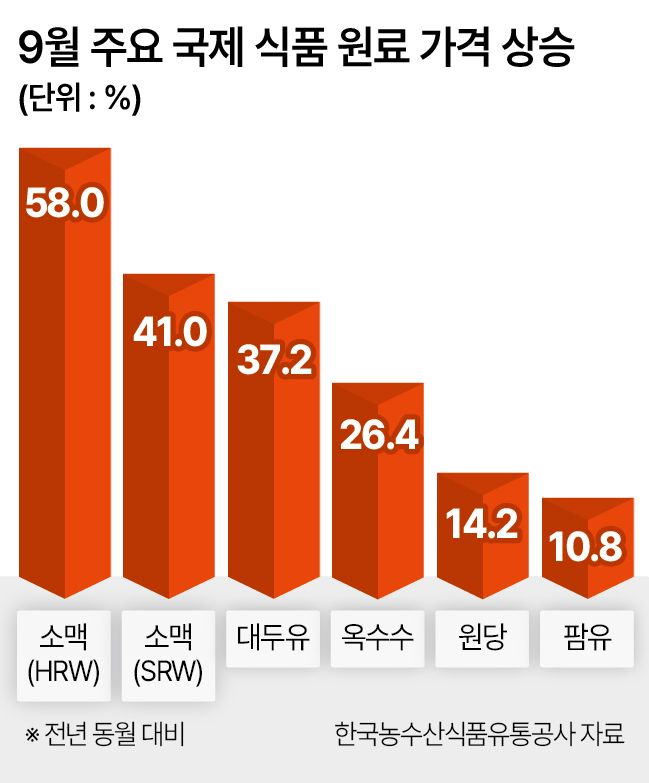
According to food industry statistics from the Korea Agro-Fisheries and Food Trade Corporation, the average price this month of soft red winter wheat, or SRW, traded on the Chicago Board of Trade stood at $266.06 per ton, up 41.0 percent from a year earlier — the highest level in three years and seven months since February 2023.
SRW, the primary raw material for flour used in cookies, crackers and cakes, has been on an upward trend since surpassing $200 per ton in February. Hard red winter wheat, or HRW, used mainly in bread and noodles, also surged 58.0 percent year-on-year this month to $295.96 per ton.
The main driver behind rising wheat prices is disruption to Black Sea grain shipments caused by the Russia-Ukraine war. Both sides have recently stepped up attacks on each other's ports, vessels and logistics facilities in the Black Sea and Sea of Azov. Worsening crop outlooks across Europe due to hot, dry weather and a weaker US dollar have also contributed.
Sugar and edible oil prices used in bread and confectionery are rising in tandem, reflecting supply concerns stemming from El Niño and other weather anomalies. The average price of raw sugar this month came in at $396.61 per ton, up 14.2 percent from a year ago. Soybean oil, used in frying and baking, jumped 37.2 percent, while palm oil rose 10.8 percent. Corn futures prices were also up 26.4 percent year-on-year.
Food companies are raising prices in response to higher raw material costs. Haitai Confectionery plans to increase prices on 25 product lines — including Oyes, Home Run Ball and Pocky — by an average of 7.8 percent starting Thursday. The company cited rising raw material costs and higher manufacturing and logistics expenses as reasons for the adjustment.
Bakery chains have also recently raised prices, pointing to higher ingredient and operating costs. Samlip raised prices on 59 bread products by an average of 9.4 percent from Sept. 1. Paris Baguette increased prices on 127 items — 86 bread products and 41 cakes and desserts — by an average of 5.0 percent from Aug. 25. Dunkin raised prices on 39 doughnut varieties by an average of 6.5 percent last month, and Tous Les Jours hiked prices on 76 bread and cake items by an average of 8.2 percent from July.
The bakery industry had cut prices on some products in March, after sugar and flour makers — including CJ CheilJedang, Samyang, Daehan Flour Mill and Sajodongaone — lowered their prices following a price-fixing investigation, and as the government pushed the industry to ease the burden on consumers. The combination of the Iran war, rising global oil prices and a high exchange rate, however, prompted companies to reverse course within just a few months.
Food companies are closely watching how raw material prices move going forward. Rising international futures prices do not immediately feed through to production costs, but companies typically secure raw materials through long-term contracts or advance purchases, meaning global market price swings can eventually be reflected in costs with a lag.
Further price adjustments could continue for now. The won-dollar exchange rate has fallen back to the 1,300-won range, easing the cost burden on imports, but the effect is being offset by rising prices for key raw materials. Cost pressures from oil prices, packaging and logistics linked to the Middle East situation also remain.
"The exchange rate has come down recently, but it is difficult for that to be reflected immediately in product costs," an industry official said. "With fuel and logistics costs still elevated and raw material prices continuing to rise, there is a possibility of further price adjustments down the line."

korean@heraldcorp.com