[Editor's note] For 45 years, the Korean National Police University has produced mid-level police officers. In that time, the social and political landscape has shifted dramatically, and the structure of criminal investigations has been overhauled. This series examines how the identity of its graduates — once symbols of an "elite police" — has evolved, and whether the institution is still producing the leaders a new era of criminal justice demands.
45 years on, three generations of graduates tell a changing story
The first two generations fought for police independence like crusaders
A new generation prizes individual careers over institutional loyalty
Experts say the education model must catch up with the times
![The graduation and commissioning ceremony for the first class of the Korean National Police University, held in April 1985. [National Archives of Korea]](https://wimg.heraldcorp.com/news/cms/2026/09/24/news-p.v1.20260918.55318edccedc47d28933deab33125091_P1.jpg)
When the government moved to abolish the National Tax University in 1998, high school students preparing to enroll, current students and alumni filed a constitutional complaint with the Constitutional Court. The petitioners argued the closure violated their constitutional right to education — and that shutting down the tax university while leaving institutions such as the Korean National Police University intact amounted to unjustified discrimination.
After deliberation, the Constitutional Court ruled in 2001 that abolishing the tax university did not violate the Constitution (99 Hunma 613). The institution was dissolved and passed into history. The police university, however, remains. In its ruling, the court offered this explanation.
"Unlike the National Tax University, the Korean National Police University is a specialized institution whose role cannot be substituted by other departments at a general university. It is distinguished by its mission to train police officers who will be responsible for national public safety."
Next month, the Supreme Prosecutors' Office will be abolished and investigative authority will be stripped from prosecutors — the most sweeping transformation of the criminal justice system in 80 years. For the police, who bear responsibility for public safety, that shift means a heavier investigative burden. Pyo Chang-won, director of the Crime Science Research Institute and a police university alumnus, said the institution must now ask itself a hard question: "Is the education provided at the police university truly irreplaceable and indispensable specialized training — as the Constitutional Court described it?"
![Newly commissioned police inspectors and senior inspectors listen to a congratulatory address by President Lee Jae Myung at a commissioning ceremony held at the Korean National Police University in Asan, South Chungcheong Province, on March 17. [Yonhap]](https://wimg.heraldcorp.com/news/cms/2026/09/24/news-p.v1.20260918.9aba87c14f0247078712557845f6ce21_P1.jpg)
An irreplaceable institution?
The Korean National Police University shall be established under the authority of the Commissioner General of the Korean National Police Agency to provide academic training and physical development for those who are to become police officers in charge of national public safety. <Article 1, Paragraph 1 of the Act on the Establishment of the Korean National Police University>
Compared with the founding legislation drafted in 1979, the only change in Article 1 is that "under the authority of the Minister of Home Affairs" has been replaced by "under the authority of the Commissioner General of the Korean National Police Agency." The sentence has otherwise remained the same for more than 40 years. Yet the people studying within those walls have changed enormously over the same period.
A senior police official who graduated from the university said that while the legal framework has stayed the same, students attending today inhabit an entirely different world. "The way they understand society is fundamentally different from how we did in our twenties — they're almost a different species," he said. "The social atmosphere and the political and cultural environment have all changed, so the way we develop police university students today needs a completely different mechanism."
Fifteen current and former police university graduates contacted for this article suggested viewing alumni in three generational cohorts. The first generation covers roughly the first ten graduating classes, beginning with those who enrolled in 1981 — people who came of age under the new military regime, lived through the June Democracy Movement and witnessed the transition to direct presidential elections. The second generation entered in the 1990s through the early 2000s. The third generation comprises those who enrolled from around 2010 onward, now mostly in their twenties and thirties.
This framework is not an academically recognized or officially codified methodology, but it offers a useful analytical lens for understanding how police university graduates have differed across eras.
First and second generations: driven by the fight for police independence
The first and second generations studied under extraordinary conditions. Full four-year tuition paid by the state, automatic commissioning as inspectors upon graduation, and alternative military service drew top students from across the country. The institution was, in effect, a police version of a military academy. One officer who attended in the 1980s recalled being told the same thing throughout his four years: "You are the elite of the police. You must work toward independent investigative authority for the police — that was drummed into us by professors and instructors until we were sick of hearing it."
The first generation in particular entered the police organization as inspectors with a shared mission: to pursue independence. Achieving investigative parity with prosecutors and breaking free from political interference were their defining collective goals. The emblematic figure of this era is Hwang Un-ha, a lawmaker with the Rebuilding Korea Party and a member of the university's inaugural class. In the turbulent democratization period of the late 1980s, he joined forces with classmates and junior colleagues to issue a declaration calling for political neutrality in policing. The reorganization of the police in 1991 — when the security headquarters under the Home Ministry was expanded into a separate agency, the Korean National Police Agency — further galvanized them.
Kim Sun-yong, an attorney at law firm Daemyung and a sixth-class graduate, recalled the spirit of the time. "The democratization of the police organization was a major issue, and it was an era when collective advancement mattered more than personal career planning," he said.
Young police university graduates spread rapidly through the organization, won fast promotions and moved into key positions. As their numbers grew, they raised their voices on sensitive issues such as investigative independence, and they did not shy away from clashing with prosecutors who wielded sweeping investigative command authority.
![Kang Shin-myeong, former Commissioner General of the Korean National Police Agency and a second-class graduate of the police university. Appointed in 2014 under the Park Geun-hye administration, he was the first Commissioner General to have graduated from the institution and served a two-year term. [Yonhap]](https://wimg.heraldcorp.com/news/cms/2026/09/24/news-p.v1.20260922.099167b0bf4b4d339bfa94b5a901e6da_P2.jpg)
A current police officer who graduated from the university recalled the confrontational atmosphere. "Young inspectors would go head-to-head with prosecutors who treated police like subordinates," he said. Prosecutors pushed back: in the early 2000s, they circulated an internal document arguing that the police university should be abolished on the grounds that it likely violated the Constitution.
During this period, police university graduates who had completed their alternative military service as auxiliary police platoon leaders were assigned, alongside officer candidates, to the investigation units of front-line police stations — the forerunners of today's integrated investigation teams. Those units handled civil complaints and accusations and had long been plagued by shoddy investigations and corrupt ties; the intent was to refresh them with young officers.
A superintendent who joined the force as an inspector in the late 1990s described the ethos of the time. "We had heard so much about duty and mission from the time we were students that we poured everything into the job. Promotion within the organization was the main life trajectory back then," he said.
The first and second generations are credited with laying the groundwork for the newly established Korean National Police Agency through the 1990s and helping to reshape its organizational culture. They advanced quickly into key posts by supporting one another, but the label of "pure-bloodism" — a closed, insular network — began to follow them. From the 2000s onward, some police university graduates began looking for other paths, including sitting for the bar exam.
Third generation: the fading idea of a job for life
Those who entered the police university from 2010 onward are, by the account of their predecessors, a different breed. They place individual expertise and career planning above collective identity, and many quietly ask themselves whether the police force is truly their one and final destination. They naturally seek — and act on — opportunities to make their mark in the legal profession or the private sector.
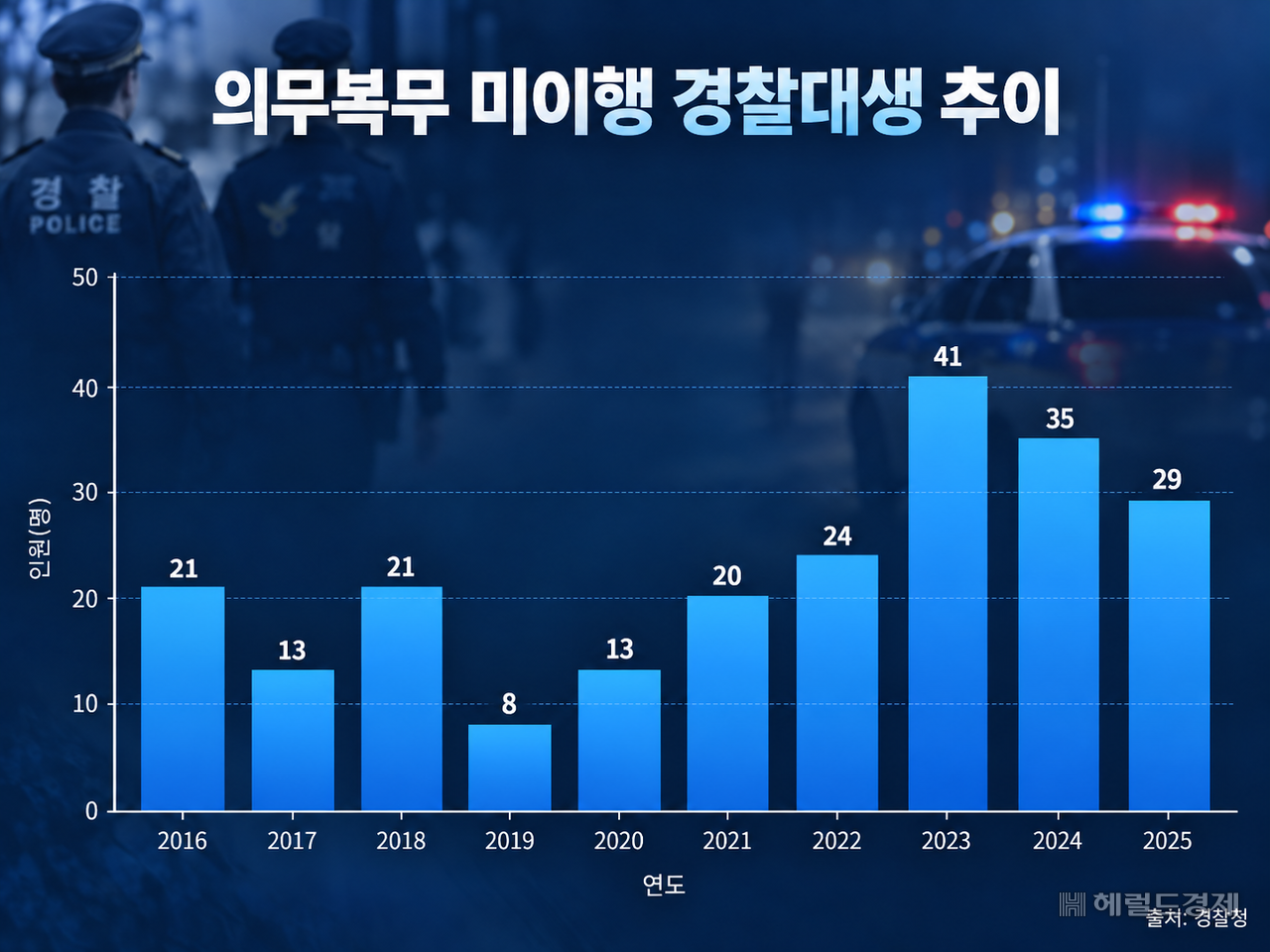
Data from the Korean National Police Agency show that the number of police university graduates who left before completing their mandatory service period was 29 last year, 25 in 2024 and 41 in 2023. That is up from an average of 17.2 per year over the five years from 2016 to 2020. Most of those who left are believed to have enrolled in law school.
A detective five years into his career after graduating from the police university and joining as an inspector said the pattern was familiar. "About 80 percent of my classmates showed real enthusiasm for doing something meaningful in the police when we were students, but as time passes, a wider world comes into view," he said. "The tendency to treat a job as a tool rather than a calling is really a trait of the younger generation as a whole, not just police university students."
The professional outlook of the third generation has shifted, and society now demands not only expertise from police but also a high degree of integrity and ethical awareness. The institution must shed its insular culture and embrace diversity and flexibility. With the overhaul of the criminal justice system, police investigations face harsher scrutiny and criticism than ever before.
Reforms driven by the Moon Jae-in administration have also reshaped the student body: those who enrolled from 2019 onward must complete regular military service and pay their own tuition and dormitory fees. A transfer system allowing students from general universities and serving police officers to enroll has been introduced, reducing the shared background of fresh high school graduates and making the student population more diverse. Faculty members, too, now emphasize openness and inclusivity.
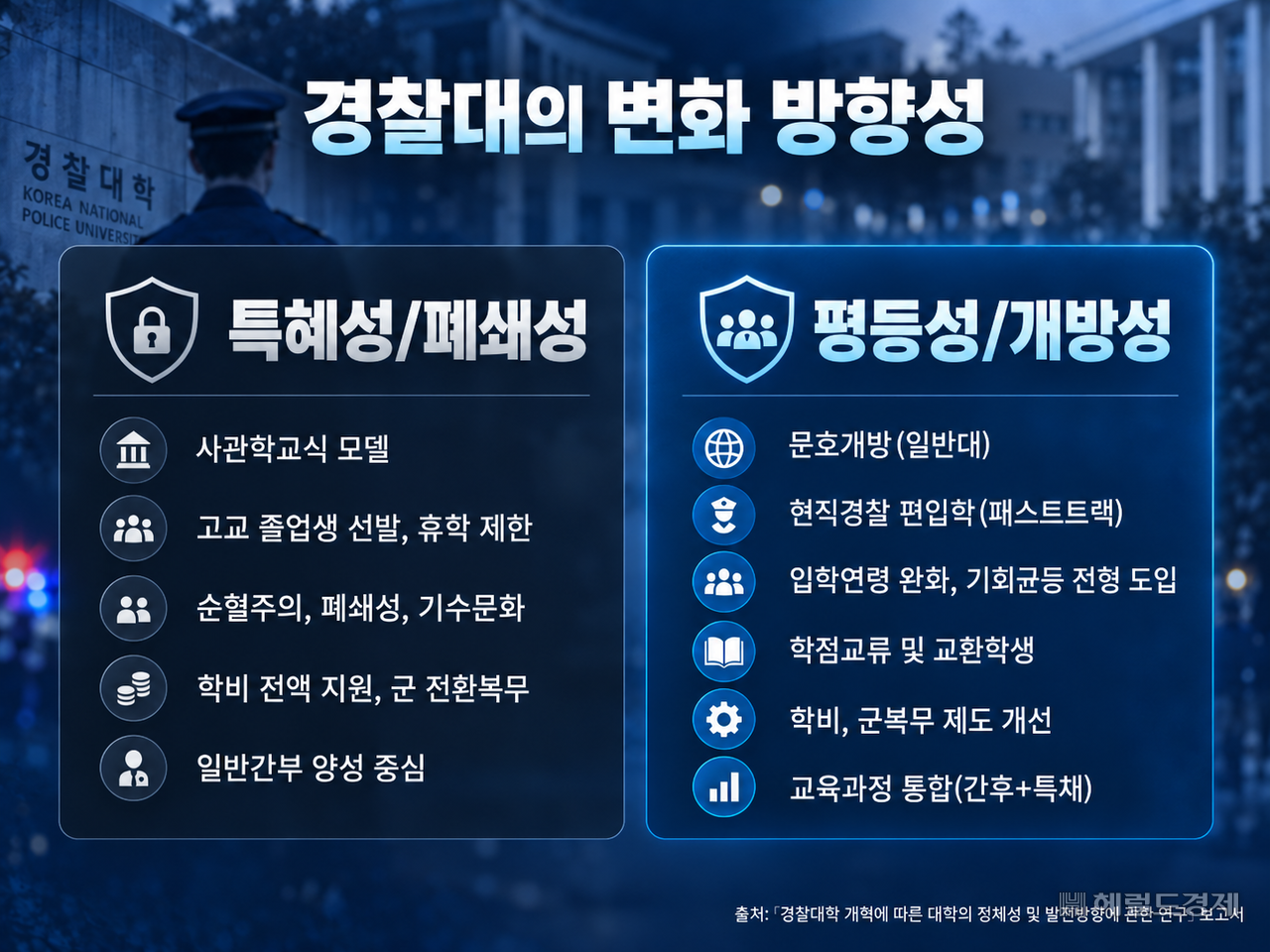
Reactions within the institution are mixed. One serving officer described the situation as fractured. "It's become a divided environment — one group of high school graduates and another of transfer students. There are voices saying we might as well abolish the police university if this is where things are headed," he said. Another officer familiar with the university's inner workings offered a different view. "It has become more like a general university, with students from different backgrounds mixing together. The old sunbae culture has faded, and people get along naturally," he said.
What matters most is what comes next. The police university has weathered calls for its abolition in every era, but as long as it continues to exist in its current form, it cannot abandon its role of producing trustworthy police talent. The Korean National Police Agency said it is preparing next year's curriculum with a stronger focus on public ethics and human rights awareness, and plans to expand field-based, hands-on training.
Experts also say attention must be paid to whether the organization itself is capable of retaining the talent it produces.
Lee Ung-hyeok, a professor of police studies at Konkuk University, said the exodus of talented graduates represents a broader failure of personnel management. "The police must offer outstanding talent an attractive career path," he said.
Seo Jun-bae, a professor at the police university, said the departures reflect not a failure of individual loyalty but a structural problem. "It is an issue of rank-centered organizational culture and career incentives," he said, adding that the university should also consider restructuring its law and public administration departments into specialized tracks such as forensic science, cybercrime investigation and financial crime investigation.
nyang@heraldcorp.com
newday@heraldcorp.com
jookapooka@heraldcorp.com