Seven test-bed gardens near the Eungbong interchange on Jungnangcheon stream will be developed through public-private-industry-academic collaboration to verify plant adaptability across soil, light, and rainfall conditions — and to create a sustainable, low-maintenance garden model for the era of climate crisis.
Seoul's Seongdong-gu is developing "Seongdong-ui Jeolgi," the country's first publicly built garden test bed, as part of an effort to create sustainable, low-maintenance green spaces that can withstand the increasingly extreme weather brought on by climate change.
The project will establish seven garden test beds in the green zone in front of the Eungbong interchange along Jungnangcheon stream. The site is designed to directly observe and systematically verify how plants adapt and grow under varying environmental conditions, including different soil types, rainfall levels, and light exposure.
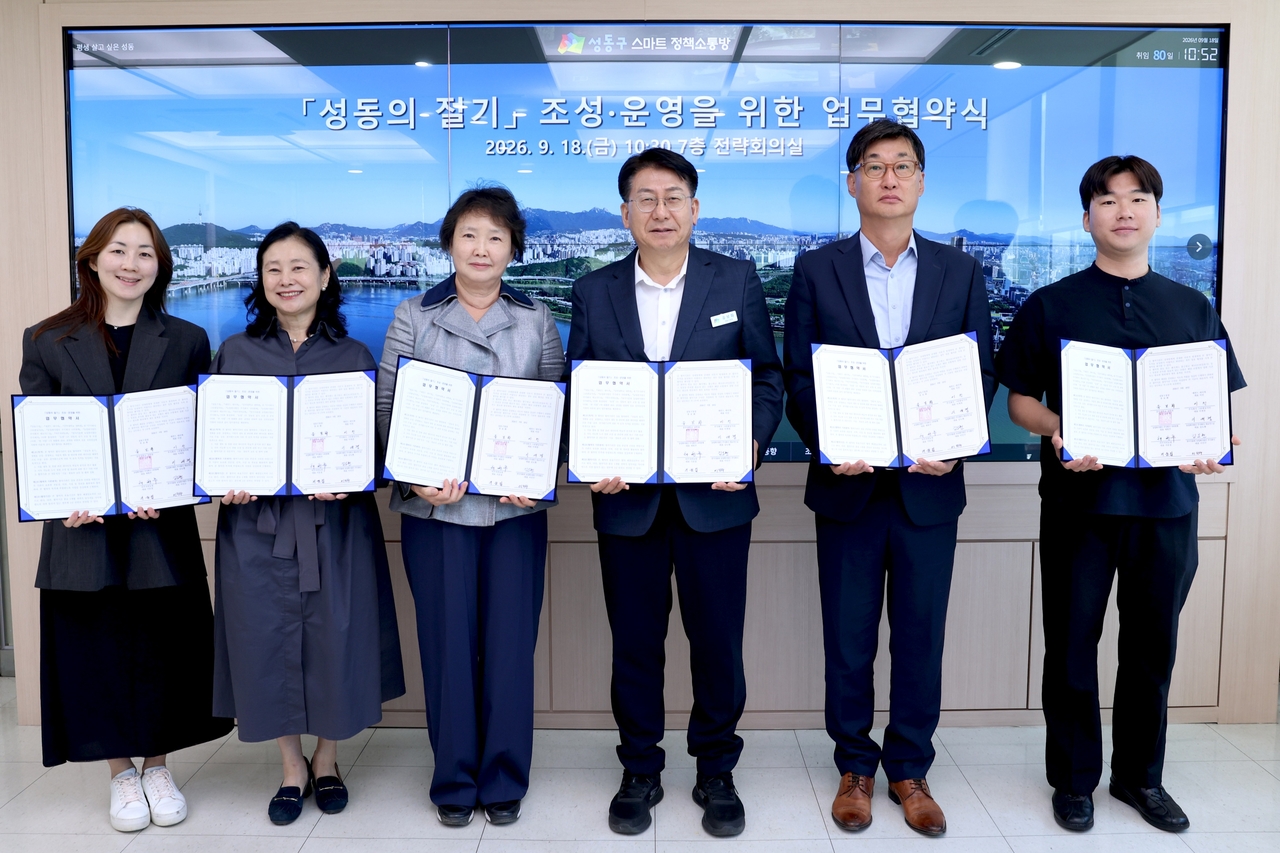
To support the project's professional development and operation, the district signed an MOU on Friday. Parties to the agreement include Second Nature, the graduate school of Jungbu University, and five participating farms — Green Farm Nursery Co., Nara Horticulture Agricultural Co., Deco Gardening Agricultural Co., Yeoju Natural Farm, and Cheonji Plant Garden Agricultural Cooperative — forming a public-private-industry-academic partnership.
Under the agreement, Second Nature will handle operation of the test beds and on-site data collection and analysis; Jungbu University's graduate school will conduct academic analysis of plant growth data and propose quality improvement measures; and the participating farms will donate test plants and share growth data. The Seoul Metropolitan Government's Agricultural Technology Center will also assist with monitoring the growth of flowering plants and soil conditions.
As extreme weather events — including heat waves, heavy downpours, and droughts — become more frequent beyond ordinary global warming, maintaining urban green spaces and gardens has grown increasingly difficult. In response, Seongdong-gu has made the development of a "low-maintenance garden" model its core objective: identifying plants and planting methods that can stay healthy with minimal upkeep while adapting well to a changing climate. The garden design draws on the example of Serge Hill in the United Kingdom.
The project will plant five identical species under three different soil conditions — standard soil, coal ash soil, and sandy soil — to compare differences in plant growth and adaptability by soil type. The findings will help establish the correlation between soil environment and plant growth, providing foundational data for selecting appropriate plants and soil conditions suited to specific site requirements in future garden projects.
Environmental data on light and rainfall will also be collected continuously. Smart plant labels will be used to systematically track growth information for each species, and data accumulated over roughly two to three years will be analyzed to identify plants that are resilient to climate change and require minimal maintenance. Verified plants and planting conditions will then be applied to future gardens developed by Seongdong-gu.
Local residents will also take part in the verification process. Seongdong-gu will run a program in which community gardeners participate from the test-bed construction phase, managing the gardens and recording plant growth conditions.
The district plans to complete the necessary administrative procedures and garden construction this month, with full plant growth data recording set to begin in October. Based on the results, it intends to develop a sustainable, low-maintenance garden model suited to the climate crisis and roll it out across Seongdong-gu.
"As extreme weather events such as heat waves and heavy downpours become the norm, urban gardens also need new approaches to design and management that match the changing climate," Seongdong-gu District Mayor Yoo Bo-hwa said. "Through 'Seongdong-ui Jeolgi,' we will systematically verify plants and planting methods that adapt well to the urban environment while minimizing maintenance burdens, and actively reflect those findings in our garden policy to create green spaces that can endure long into the future despite climate change."
seouldream01@heraldcorp.com