Cumulative sales top 120,000 loaves in 5 months
3% of sales revenue goes to social causes; bread delivered to 34 facilities across Seoul
"Seoul Bread," a city-branded product purchased by Seoul residents, has found a new purpose ahead of Chuseok — as a gift for children in child-rearing facilities. The collaboration between Seoul's city brand and a private bakery has moved beyond commercial success to give back to the local community.
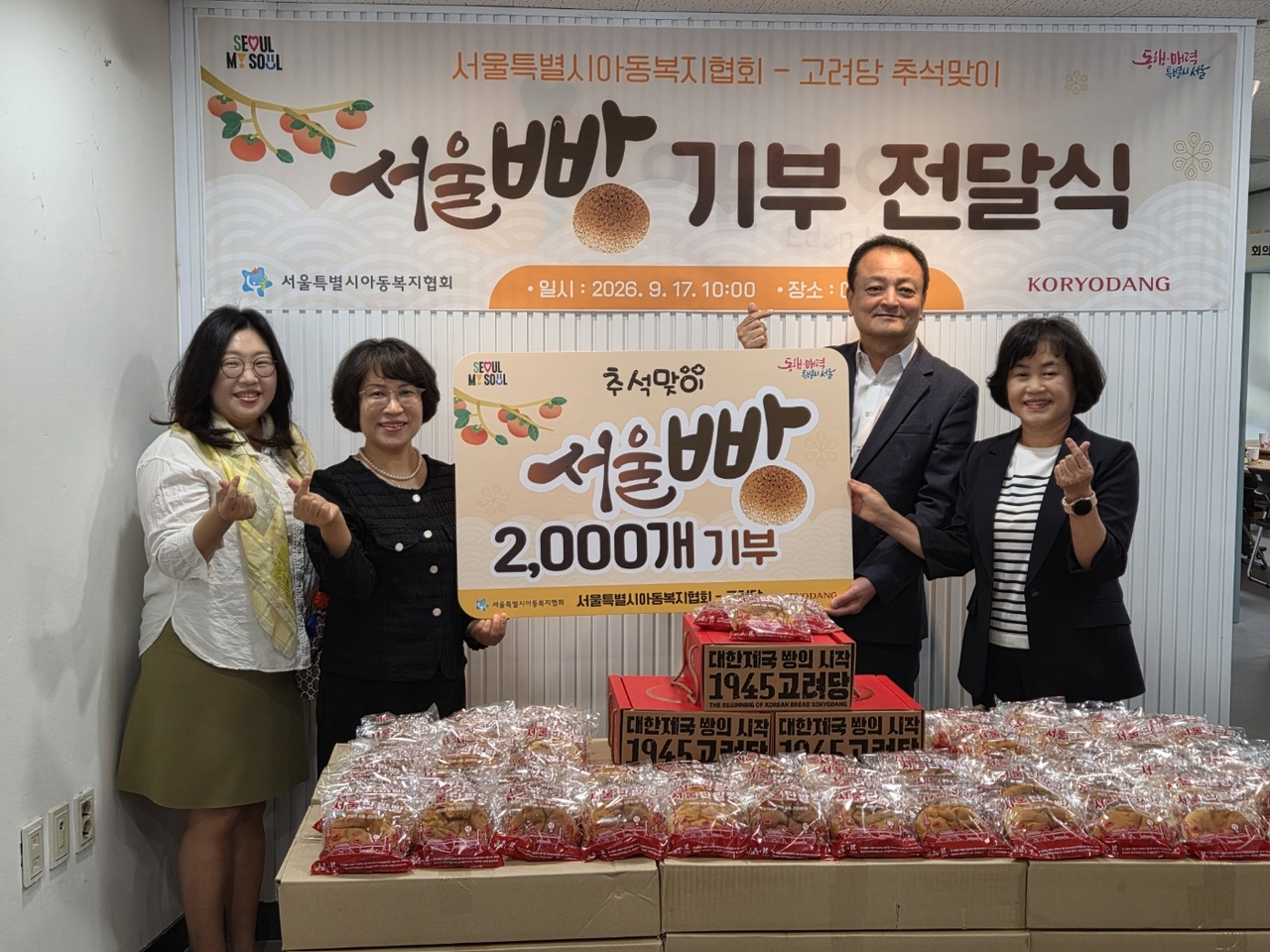
The Seoul Metropolitan Government said Thursday it held a Chuseok donation ceremony at Eden I-vil, a child-rearing facility in Seongdong-gu, Seoul, together with Goryeo-dang and the Seoul Child Welfare Association, delivering 2,000 loaves of Seoul Bread to children at the facility.
At the event, the donated loaves were displayed alongside a presentation board reading "Donation of 2,000 loaves of Seoul Bread." Attendees included Ma Chae-suk, head of the Seoul Metropolitan Government's Women and Family Division, Hong In-seong, CEO of Goryeo-dang, Lee So-young, president of the Seoul Child Welfare Association, and Jeong Mi-sun, a division head at Goryeo-dang.
After presenting the donations, attendees toured the facility's living quarters and program rooms to observe the children's living conditions and care arrangements.
The donated bread will be distributed to children living in child-rearing facilities across Seoul through the Seoul Child Welfare Association. As of this month, Seoul has 34 such facilities housing a total of 1,409 children.
Donation held at Eden I-vil, a child-rearing facility founded in 1950
Eden I-vil, where the ceremony was held, is a child-rearing facility established in 1950. It provides age-appropriate living spaces and program rooms for residents ranging from preschool-age children to young adults whose care period has been extended, supporting their protection, upbringing and preparation for independent living.
As of late last month, 31 children were living at the facility — 10 preschoolers, 10 elementary school students, six middle school students, four high school students and one child on an extended care arrangement.
"I hope Seoul Bread reaches the children not just as food, but as a warm message that there are people who support and care for them," Ma said. "We will pay close attention to ensure that children living in these facilities are not left behind and can grow up healthy as proud members of our society."
Seoul Bread is a city-branded product developed by combining the Seoul Metropolitan Government's health policy direction with the baking technology of a homegrown Seoul company.
Working with Goryeo-dang — a bakery company founded in Seoul in 1945 — the city launched Seoul Red Bean Bread and Seoul Whole Wheat Bread in April. A third variety, Seoul Chestnut Red Bean Bread, was added in July, expanding the lineup to three products.
Seoul Red Bean Bread uses domestically grown low-sugar whole red beans and low-sugar dough, cutting sugar content by 36 percent compared with conventional products. Seoul Whole Wheat Bread raises the whole wheat content to 80 percent and contains no added sugar or butter. Seoul Chestnut Red Bean Bread likewise reduces sugar content by 36 percent while preserving the flavor and texture of chestnut.
Protein content across all three products has also been raised by 15 to 30 percent compared with conventional offerings. The city said the lineup puts its "Healthy City Seoul" initiative into practice through everyday food that residents can access in their daily lives.
As of Monday, cumulative sales of the three Seoul Bread varieties had reached 122,138 loaves — a figure achieved in roughly five months since the first product launched in April.
"Seoul Bread, made in partnership with the city, has received strong support from residents," Hong said. "We will continue to share that warmth by looking after our more vulnerable neighbors."
Consumer spending loops back into the community
The donation carries added significance as an example of linking the commercial success of a city-branded product to corporate social responsibility.
The Seoul Metropolitan Government and Goryeo-dang are jointly running the Seoul Bread project from December 2025 through June 2027. Under their agreement, Goryeo-dang allocates 3 percent of Seoul Bread sales revenue to social contribution.
The arrangement has the public sector setting the city's policy direction and brand identity while the private company handles product development and retail — with a portion of sales revenue directed toward supporting vulnerable groups, creating a structure in which residents' spending flows back into the community.
Seoul Bread is gaining recognition as a public-private partnership that connects health policy, city branding and corporate social responsibility.
"It is meaningful that a share of the revenue from Seoul Bread — which embodies Seoul's healthy and vibrant lifestyle — is being returned to society," said Kim Hyeong-rae, the Seoul Metropolitan Government's public relations planning officer. "We will continue developing products that carry Seoul's values so that more residents can experience them."
7toy7@heraldcorp.com