Labor income exceeds consumption from age 28
Surplus years last 33, ending at 61
Elderly spending up 8.1% amid rapid aging
![Elderly people line up for a free lunch at a senior meal service near Tapgol Park in Jongno-gu, Seoul. [Yonhap]](https://wimg.heraldcorp.com/news/cms/2026/09/17/rcv.YNA.20250203.PYH2025020307100001300_P1.jpg)
The lifecycle deficit of South Koreans aged 65 and older has for the first time surpassed that of children aged 14 and under, driven by rapid aging and rising elderly consumption. On a per-person basis, the surplus years — when labor income exceeds consumption — span only 33 years, from age 28 to 60.
According to the 2024 National Transfer Accounts released by the Ministry of Statistics on Thursday, the elderly lifecycle deficit reached 188.9 trillion won ($138 billion), up 9.6 trillion won, or 5.3 percent, from the previous year. That figure exceeds the children's deficit of 186.2 trillion won by about 2.7 trillion won.
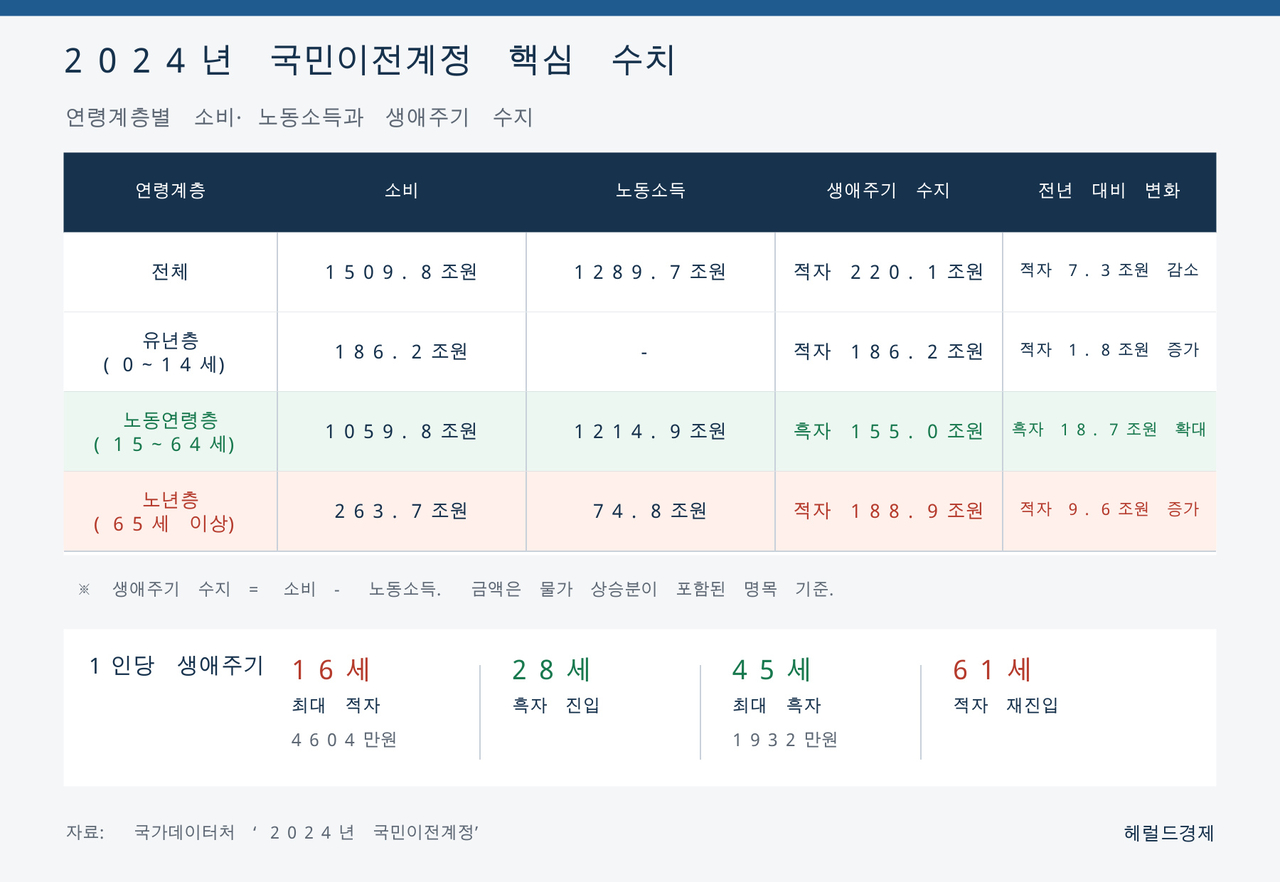
The lifecycle deficit is calculated by subtracting labor income from consumption for each age group. It is the first time since the Ministry of Statistics began compiling the National Transfer Accounts in 2010 that the elderly deficit has exceeded the children's deficit.
The elderly deficit has grown 2.3 times over the past decade, rising from 83.3 trillion won in 2014. Over the same period, the children's deficit increased 38.5 percent, from 134.5 trillion won to 186.2 trillion won. Analysts attribute the divergence to a shrinking child population due to the low birth rate and a rapidly expanding elderly population.
Elderly consumption in 2024 reached 263.7 trillion won, up 8.1 percent from the previous year. Public consumption rose 8.9 percent and private consumption 7.6 percent. Elderly labor income also grew 15.7 percent to 74.8 trillion won but failed to keep pace with spending.
By contrast, the working-age population between 15 and 64 recorded a labor income surplus over consumption of 155 trillion won, an expansion of 18.7 trillion won from the prior year. Children, who have no labor income, consumed 186.2 trillion won, generating a deficit of the same amount.
The overall lifecycle deficit across all age groups fell 7.3 trillion won, or 3.2 percent, to 220.1 trillion won. Total consumption grew 3.4 percent to 1,509.8 trillion won, while labor income rose 4.6 percent to 1,289.7 trillion won — a faster pace than consumption growth.
On a per-person basis, individuals run a lifecycle deficit from birth through age 27, then turn a surplus starting at 28. The surplus continues through age 60, after which the deficit resumes at 61.
The surplus period now spans 33 years in total. In 2010, the surplus began at age 27 and ended at 56, lasting 29 years. As people remain in the labor market longer, the age at which the deficit resumes has been pushed back by five years over the past 14 years.
Per-capita consumption peaks at age 16 at 46.04 million won, concentrated in education spending, when labor income is nearly zero and the lifecycle deficit is at its widest. Labor income peaks at age 45 at 46.51 million won; after subtracting per-capita consumption of 27.19 million won at that age, the surplus of 19.32 million won is the largest recorded at any age.
Looking at intergenerational transfers, a net outflow of 344.9 trillion won from the working-age population was redistributed to children and the elderly — 185.9 trillion won and 148.3 trillion won, respectively. Children received 92.6 trillion won mainly through private transfers such as family support, while the elderly saw net public transfer inflows of 123 trillion won through pensions, healthcare and other programs.
The National Transfer Accounts track the flow of economic resources across generations by analyzing consumption, labor income, and public and private transfers by age group. The figures include the effects of inflation.
fact0514@heraldcorp.com